

Australasian Grass-Owl vs American Barn Owl
Tyto longimembris versus Tyto furcata
Play a quiz with Australasian Grass-Owl and American Barn Owl
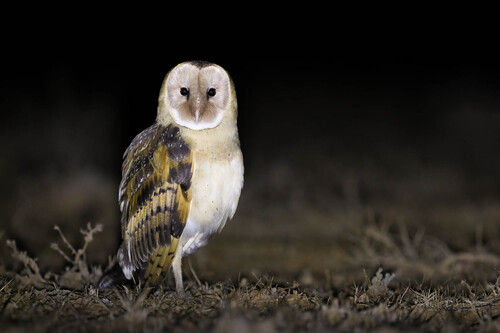 Australasian Grass-Owl
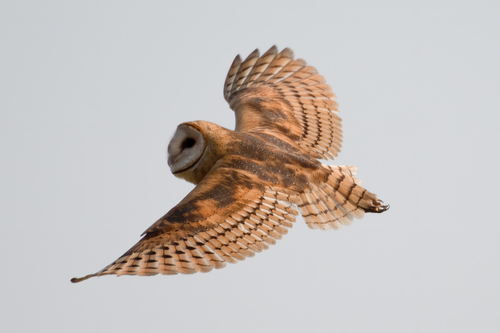 American Barn Owl
In short
The most reliable field separation between Australasian Grass-Owl and American Barn Owl is their structure and plumage in flight: Grass-Owl shows notably longer legs that project well beyond the tail, and its upperparts are darker and more heavily marked, especially on the wings. Both species have a heart-shaped facial disk, but Grass-Owl’s face is more buff-toned with a white border, while American Barn Owl usually shows a whiter face. In perched birds, Grass-Owl’s long, feathered legs and darker upperparts are key, while Barn Owl is paler and more uniform below. Both are similar in size, but Grass-Owl tends to look leggier and more adapted to dense grassland cover.
Identification tips
- Leg length in flight: Grass-Owl’s long, feathered legs project conspicuously beyond the tail in flight, giving a 'dangly' look. Barn Owl’s legs are much shorter and barely extend past the tail tip. This is the single most reliable field mark, especially in younger birds or when seen from below.
- Upperwing pattern: Grass-Owl shows darker, more heavily barred upperwings with bold black and tan bars, while Barn Owl’s wings are paler brown with finer, less contrasting dark bands. This contrast is visible in both perched and flying birds.
- Facial disk color: Grass-Owl has a heart-shaped facial disk that is buff with a white border; Barn Owl’s is usually bright white (sometimes buff in some subspecies), lacking the strong white border.
- Underparts: Barn Owl is typically much paler below, often pure white or pale buff, sometimes with fine dark speckles (especially in females). Grass-Owl is pale below but usually not as strikingly white, and less speckled.
- Upperparts color: Grass-Owl is overall darker above (dark brown/tan with pale spots), while Barn Owl is paler brown or greyish, with fine black-and-white speckling but less overall contrast.
- Eye color: Both have dark brown to blackish eyes, not a useful separator in the field.
- Beak color: Grass-Owl has a very pale beak; Barn Owl’s beak varies from pale horn to dark buff, but this is subtle and not usually diagnostic at a distance.
- Tail shape: Barn Owl has a short, squarish tail, which can help in flight; Grass-Owl’s tail is similar but the long legs make the tail look even shorter by comparison.
- Perched structure: Grass-Owl appears longer-legged and more upright when perched, sometimes with legs visible even at rest. Barn Owl is more compact and sits lower to the perch.
- Habitat context: Grass-Owl is almost always in tall grassland or swamp, rarely elsewhere. Barn Owl is found in a wide range of open habitats, including barns, fields, and even urban areas.
- Roosting/nesting sites: Grass-Owl roosts in grass 'tunnels' and nests on the ground in dense vegetation. Barn Owl uses tree cavities, buildings, and nest boxes more often.
- Flight style: Both have buoyant, silent flight, but Grass-Owl’s longer legs may give it a more 'draggy' or elongated look in the air.
- Sexual dimorphism: In both species, females are larger and often darker/more spotted below, but this is not a reliable field mark for separation between species.
- Vocalizations: Both give harsh screeches; Grass-Owl’s is slightly louder, but this is not a practical field separator.
- Geographic range: If seen in the Americas, it is almost certainly Barn Owl; in Australasia or East Asia, Grass-Owl is possible, especially in appropriate habitat.
Size
Both species are medium-sized Tyto owls, with overlapping measurements. Australasian Grass-Owl males are 32–38 cm long (females 35–42 cm), wingspan 100–116 cm, and mass 400–460 g. American Barn Owl is similarly sized, with the largest females of some subspecies exceeding 550 g, but most are in the same range as Grass-Owl. In the field, size is not a reliable separator due to overlap and sexual dimorphism in both species.
Plumage
- Juvenile/immature flight: No specific age-dependent upperwing pattern is described for either species that is diagnostic in flight, but Grass-Owl is consistently darker above with more obvious black and tan barring on the wings. Barn Owl upperparts are paler, often showing more grey or pale brown with fine speckling, and the remiges (flight feathers) are lighter brown with darker bands.
- Adults: Grass-Owl has dark brown or tan upperparts with pale spots and bold black/tan wing bars, a buffy heart-shaped face with a white border, and dark brown eyes. Its underparts are paler but not as white as typical American Barn Owl. American Barn Owl is much paler overall, especially below, with a bright white or buff heart-shaped face, blackish-brown eyes, and underparts that range from white to reddish buff, often with fine dark speckles (especially in females). The beak of Grass-Owl is very pale, while Barn Owl’s can be pale horn to dark buff. Both have feathered legs, but Grass-Owl’s are longer and more conspicuous.
Behaviour
Grass-Owl is adapted for hunting in tall grasslands and swamps, using its long legs to reach prey in dense cover. It roosts and nests in flattened vegetation within grass tunnels. American Barn Owl is more generalist, often hunting over open fields, meadows, and agricultural land, and is less specialized for dense grass. Both species hunt mainly small rodents and fly with silent, buoyant wingbeats, but Grass-Owl’s flight may appear more elongated and 'dangly' due to its leg length.
Habitat
Australasian Grass-Owl is strongly associated with tall grasslands and swamps, often in areas with dense ground cover and little disturbance. It is rarely found away from such habitats. American Barn Owl is much more versatile, occupying open country, farmland, grasslands, and even urban edges. If seen in extensive tall grass or swamp, especially in Australasia or East Asia, Grass-Owl is more likely; in open fields, barns, or agricultural settings, especially in the Americas, Barn Owl predominates.
Voice
Both species give harsh, hissing screeches or screams typical of Tyto owls. Grass-Owl’s call is described as louder than Barn Owl’s but softer than Masked Owl. In practice, the difference is subtle and not reliable for field separation unless both are known well. Neither species is likely to be separated confidently by voice alone in the field.
Australasian Grass-Owl · American Barn Owl · My Tricky Birds