

Atlantic Yellow-nosed Albatross vs Black-browed Albatross
Thalassarche chlororhynchos versus Thalassarche melanophris
Play a quiz with Atlantic Yellow-nosed Albatross and Black-browed Albatross
 Atlantic Yellow-nosed Albatross
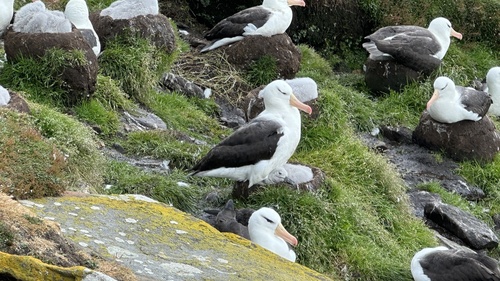 Black-browed Albatross
In short
The most reliable field mark to separate Atlantic Yellow-nosed Albatross from Black-browed Albatross is the width and shape of the black border on the underwing: Atlantic Yellow-nosed shows a thin, even black margin, while Black-browed has a much broader, irregular black border. Juvenile Atlantic Yellow-nosed also has a white head and all-black bill, whereas juvenile Black-browed shows a grey head and collar with a dark horn-colored bill. Bill color and head pattern are key at all ages, but the underwing pattern in flight is the quickest way to distinguish them, especially at a distance. Both are black-and-white mollymawks, but careful attention to these features will resolve most field confusion.
Identification tips
- Underwing pattern in flight (all ages): Atlantic Yellow-nosed shows a thin, even black margin to the underwing; Black-browed has a broad, irregular black border. This is the fastest and most reliable field mark at any distance.
- Juvenile head and bill: Juvenile Atlantic Yellow-nosed has a white head and all-black bill. Juvenile Black-browed has a grey head and collar with a dark horn-colored bill and dark tip. Use this at close range or in photos.
- Adult head color: Adult Atlantic Yellow-nosed has a grey head with a large dark eye patch; Black-browed has a white head with a bold dark eyebrow. This contrast is visible even at moderate range.
- Bill color (adults): Atlantic Yellow-nosed has a mostly black bill with a yellow line (culminicorn) and a pink tip. Black-browed has a yellow-orange bill with a darker reddish-orange tip. Bill color is best seen at close range.
- Overall size and structure: Black-browed is bulkier, longer, and has a broader wingspan. Atlantic Yellow-nosed is smaller and more slender with narrower wings. This is most apparent in mixed flocks or with experience.
- Upperwing and saddle: Both have dark upperwings and saddles, but these are not reliably different between the two.
- Tail and rump: Both have dark tails and white rumps; not a useful separation point.
- Facial pattern: The dark eyebrow of Black-browed is unique among mollymawks except Campbell Albatross (not in this comparison). Atlantic Yellow-nosed lacks this, instead showing a grey head and dark eye patch.
- Bill tip color: The pink tip of Atlantic Yellow-nosed’s bill is a subtle but helpful mark at close range; Black-browed’s bill tip is a darker orange.
- Context and abundance: If seen in the North Atlantic or among gannet colonies, Black-browed is far more likely. In the South Atlantic, check all field marks carefully.
- Immature confusion: Immature Black-browed may resemble Grey-headed Albatross, but always check for the dark eyebrow and bill color.
- Voice: Not useful for field separation.
- Sex and season: No sexual dimorphism or strong seasonal variation in either species that affects identification.
- Pitfalls: Do not rely on upperwing or saddle color alone; always check underwing margin and head/bill pattern. Juvenile Atlantic Yellow-nosed’s white head is unique among mollymawks in this pair.
- Flight jizz: Atlantic Yellow-nosed’s narrower wings and lighter build may be apparent with experience, but always confirm with plumage and bill/head pattern.
Size
Atlantic Yellow-nosed Albatross is distinctly smaller and lighter than Black-browed Albatross. The Atlantic Yellow-nosed averages about 2060 g in body mass [wikidata], while Black-browed is much heavier (typically 2.9–4.7 kg, though no AVONET/Wikidata value is given here) and longer (80–95 cm vs. Atlantic Yellow-nosed’s 81 cm). In the field, Black-browed appears bulkier and has a broader wingspan (200–240 cm vs. narrower wings in Atlantic Yellow-nosed). Atlantic Yellow-nosed also has notably narrower wings, which can be apparent in direct comparison or in mixed flocks.
Plumage
Juveniles are best separated by head and bill color: juvenile Atlantic Yellow-nosed has a white head and all-black bill, while juvenile Black-browed has a grey head and collar with a dark horn-colored bill. For all ages, the underwing pattern is diagnostic: Atlantic Yellow-nosed shows a thin, even black margin to the underwing, whereas Black-browed has a broad, irregular black border. Adult Atlantic Yellow-nosed has a grey head with a large dark eye patch and a mostly black bill with a yellow line and pink tip; Black-browed adult has a white head with a distinctive dark eyebrow and a yellow-orange bill with a darker orange tip. Both have dark upperwings and saddles, but the head and bill patterns are consistently different.
Behaviour
Both species are typical mollymawks in flight, gliding low over the ocean with stiff-winged, arcing flight. Black-browed Albatross, being larger and heavier, may appear more robust and powerful in flight, while Atlantic Yellow-nosed looks more slender with narrower wings. There are no strong behavioral differences noted in the sources for perched or feeding birds that would separate these two in the field.
Habitat
Both species are pelagic and can be seen far from land, but Black-browed Albatross is much more widespread and common globally, including vagrant records in the North Atlantic and even among gannet colonies. Atlantic Yellow-nosed is more restricted to the South Atlantic. Habitat alone is not diagnostic, but if seen among gannets in the North Atlantic, Black-browed is far more likely.
Voice
No diagnostic vocal differences are described for field separation between these two species. Both are noisy at colonies, but these sounds are not useful for identification at sea or in flight.
Atlantic Yellow-nosed Albatross · Black-browed Albatross · My Tricky Birds