

Asian Koel vs Asian Emerald Cuckoo
Eudynamys scolopaceus versus Chrysococcyx maculatus
Play a quiz with Asian Koel and Asian Emerald Cuckoo
 Asian Koel
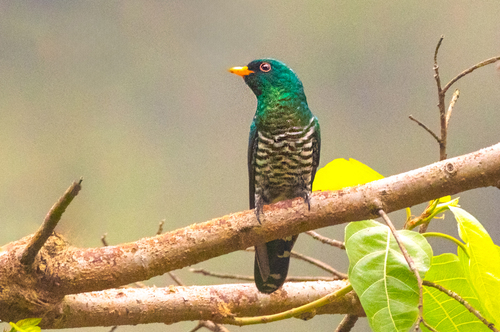 Asian Emerald Cuckoo
In short
The most reliable way to separate Asian Koel from Asian Emerald Cuckoo is by size and structure: the koel is much larger and longer-tailed, while the emerald cuckoo is compact and short-tailed. In flight, adult and juvenile Asian Emerald Cuckoos show a bold white band on the underwing, which Asian Koel never shows at any age. Males of both species are dark, but the koel is glossy blackish-blue and much bulkier, whereas the emerald cuckoo male is bright iridescent green with a white lower breast. Females and immatures of both can be streaky or spotted, but the koel is always much bigger and longer-tailed, with a heavier bill. Habitat overlap is possible, but the emerald cuckoo prefers forest, while the koel is often in open country or near human habitation.
Identification tips
- Size and shape: Asian Koel is more than twice the length of Asian Emerald Cuckoo and much heavier; always check overall bulk and especially tail length.
- Tail: Koel has a long, graduated tail, often held straight or fanned; emerald cuckoo's tail is short and square, never as prominent.
- Bill: Koel's bill is thick and pale greenish-grey (adults), while emerald cuckoo's bill is slender, orange/yellow with a black tip.
- Adult male plumage: Koel males are glossy bluish-black with crimson eyes; emerald cuckoo males are iridescent dark green with a white lower breast and green-barred belly.
- Adult female plumage: Koel females are brownish with rufous streaks on the head, dark brown upperparts with white/buff spots, and heavily streaked whitish underparts. Emerald cuckoo females are coppery-green above, rusty brown on crown/nape, and green-barred below.
- Juvenile/immature flight pattern: Emerald cuckoo (all ages) shows a bold white band on the underwing in flight; koel never shows this mark.
- Juvenile plumage: Young koels resemble adult males but with a black beak; young emerald cuckoos are more barred below and lack the white lower breast.
- Underparts pattern: Koel females/immatures are heavily streaked below; emerald cuckoo females/immatures are barred, not streaked, and have a more compact look.
- Eye color: Koel males have striking crimson eyes; emerald cuckoo has orange bare skin around the eye.
- Habitat: Koel is common in open areas, gardens, and near people; emerald cuckoo is a forest specialist.
- Behavior: Koel is often conspicuous, perching in the open and calling; emerald cuckoo is more secretive, staying in dense canopy.
- Voice: Koel's loud, repetitive 'koo-Ooo' and 'kik-kik-kik' are diagnostic; emerald cuckoo gives a sharp 'chweek' and softer twitters.
- Context: If seen in a city, plantation, or near houses, koel is likely; in dense forest, especially away from people, emerald cuckoo is more probable.
- Bill color in juveniles: Young koels have a black beak, unlike adults; emerald cuckoo juveniles' bill is similar to adults (orange/yellow with black tip).
- When in doubt: Use size, tail length, and underwing pattern in flight as your first checks—these are the most reliable and least affected by age or sex.
Size
Asian Koel is dramatically larger, measuring 39–46 cm in length and weighing 190–327 g. In contrast, Asian Emerald Cuckoo is only about 18 cm long (less than half the length) and much lighter. This difference is obvious even at a distance: the koel appears crow-sized with a long, graduated tail, while the emerald cuckoo is more thrush-sized and compact. Bill size also differs: koel has a thick, pale greenish-grey bill, while the emerald cuckoo's bill is slender and orange/yellow with a black tip. Size alone can eliminate confusion in most field situations.
Plumage
- Juvenile/Immature flight views: Asian Emerald Cuckoo (all ages/sexes) shows a distinct white band on the underwing in flight, a key mark not present in Asian Koel at any age. Juvenile emerald cuckoos have more heavily barred underparts and lack the adult's white lower breast.
- Adult males: Asian Koel males are glossy bluish-black all over with a pale greenish-grey bill and crimson eyes. Asian Emerald Cuckoo males are iridescent dark green above and on the upper breast, with a sharply contrasting white lower breast and green-barred belly, plus orange bare skin around the eye and a bicolored bill.
- Adult females: Koel females are brownish on the crown with rufous streaks, dark brown upperparts with white/buff spots, and heavily streaked whitish underparts. Emerald cuckoo females have coppery-green upperparts, rusty brown crown/nape, and green-barred underparts. Both can look streaky or spotted below, but the koel is much larger and longer-tailed.
- Juveniles: Young koels resemble adult males (dark above), but with a black beak. Young emerald cuckoos are more barred below and lack the white lower breast. The underwing white band in flight remains a key mark for emerald cuckoo at all ages.
Behaviour
Asian Koel is often seen moving slowly through open canopy, fruiting trees, or even in gardens and urban areas, sometimes quite conspicuous and vocal. It has a heavy, slow, and direct flight, often with a long tail trailing. Asian Emerald Cuckoo is more arboreal and secretive, usually staying in the mid- to upper canopy of dense forests, moving quickly and often perching quietly. Its flight is more rapid and direct, with a shorter tail and less bulk. Koel is much more likely to be seen in open or human-modified habitats, while emerald cuckoo is a forest specialist.
Habitat
Both species can occur in overlapping regions (South and Southeast Asia), but their preferred habitats differ. Asian Koel is common in open woodlands, gardens, plantations, and even urban areas, often near fruiting trees and host nests. Asian Emerald Cuckoo is a bird of subtropical or tropical moist lowland and montane forests, rarely venturing into open country. If seen in dense forest, especially away from human habitation, emerald cuckoo is more likely; if in a city park, plantation, or village, koel is much more probable.
Voice
Asian Koel is highly vocal, especially in the breeding season (March–August), with the male giving a loud, repeated 'koo-Ooo' and the female a shrill 'kik-kik-kik...'. These calls are distinctive and often heard before the bird is seen. Asian Emerald Cuckoo is less vocal, with a sharp 'chweek' call given in flight and various whistled twitters, but it is generally much quieter and less conspicuous than the koel. If you hear the classic koel song, the ID is certain.