

Asian Emerald Cuckoo vs Banded Bay Cuckoo
Chrysococcyx maculatus versus Cacomantis sonneratii
Play a quiz with Asian Emerald Cuckoo and Banded Bay Cuckoo
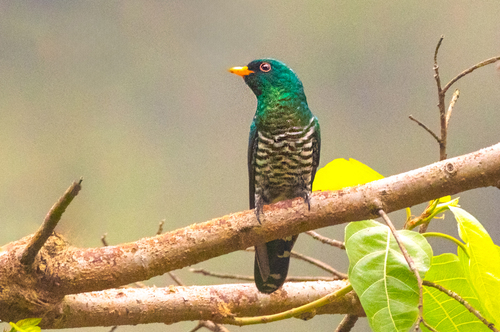 Asian Emerald Cuckoo
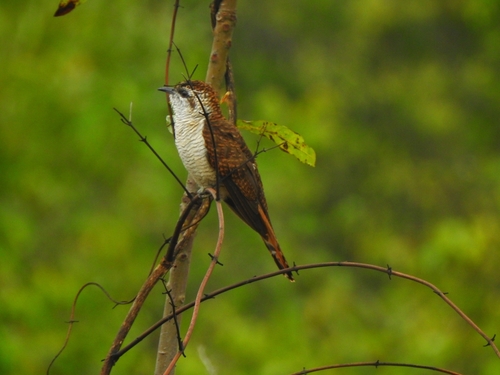 Banded Bay Cuckoo
In short
The most reliable field separation is plumage: adult Asian Emerald Cuckoo males are strikingly iridescent green above with a white lower breast and green-barred belly, while Banded Bay Cuckoo is rufous above with bold dark barring and a whitish supercilium. In flight, both sexes and ages of Asian Emerald Cuckoo show a diagnostic white underwing band, absent in Banded Bay Cuckoo. Juveniles differ: young Asian Emerald Cuckoo lack the white lower breast and are more heavily barred below, but still have green tones and the white underwing band, while juvenile Banded Bay Cuckoo resembles adults but with paler lower mandible and white feather fringes above. Structurally, Banded Bay Cuckoo is longer-billed and has a more graduated, boldly patterned tail. Both species overlap in range and habitat, but Banded Bay Cuckoo is more often seen in lower hill forests and is highly vocal during the breeding season.
Identification tips
- White underwing band (all ages, Asian Emerald Cuckoo only): In flight, look for a clear white bar on the underwing—present in both sexes and all ages of Asian Emerald Cuckoo, absent in Banded Bay Cuckoo.
- Adult male plumage: Asian Emerald Cuckoo males are iridescent dark green above, with a white lower breast and green-barred belly. Banded Bay Cuckoo is never green; it is rufous above with bold dark barring.
- Adult female/immature plumage: Female Asian Emerald Cuckoo is coppery-green above with a rusty crown and green-barred underparts. Juveniles are more heavily barred below but retain green tones and the white underwing band. Banded Bay Cuckoo of all ages is rufous/bay above with bold dark barring and a whitish supercilium.
- Supercilium: Banded Bay Cuckoo shows a strong whitish eyebrow above a dark eye-line, lacking in Asian Emerald Cuckoo.
- Tail pattern: Banded Bay Cuckoo has a long, graduated tail with a dark brown center, a subterminal black band, and white tips—often obvious when the tail is fanned. Asian Emerald Cuckoo's tail is shorter and less boldly patterned.
- Bill shape and color: Banded Bay Cuckoo has a long, slightly curved black bill with a greenish-grey base to the lower mandible. Asian Emerald Cuckoo's bill is shorter, orange/yellow with a black tip, and surrounded by orange bare skin at the eye.
- Eye color: Banded Bay Cuckoo has a yellow iris; Asian Emerald Cuckoo's iris color is not specified, but the orange bare skin around the eye is distinctive.
- Juvenile marks: Juvenile Banded Bay Cuckoo has a pale lower mandible and white fringes to upper body feathers, but otherwise resembles adults. Juvenile Asian Emerald Cuckoo is more heavily barred below, lacks the white lower breast, but still shows green upperparts and the white underwing band.
- Size and structure: Banded Bay Cuckoo is about 22 cm, longer and lankier with a longer bill and tail. Asian Emerald Cuckoo is more compact at 18 cm, with a shorter bill and tail.
- Vocalizations: Persistent, high-pitched four-note whistles indicate Banded Bay Cuckoo. Asian Emerald Cuckoo gives a less distinctive "chweek" and whistled twitters.
- Habitat context: Banded Bay Cuckoo is more common in lower hill forests and is often detected by voice during the monsoon/breeding season. Asian Emerald Cuckoo prefers denser, moister forests and is quieter.
- Behavior: Banded Bay Cuckoo often perches conspicuously and sings; Asian Emerald Cuckoo is more secretive and forages quietly.
- Sexual dimorphism: Only Asian Emerald Cuckoo shows strong sexual differences; Banded Bay Cuckoo sexes are alike.
- Seasonal context: Banded Bay Cuckoo is often migratory and most vocal during the breeding/monsoon season; Asian Emerald Cuckoo's presence is less tied to seasonality in the field.
- Common pitfalls: Hepatic (rufous) forms of other Cacomantis cuckoos can resemble Banded Bay Cuckoo, but the combination of supercilium, long bill, and boldly barred tail is distinctive. Asian Emerald Cuckoo's white underwing band is unique among these options.
Size
Asian Emerald Cuckoo is smaller, reaching about 18 cm in length, while Banded Bay Cuckoo is larger at about 22 cm. This difference is subtle in the field but can be apparent if both are seen together. Banded Bay Cuckoo also has a noticeably longer and slightly decurved bill, and a more graduated tail, contributing to a lankier appearance compared to the compact, short-billed Asian Emerald Cuckoo.
Plumage
- Juvenile/immature birds in flight: Asian Emerald Cuckoo (all ages and sexes) shows a clear white band on the underwing, a key mark visible in flight and often when perched with wings spread. Juvenile Asian Emerald Cuckoo lacks the adult male's white lower breast and is more heavily barred below, but still shows green upperparts and the white underwing band. Juvenile Banded Bay Cuckoo is similar to adults but has a pale lower mandible and white fringes to upper body feathers; it never shows a white underwing band.
- Adult males: Asian Emerald Cuckoo is iridescent dark green above and on the upper breast, with a white lower breast and green-barred belly. Banded Bay Cuckoo is bright rufous (bay) above, with broad dark barring, a whitish supercilium, and a whitish underside with fine striations.
- Adult females: Female Asian Emerald Cuckoo is coppery-green above with a rusty brown crown/nape and green-barred underparts; still shows the white underwing band. Banded Bay Cuckoo females are like males, with no sexual dimorphism.
- Tail: Banded Bay Cuckoo has a graduated tail with a dark brown center, a subterminal black band, and white tips; Asian Emerald Cuckoo's tail is less boldly marked.
- Bill and bare parts: Asian Emerald Cuckoo has orange bare skin around the eye and an orange/yellow bill tipped black; Banded Bay Cuckoo has a black bill with greenish-grey base to lower mandible, yellow iris, and no orange eye-ring.
Behaviour
Banded Bay Cuckoo often sings from exposed branches, especially during the breeding season, and may be seen sallying for insects or gleaning in the canopy. Asian Emerald Cuckoo is less conspicuous, typically foraging quietly in the mid to upper canopy. Both are brood parasites, but this is not a field mark. Banded Bay Cuckoo's more vocal and active behavior can help distinguish it, especially when calling.
Habitat
Both species occur in overlapping ranges across South and Southeast Asia. Asian Emerald Cuckoo prefers subtropical or tropical moist lowland and montane forests, while Banded Bay Cuckoo is more often found in well-wooded areas, mainly in lower hills. Banded Bay Cuckoo may be more likely in drier or more open wooded habitats and is often detected by voice in the monsoon and breeding seasons.
Voice
Banded Bay Cuckoo has a distinctive, high-pitched four-note whistle, often transcribed as "wee-ti wee-tee" or "smoke-yer-pepper," with each note falling in pitch. This call is loud, far-carrying, and repeated persistently, especially in the breeding season. Asian Emerald Cuckoo's voice is less distinctive: a "chweek" given in flight and various whistled twitters, but not a loud, repeated phrase. If you hear the classic four-note whistle, it is Banded Bay Cuckoo.