

Aquatic Warbler vs Common Reed Warbler
Acrocephalus paludicola versus Acrocephalus scirpaceus
Play a quiz with Aquatic Warbler and Common Reed Warbler
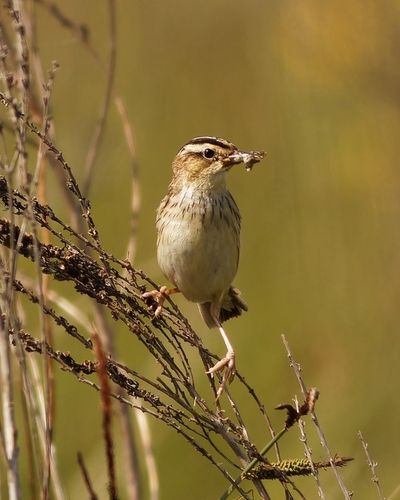 Aquatic Warbler
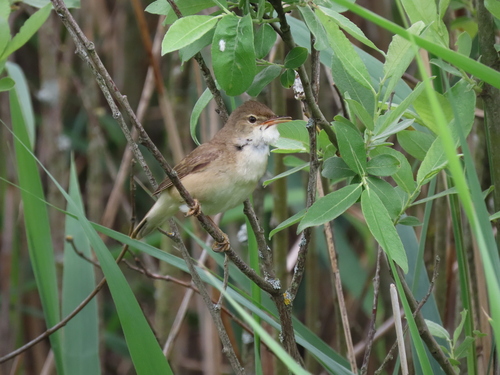 Common Reed Warbler
In short
The most reliable field mark to separate Aquatic Warbler from Common Reed Warbler is the presence of strong dark streaking on the Aquatic Warbler's crown and back, including a prominent pale crown stripe and supercilium, which are absent in Common Reed Warbler. Juvenile Aquatic Warblers are especially distinctive, with a spiky-tailed look and bold streaking above, while juvenile Common Reed Warblers are unstreaked and warmer buff below. Both species are medium-sized Acrocephalus warblers with similar structure, but Aquatic Warbler appears paler and more patterned, especially in flight. Voice, habitat, and subtle size differences can help, but streaking and crown pattern are the most practical field marks.
Identification tips
- Crown and back streaking: Aquatic Warbler of all ages (except underparts of juveniles) shows strong dark streaking on the crown and back, with a prominent pale crown stripe. Common Reed Warbler is always plain and unstreaked above, with no crown stripe.
- Supercilium: Aquatic Warbler has a bold, whitish supercilium that stands out against the streaked crown. Common Reed Warbler's supercilium is weaker and less contrasting.
- Juvenile underparts: Juvenile Aquatic Warblers are unstreaked below, but still show the strong upperpart streaking and crown stripe. Juvenile Common Reed Warblers are richer buff below, but remain plain above.
- Overall coloration: Aquatic Warbler appears paler and more patterned, especially in flight, while Common Reed Warbler is warmer brown and uniform.
- Tail shape in flight: Aquatic Warbler can look spiky-tailed and slightly shorter-tailed, especially when flying. Common Reed Warbler's tail is more rounded and less distinctive.
- Bill and head shape: Both have strong, pointed bills and flattened foreheads, but Aquatic Warbler may appear slightly sharper-headed due to the crown stripe.
- Habitat context: In breeding season, Aquatic Warbler is found in short, open sedge beds, rarely in tall reeds. Common Reed Warbler prefers dense, tall reedbeds.
- Abundance: Aquatic Warbler is much rarer and highly localized, especially outside migration. If seen in western Europe, Common Reed Warbler is far more likely.
- Song: Aquatic Warbler's song is faster and more mechanical; Common Reed Warbler's is slower and includes mimicry. Use with caution, as both can be variable.
- Sexes: Both species are sexually monomorphic; do not use sex for identification.
- Size: Aquatic Warbler is slightly lighter, but size overlap is great and not reliable in the field.
- Pitfalls: Juvenile Common Reed Warbler can look pale below, but never shows streaking or a crown stripe. Juvenile Sedge Warbler (not in this pair) can show a faint crown stripe but is warmer-toned and more patterned on the face.
- Flight views: In brief flight views, look for the pale, spiky-tailed, streaked appearance of Aquatic Warbler versus the plain, warm brown of Common Reed Warbler.
- Perched views: Focus on the crown and back pattern; streaking and a pale crown stripe point to Aquatic Warbler.
- Season: Both migrate through Europe, but Aquatic Warbler is much rarer and more likely in late summer/autumn migration in western Europe.
Size
Aquatic Warbler is slightly lighter (10.5g) than Common Reed Warbler (12.0g) [wikidata], but both are medium-sized warblers and can appear similar in the hand or at a distance. Length and structure are not reliably diagnostic in the field, though Aquatic Warbler may look a bit spikier-tailed. Size alone is not a safe separator.
Plumage
Juvenile and adult Aquatic Warblers show heavy dark streaking on the brown back and a bold pale crown stripe, with a strong whitish supercilium. This streaking is present on the upperparts and crown in all ages except for the underparts of young birds, which are unstreaked below. In contrast, Common Reed Warbler of all ages is plain and unstreaked above, with a uniform brown back and no crown stripe; juveniles are richer buff below but lack any streaking or crown pattern. In flight, Aquatic Warbler can look paler and more patterned, with a spiky tail impression, while Common Reed Warbler is overall plainer and warmer brown. Sexes are identical in both species.
Behaviour
Both species behave similarly, often skulking in wet vegetation and climbing through reeds or sedges. Aquatic Warbler may appear more restless and is often seen in shorter, sparser sedge beds compared to the denser reedbeds favored by Common Reed Warbler. Aquatic Warbler can look spikier-tailed and more active in flight, but behavioral differences are subtle and best used in combination with plumage.
Habitat
Aquatic Warbler breeds in wet sedge beds with short vegetation (usually under 30 cm), often in more open, marshy areas. Common Reed Warbler prefers denser reedbeds, especially stands of tall Phragmites. While both can overlap in migration, Aquatic Warbler is much rarer and more habitat-restricted, especially in breeding season. If seen in short, open sedge, Aquatic Warbler is more likely; in tall, dense reeds, Common Reed Warbler dominates.
Voice
Aquatic Warbler's song is a fast, chattering 'ja-ja-ja' with acrocephaline whistles, while Common Reed Warbler sings a slower, chattering 'jit-jit-jit' with similar whistles and some mimicry. Both are variable and can be confusing, but Aquatic Warbler's song is generally faster and more mechanical. Calls are not reliably separated in the field.