

Antarctic Prion vs Slender-billed Prion
Pachyptila desolata versus Pachyptila belcheri
Play a quiz with Antarctic Prion and Slender-billed Prion
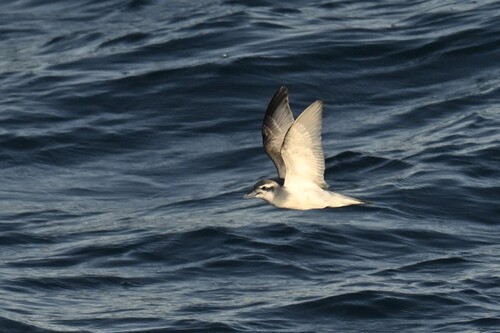 Antarctic Prion
 Slender-billed Prion
In short
Antarctic Prion and Slender-billed Prion are extremely similar at all ages, with blue-grey upperparts, white underparts, and a dark 'M' across the back and wings. The most reliable field mark, when visible, is the bill: Antarctic Prion has a noticeably broader, stubbier bill, while Slender-billed Prion's bill is narrower and more delicate. Both species show a white eyebrow and wedge-shaped tail with a black tip, and their plumage is nearly indistinguishable in the field, especially at sea. Separation is challenging even for experts, and most field identifications rely on subtle structural differences rather than plumage.
Identification tips
- Bill shape is the key field mark: Antarctic Prion has a broader, stubbier bill, while Slender-billed Prion's bill is noticeably narrower and more delicate. This difference is subtle and best seen at close range or in good light; it is often impossible to judge at sea or in flight.
- Size is only a minor clue: Antarctic Prion is the largest prion, but the difference is slight and not reliable unless birds are side by side.
- Plumage is nearly identical: Both species show blue-grey upperparts, white underparts, a dark 'M' across the upperwings, a white eyebrow, and a wedge-shaped tail with a black tip. Do not rely on plumage for separation.
- Greater coverts and wing pattern: Antarctic Prion's greater coverts are described as near black, but this is not a consistent or diagnostic difference from Slender-billed Prion, which has a very similar wing pattern.
- Facial markings: Slender-billed Prion may show a more distinct dark line below the eye extending toward the neck, but this feature is subtle and variable, and not always visible.
- Feet color: Both have blue or pale blue feet, which is not a useful field mark for separation.
- Tail pattern: Both species have a grey, wedge-shaped tail with a black tip; this is not a distinguishing feature.
- Flight style and behavior: Both species have similar flight styles and feeding behaviors; do not use behavior for identification.
- Age and molt: No age-specific or molt-related differences are described between these two species; juveniles and adults look alike.
- At-sea identification is unreliable: Even experienced observers often cannot distinguish these species at sea; most field identifications are best left as 'prion sp.' unless the bill can be clearly seen.
- Context and range: Both species overlap extensively in the Southern Ocean; do not use location as a primary field mark.
- Mixed flocks: Both species may occur together in mixed prion flocks, making identification even more challenging.
- Photographs: If attempting identification from photos, focus on bill shape and width, but be aware that angles and lighting can be misleading.
- Voice: No vocal differences are described or useful for separation in the field.
- Summary: In most field situations, especially at sea, separation of Antarctic and Slender-billed Prion is not possible without an exceptionally clear view of the bill. When in doubt, record as 'prion sp.' and note any structural impressions for later review.
Size
Antarctic Prion is the largest prion species, with an average mass of about 156 g [wikidata], while Slender-billed Prion is slightly smaller, though precise mass data is not provided. In practice, this size difference is subtle and rarely diagnostic in the field unless seen side by side. Both species are similar in overall length and wingspan, but Antarctic Prion may appear a bit bulkier and heavier-bodied.
Plumage
Both species share the classic prion plumage: blue-grey upperparts, white underparts, a dark 'M' pattern across the upperwings and back, a white eyebrow, and a wedge-shaped grey tail with a black tip. Antarctic Prion's greater coverts are described as near black, but this is not a reliable field mark for separation from Slender-billed Prion, which shows a very similar pattern. Slender-billed Prion is noted for a dark line extending from below the eye almost to the neck, which may be slightly more pronounced than in Antarctic Prion, but this is subtle and variable. No age-specific upperwing or flight pattern differences are described between these two species, and both adults and immatures are essentially identical in plumage. At sea, even experienced observers often cannot distinguish them by plumage alone.
Behaviour
Both species are pelagic and spend most of their lives at sea, feeding primarily on zooplankton by filtering water through their bills. Their flight is buoyant and gliding, typical of prions, and no behavioral differences are noted that would aid in field separation. Both may be seen in mixed prion flocks, further complicating identification.
Habitat
Both Antarctic and Slender-billed Prions inhabit the Southern Ocean and are found in similar pelagic environments. There is no habitat-based separation in the field, as both species can occur together in the same areas, especially during non-breeding seasons.