

Antarctic Prion vs Fluttering Shearwater
Pachyptila desolata versus Puffinus gavia
Play a quiz with Antarctic Prion and Fluttering Shearwater
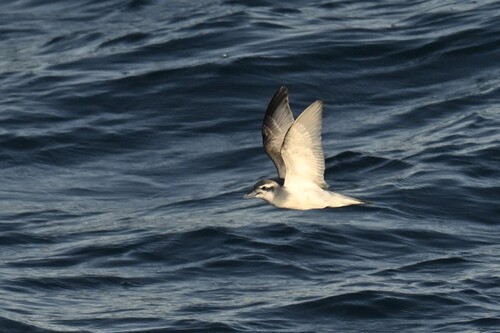 Antarctic Prion
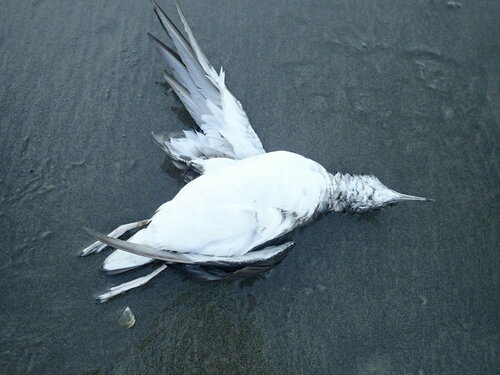 Fluttering Shearwater
In short
The most reliable field mark to separate Antarctic Prion from Fluttering Shearwater is the upperwing pattern: Antarctic Prion (all ages) shows a blue-grey upperwing with a bold dark 'M' extending from the back to the wingtips, while Fluttering Shearwater has uniformly dark brown upperparts without any 'M' or contrasting panel. In flight, the prion's paler blue-grey tones and black-tipped wedge tail contrast with the shearwater's more uniformly dark, brownish upperparts and short, fan-shaped tail. Fluttering Shearwater is also notably larger and heavier-bodied, with a longer, thinner bill and pinkish-brown legs that often project beyond the tail in flight. Both species can appear superficially similar at a distance, but careful attention to wing pattern, structure, and leg color will separate them.
Identification tips
- Upperwing pattern (all ages): Antarctic Prion shows a blue-grey upperwing with a bold dark 'M' from back to wingtips; Fluttering Shearwater is uniformly dark brown above, lacking any 'M' or panel. This is the single best mark in flight.
- Tail shape and color: Antarctic Prion has a wedge-shaped grey tail with a black tip; Fluttering Shearwater's tail is short, fan-shaped, and mixed brown and white.
- Bill structure: Prion's bill is short, thick, and blue-grey; Fluttering Shearwater's bill is longer, thinner, and dark. Bill color and shape are best seen at close range or in good light.
- Leg color and projection: Fluttering Shearwater has pinkish-brown legs and feet with dark webs, and the feet often extend beyond the tail in flight. Antarctic Prion has blue feet, but these are rarely visible in flight.
- Facial pattern: Prion has a white eyebrow and a more contrasting blue-grey face; Fluttering Shearwater's face is grey-brown, fading to white below the eye, with no strong eyebrow.
- Underwing: Fluttering Shearwater has mostly white underwings with a grey-brown axillary area; Antarctic Prion's underwing is not described in detail, but underparts are white.
- Body size and jizz: Fluttering Shearwater is bulkier, longer-winged, and heavier-bodied; Antarctic Prion is smaller and more delicate. In mixed flocks, size difference can be apparent.
- Flight style: Prion has a more buoyant, gliding flight; shearwater flies low and fast with rapid wingbeats and glides.
- Moult effects: Fluttering Shearwater in late summer-autumn can look paler and ragged above, but still lacks the prion's 'M' pattern.
- Juvenile confusion: Juvenile Fluttering Shearwaters are similar to adults but with paler wing-covert margins; no distinctive juvenile marks for prion noted.
- Habitat context: Fluttering Shearwater is likely near New Zealand coasts; Antarctic Prion is more pelagic and less likely near shore.
- Vocalization: If heard, Fluttering Shearwater's 'ka-hek-ka-hek' call is distinctive; prion's call is not a field mark.
- Feeding behavior: Prion often filters zooplankton at the surface; shearwater may be seen diving or chasing fish.
- Seasonal context: Fluttering Shearwater is present in New Zealand waters mainly September–February; Antarctic Prion's presence is less tied to local breeding seasons.
- When marks fail: At great distance or in poor light, both can appear as small, pale-bellied seabirds; focus on wing pattern and flight style for best separation.
Size
Antarctic Prion is significantly smaller and lighter than Fluttering Shearwater. The prion averages around 156 g [wikidata], while Fluttering Shearwater females average 302 g and males 243 g [wikipedia]. In the field, Fluttering Shearwater looks bulkier, with a longer body and noticeably longer wings. The prion is more delicate and compact, with a shorter, stubbier bill and smaller overall impression.
Plumage
- Juvenile/immature and adult Antarctic Prion: Blue-grey upperparts with a strong dark 'M' from the back across the wings to the wingtips; white underparts; white eyebrow; blue-grey bill; blue feet; wedge-shaped grey tail with a black tip; greater coverts near-black, creating a contrast on the wing. This pattern is consistent across ages, with no mention of juvenile-specific upperwing marks [wikipedia].
- Fluttering Shearwater (all ages): Upperparts, including neck, wings, and tail, are uniformly dark brown, lacking any 'M' or contrasting panel. The face and neck are grey-brown, fading to white below the eye. Underparts are white with a dark thigh patch visible in flight. The underwing is mostly white with a grey-brown axillary area. Tail is short, fan-shaped, and mixed dark brown and white. Moulting birds (late summer-autumn) appear paler and ragged, with upperparts fading to rusty brown [wikipedia]. Juveniles have similar coloration to adults but with paler wing-covert margins.
Behaviour
Antarctic Prion is a filter-feeder, often seen skimming the surface for zooplankton. Its flight is typically buoyant and gliding, with less rapid wingbeats than shearwaters. Fluttering Shearwater has a low, fast, purposeful flight with rapid wingbeats interspersed with glides. It often pursues prey underwater using its wings, and its legs and feet can be conspicuous trailing behind the tail. The prion is more likely to be seen in open ocean, while Fluttering Shearwater may be seen closer to shore, especially near New Zealand.
Habitat
Antarctic Prion is a Southern Ocean species, typically seen far from land except during breeding, and is not endemic to New Zealand. Fluttering Shearwater is endemic to New Zealand, breeding there and migrating to Australia and the Solomon Islands. It is more likely to be seen near rocky shores and coastal waters, while Antarctic Prion is almost exclusively pelagic.
Voice
Fluttering Shearwater has a distinctive, disjointed call described as 'ka-hek-ka-hek-ka-hek', usually given in flight. Antarctic Prion's voice is not described in the provided notes, and is not a reliable field mark for separation.