

American Oystercatcher vs Black Oystercatcher
Haematopus palliatus versus Haematopus bachmani
Play a quiz with American Oystercatcher and Black Oystercatcher
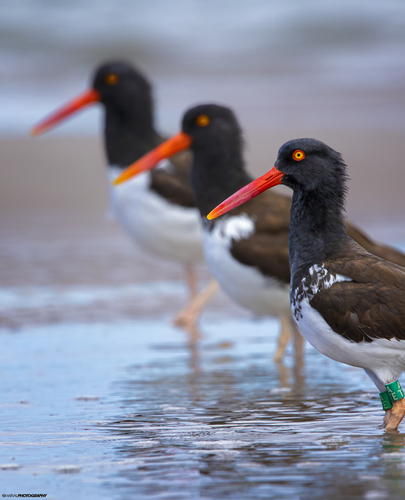 American Oystercatcher
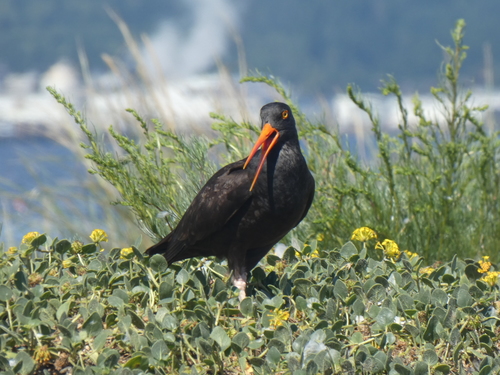 Black Oystercatcher
In short
The most reliable field mark between American Oystercatcher and Black Oystercatcher is overall plumage: American is boldly black-and-white, while Black is nearly all dark. In flight or at rest, American Oystercatcher shows a striking white belly and white wing patches, contrasting sharply with its black head and breast; Black Oystercatcher is much more uniformly dark, with only subtle brownish tones on the body and no white on the underparts. Both have long, bright orange bills and pink legs, but the American’s bill often appears slightly longer and more tapered. If you see a mostly black shorebird with a red bill on the Pacific coast north of Baja, it’s almost certainly Black Oystercatcher. Overlap is minimal and mostly in Baja California.
Identification tips
- Plumage contrast is key: American Oystercatcher always shows a sharp division between black head/breast and white underparts, with white visible on the wings and rump in flight. Black Oystercatcher is uniformly dark, with no white belly or wing stripe, at all ages.
- Flight view: Look for bold white wing stripe and rump patch on American Oystercatcher; Black Oystercatcher shows all-dark wings and body in flight, with no white.
- Resting bird: American Oystercatcher’s white belly and flanks are obvious even when perched; Black Oystercatcher appears entirely dark, sometimes with a brownish tinge to the body.
- Bill color and shape: Both have long, bright orange-red bills, but the American’s may look slightly longer and more tapered. This is subtle and not always reliable.
- Leg color: Both have pink legs; not a useful separator.
- Eye color: Both have yellow irises and red/orange orbital rings; not diagnostic in the field.
- Habitat and range: On the Pacific coast north of Baja California, any oystercatcher is almost certainly Black. On the Atlantic, Gulf, or Caribbean coasts, it will be American. In Baja, check plumage carefully.
- Preferred substrate: Black Oystercatcher is almost always on rocky shores; American can be found on sand, mud, or rock.
- Behavior: Both species forage on intertidal shellfish beds, but Black Oystercatcher is more strictly tied to rocks and is highly territorial.
- Season and age: No significant seasonal or age-related plumage overlap; the black-and-white vs. all-dark contrast holds for all ages.
- Juvenile/immature birds: No unique upperwing or flight marks are described for young birds; the same general plumage rules apply.
- Size and structure: Both are large, heavy-bodied shorebirds with long legs and bills; size is not a reliable field mark.
- Voice: Both are noisy, but no diagnostic differences are described in the notes.
- Common pitfalls: Do not rely on bill color or leg color alone, as both are similar. Always check for white on the underparts and wings for American Oystercatcher.
- Where confusion is most likely: Overlap is limited to Baja California; elsewhere, range and habitat usually resolve the ID.
Size
Direct size comparison is difficult in the field, as both species are large oystercatchers with similar overall structure. Available data gives adult Black Oystercatcher a body mass of about 681 g [wikidata], which is within the typical range for large oystercatchers. American Oystercatcher’s length is 42–52 cm [wikipedia], but no direct mass is given. In practice, both species appear similarly robust, with long legs and a heavy, straight bill. Size alone is not a reliable separator.
Plumage
Plumage is the single most useful distinction at all ages. American Oystercatcher (adult and immature) is boldly patterned: black head and breast, white underparts, and dark gray-black upperparts. In flight, it shows a broad white wing stripe (from the inner primaries and coverts), a white rump, and a white tail base. These white areas are visible even on distant or flying birds. Black Oystercatcher is almost entirely dark: black head, neck, and breast, with dark brownish-black body and wings. The underparts are also dark, lacking any white belly or wing stripe. Even juveniles are dark overall, with only slight variation in tone (darker further north). Both species have a long, bright orange-red bill and pink legs, but the American’s bill may appear slightly longer and more slender. Eye color is similar (yellow iris, red/orange orbital ring), but is rarely diagnostic at distance. No age-specific upperwing patterns are described for either species, so the black-and-white vs. all-dark contrast holds for all plumages.
Behaviour
Both species forage by walking over intertidal areas and using their bills to pry open or hammer shellfish. Black Oystercatcher is especially tied to rocky shorelines and is highly territorial, often seen defending its feeding and nesting areas with loud calls. American Oystercatcher is also coastal but can be found on sandy or mixed shores, not just rocks. Both species may be seen resting during high tide. In flight, both are strong and direct, but American’s white wing and rump patches are often visible even at a distance.
Habitat
Habitat is a strong clue. Black Oystercatcher is almost exclusively found on rocky shorelines of the Pacific coast, from Alaska to Baja California, rarely straying from the immediate intertidal zone. It strongly prefers rocky outcrops, jetties, and embayments. American Oystercatcher is found on Atlantic and Gulf coasts, the Caribbean, and overlaps with Black only in Baja California. It uses a wider range of coastal habitats, including sandy beaches, mudflats, and shellfish beds, as well as rocky shores. If you are north of Baja on the Pacific, a blackish oystercatcher is almost certainly Black; on the Atlantic or Gulf, it will be American.
Voice
Both species are loud and conspicuous, especially when defending territory, but no distinctive vocal differences are described in the notes. Both give sharp, piping calls, but voice is not a reliable separator based on available information.
American Oystercatcher · Black Oystercatcher · My Tricky Birds