

American Moorhen vs Townsend's Solitaire
Gallinula galeata versus Myadestes townsendi
Play a quiz with American Moorhen and Townsend's Solitaire
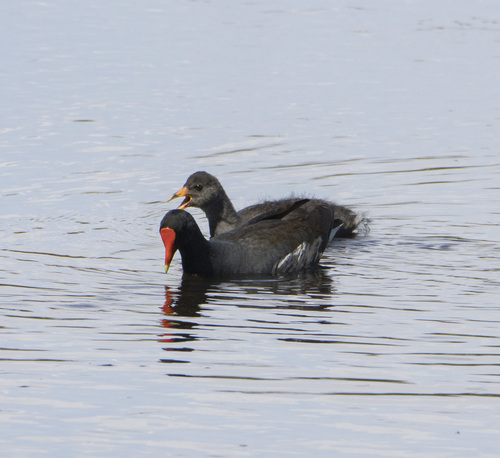 American Moorhen
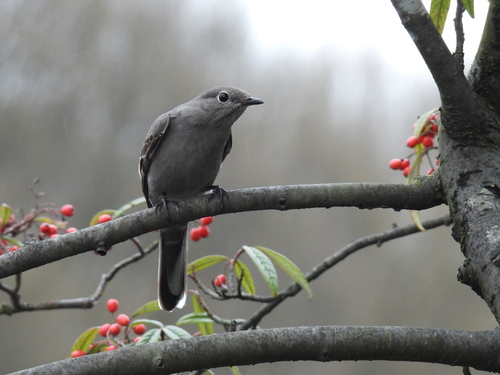 Townsend's Solitaire
In short
The most reliable field mark between American Moorhen and Townsend's Solitaire is overall structure and color: the moorhen is a dark, chicken-like marsh bird with a red shield on its face and yellow legs, while the solitaire is a slim, upright gray thrush with a white eye ring and buffy wing stripe. Juvenile moorhens are browner and lack the red shield, but still show a white undertail and yellowish legs, unlike the solitaire's gray, white-edged tail and upright posture. Moorhens are always found in or near water, often walking on floating vegetation, while solitaires perch high and upright, usually in drier, wooded or shrubby habitats. Size difference is extreme: the moorhen is nearly ten times heavier than the solitaire.
Identification tips
- Habitat: Moorhen is never far from water; solitaire is almost never in marshes or on open water. Use habitat as your first filter.
- Size: Moorhen is nearly ten times heavier and much bulkier than the solitaire. If the bird looks chicken-sized, it's not a solitaire.
- Structure: Moorhen has a chicken-like body, short tail, and long, wide toes for walking on vegetation. Solitaire is slim, with a long, tapered tail and upright, thrush-like stance.
- Bill: Moorhen has a short, thick, red bill with a red frontal shield; solitaire has a short, thick, blackish bill with no shield.
- Legs and Feet: Moorhen has bright yellow legs and very large feet; solitaire has normal, inconspicuous legs and feet.
- Facial Markings: Moorhen (adult) shows a bold red shield above the bill; solitaire has a white eye ring and no shield.
- Plumage Color: Moorhen is dark overall with a white undertail; solitaire is smooth gray with a buffy wing stripe and white-edged tail.
- Wing Pattern: Solitaire shows a buffy wing stripe and white tail edges in all ages; moorhen never shows a wing stripe or white in the wing.
- Juvenile Plumage: Juvenile moorhen is browner, lacks the red shield, but still has a white undertail and yellowish legs. Juvenile solitaire is mottled gray and white, with a pale eye ring and buffy wing stripe.
- Tail: Moorhen has a short, square tail with a white undertail; solitaire has a long, tapered tail edged with white.
- Posture: Moorhen is horizontal, often skulking or swimming; solitaire is upright, perching high and still.
- Behavior: Moorhen walks on floating plants or swims; solitaire perches, sallies for insects, and defends berry patches.
- Vocalizations: Moorhen gives harsh gargles and hisses; solitaire sings melodious, flute-like phrases and gives a squeaky call.
- Context: If the bird is in a marsh or on water, think moorhen; if it's in dry woods or on a high perch, think solitaire.
- Pitfalls: Immature moorhens can lack the red shield and appear browner, but will never show a wing stripe or eye ring. Solitaires, even as juveniles, always show some pale mottling and a white eye ring.
Size
American Moorhen is much larger and heavier (310–456 g, 32–35 cm long, 54–62 cm wingspan) than Townsend's Solitaire (32 g, 20–24 cm long, 37 cm wingspan). The moorhen is a robust, chicken-sized bird, while the solitaire is a slender, small thrush. Even at a distance, the moorhen's bulk and long toes are obvious compared to the solitaire's petite, upright silhouette.
Plumage
- Juvenile/immature birds: Juvenile moorhens are browner overall, lack the adult's red facial shield, but still show a white undertail and yellowish legs. Juvenile solitaires are mottled gray and white, with a pale eye ring and buffy wing stripe already present. The solitaire's tail is always edged with white, even in young birds, and is long and tapered.
- Adults: Adult moorhens are dark (almost blackish) with a bold red shield above the bill, yellow legs, and a white undertail. Adult solitaires are smooth gray with a white eye ring, buffy wing stripe, and white-edged tail. The moorhen never shows a wing stripe or eye ring; the solitaire never shows a red shield or yellow legs. In flight, the solitaire's white tail edges and wing stripe are visible; the moorhen shows a flash of white under the tail but otherwise remains dark.
Behaviour
Moorhens are often secretive, skulking through dense marsh vegetation or walking on floating plants, but can become tame and visible in some areas. They swim, walk, and sometimes upend like ducks. Solitaires perch upright, often high and exposed, and may sit motionless for long periods. They feed on berries and insects, often sallying from perches, and defend winter territories around juniper bushes. Moorhens rarely perch high or remain still in the open for long.
Habitat
American Moorhen is always associated with water—marshes, ponds, canals, or lakes with dense vegetation. If you see the bird away from water, it is almost certainly not a moorhen. Townsend's Solitaire prefers dry, wooded, or shrubby habitats, especially areas with juniper in winter. It nests on the ground in forested or brushy areas, never in marshes or open water. Habitat alone is often enough to separate these two species.
Voice
Moorhen gives a variety of gargling calls and loud hisses, especially when alarmed. Its calls are not musical. Townsend's Solitaire sings a loud, melodious, flute-like song with rising and falling phrases, sometimes with a mechanical quality, and gives a squeaky 'eeek' or soft whistle as a call. If you hear a musical song, it's a solitaire; if you hear harsh gargles or hisses, it's a moorhen.