

Motmot

American Moorhen vs American Coot

Gallinula galeata versus Fulica americana

Play a quiz with American Moorhen and American Coot
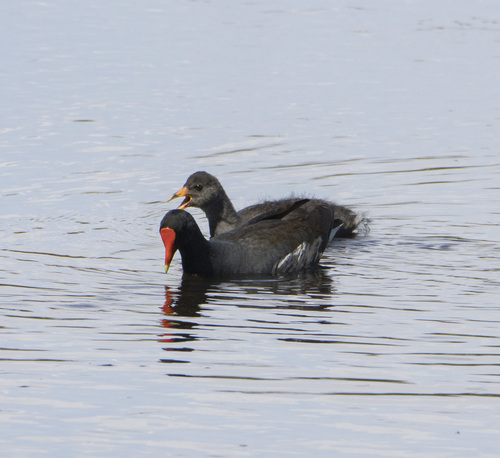
American Moorhen (Gallinula galeata) American Moorhen
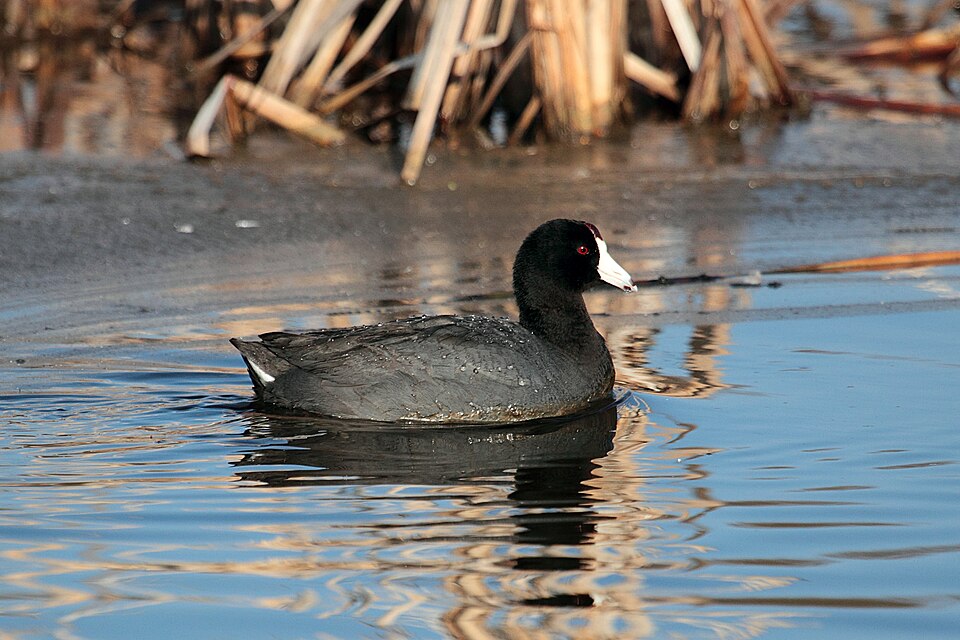
American Coot (Fulica americana) American Coot

Media

Loading…

In short

The most reliable field mark to separate American Moorhen (Gallinula galeata) from American Coot (Fulica americana) is the color of the bill and frontal shield: adult moorhens show a bright red bill with a yellow tip and a red shield, while adult coots have a white bill and shield with a reddish-brown spot. Juvenile plumage can be confusing, but moorhen juveniles are browner and lack the red shield, whereas coot juveniles have olive-brown crowns and a gray body. Both species are dark waterbirds with white undertails, but coots are bulkier and have a more duck-like, rounded profile. In flight or on the water, look for the moorhen’s yellow legs and the coot’s distinctive lobed toes. Both species occur in similar marshy habitats, so careful attention to bill, shield, and leg color is key.

Identification tips

  1. Bill and Frontal Shield (Adults): Adult moorhens have a bright red bill with a yellow tip and a red frontal shield; adult coots have a white bill and shield with a reddish-brown spot. This is the most reliable mark at close to moderate range.
  2. Juvenile Plumage: Juvenile moorhens are browner overall and lack the red shield, while juvenile coots have olive-brown crowns and a gray body. If the bird is brownish and lacks any red on the face, consider moorhen; if grayish with an olive-brown crown, consider coot.
  3. Leg and Feet Color: Moorhens have yellow legs, which can be seen when perched or walking. Coots have grayish legs with broad, lobed toes—look for these if you see the bird out of the water or climbing onto a bank.
  4. Body Shape and Size: Coots are bulkier, more rounded, and often appear duck-like, especially on the water. Moorhens are slimmer, with a more delicate, chicken-like profile.
  5. Swimming Posture: Coots often sit higher in the water and appear more upright; moorhens are lower-slung and more horizontal.
  6. Behavior on Land: Coots walk more readily on open ground due to their lobed toes; moorhens are more likely to be seen walking on floating vegetation or skulking in reeds.
  7. Flight Pattern: Both species have weak, fluttery flight with legs trailing, but flight jizz is not strongly diagnostic between the two.
  8. Undertail Pattern: Both have white undertails, so this is not a reliable separator.
  9. Habitat Use: Both species overlap in marshes and ponds, but moorhens may be more closely tied to dense vegetation, while coots are more often seen in open water or even saltwater in winter.
  10. Aggression and Sociality: Coots are often seen in larger flocks and are more aggressive in open water; moorhens are more solitary or in pairs, especially in breeding season.
  11. Vocalizations: Both are noisy, but calls are not reliably separable in the field based on the notes provided.
  12. Seasonal Variation: Both species can be found year-round where water does not freeze, but coots are more likely to overwinter in northern areas if water remains open.
  13. Sex Differences: Both species are similar between sexes; size difference in coots (males larger) is subtle and not useful in the field.
  14. Subspecies Variation: Not reliably separable in the field; location is not a safe guide due to migratory tendencies.
  15. Common Pitfall: The most frequent mix-up is with immature birds lacking adult bill color—focus on overall body color (brownish for moorhen, grayish for coot) and leg color if visible.

Size

American Coots are generally larger and heavier than American Moorhens. Coots measure 34–43 cm in length with a wingspan of 58–71 cm and adult body mass ranging from 427–848 g, with males being larger than females. Moorhens are slightly smaller, at 32–35 cm in length and a wingspan of 54–62 cm, with a weight of 310–456 g. In the field, coots often appear more robust and rounded, while moorhens are slimmer and more delicate in build.

Plumage

Juvenile plumage is a key pitfall: young American Moorhens are browner overall and lack the red frontal shield, while juvenile American Coots have olive-brown crowns and a grayish body, transitioning to adult coloration by about four months. Adult moorhens are dark overall with a white undertail, yellow legs, and a striking red bill with a yellow tip and red shield. Adult coots are also dark with a white undertail, but their bill and shield are white with a reddish-brown spot. Both species lack strong upperwing pattern in flight, so separation relies on head and bill coloration, especially at a distance or in poor light. Leg color is also helpful: moorhens have yellow legs, while coots have grayish legs with broad, lobed toes.

Behaviour

Both species are often seen swimming or foraging at the water’s edge, but American Coots are more likely to be seen walking on land due to their lobed toes, which facilitate movement on mud and grass. Moorhens, with their wide feet, are adept at hopping on floating vegetation like lily pads. Coots often appear more aggressive and are frequently mistaken for ducks due to their rounded bodies and upright posture. Moorhens are generally more secretive but can become tame in some areas. Both species defend their territories vigorously during the breeding season.

Habitat

Both species inhabit well-vegetated marshes, ponds, and lakes, often co-occurring in the same wetlands. Moorhens are more closely tied to dense emergent vegetation and are often seen skulking along the edges or among reeds. Coots are more adaptable and may be found in open water as well as marshes, and are more likely to be seen in saltwater environments during winter. Both species are widespread and can be locally abundant.

Voice

American Moorhens produce a wide range of gargling calls and loud hisses when threatened. American Coots are also vocal, but their calls are not described in detail in the notes. In general, both species are noisy in breeding season, but voice is not a primary field mark for separation based on the available information.

Submit a better description

Use the same sections as the comparison. Your text is published immediately.

The most reliable field mark to separate American Moorhen (Gallinula galeata) from American Coot (Fulica americana) is the color of the bill and frontal shield: adult moorhens show a bright red bill with a yellow tip and a red shield, while adult coots have a white bill and shield with a reddish-brown spot. Juvenile plumage can be confusing, but moorhen juveniles are browner and lack the red shield, whereas coot juveniles have olive-brown crowns and a gray body. Both species are dark waterbirds with white undertails, but coots are bulkier and have a more duck-like, rounded profile. In flight or on the water, look for the moorhen’s yellow legs and the coot’s distinctive lobed toes. Both species occur in similar marshy habitats, so careful attention to bill, shield, and leg color is key.

  1. Bill and Frontal Shield (Adults): Adult moorhens have a bright red bill with a yellow tip and a red frontal shield; adult coots have a white bill and shield with a reddish-brown spot. This is the most reliable mark at close to moderate range.
  2. Juvenile Plumage: Juvenile moorhens are browner overall and lack the red shield, while juvenile coots have olive-brown crowns and a gray body. If the bird is brownish and lacks any red on the face, consider moorhen; if grayish with an olive-brown crown, consider coot.
  3. Leg and Feet Color: Moorhens have yellow legs, which can be seen when perched or walking. Coots have grayish legs with broad, lobed toes—look for these if you see the bird out of the water or climbing onto a bank.
  4. Body Shape and Size: Coots are bulkier, more rounded, and often appear duck-like, especially on the water. Moorhens are slimmer, with a more delicate, chicken-like profile.
  5. Swimming Posture: Coots often sit higher in the water and appear more upright; moorhens are lower-slung and more horizontal.
  6. Behavior on Land: Coots walk more readily on open ground due to their lobed toes; moorhens are more likely to be seen walking on floating vegetation or skulking in reeds.
  7. Flight Pattern: Both species have weak, fluttery flight with legs trailing, but flight jizz is not strongly diagnostic between the two.
  8. Undertail Pattern: Both have white undertails, so this is not a reliable separator.
  9. Habitat Use: Both species overlap in marshes and ponds, but moorhens may be more closely tied to dense vegetation, while coots are more often seen in open water or even saltwater in winter.
  10. Aggression and Sociality: Coots are often seen in larger flocks and are more aggressive in open water; moorhens are more solitary or in pairs, especially in breeding season.
  11. Vocalizations: Both are noisy, but calls are not reliably separable in the field based on the notes provided.
  12. Seasonal Variation: Both species can be found year-round where water does not freeze, but coots are more likely to overwinter in northern areas if water remains open.
  13. Sex Differences: Both species are similar between sexes; size difference in coots (males larger) is subtle and not useful in the field.
  14. Subspecies Variation: Not reliably separable in the field; location is not a safe guide due to migratory tendencies.
  15. Common Pitfall: The most frequent mix-up is with immature birds lacking adult bill color—focus on overall body color (brownish for moorhen, grayish for coot) and leg color if visible.

American Coots are generally larger and heavier than American Moorhens. Coots measure 34–43 cm in length with a wingspan of 58–71 cm and adult body mass ranging from 427–848 g, with males being larger than females. Moorhens are slightly smaller, at 32–35 cm in length and a wingspan of 54–62 cm, with a weight of 310–456 g. In the field, coots often appear more robust and rounded, while moorhens are slimmer and more delicate in build.

Juvenile plumage is a key pitfall: young American Moorhens are browner overall and lack the red frontal shield, while juvenile American Coots have olive-brown crowns and a grayish body, transitioning to adult coloration by about four months. Adult moorhens are dark overall with a white undertail, yellow legs, and a striking red bill with a yellow tip and red shield. Adult coots are also dark with a white undertail, but their bill and shield are white with a reddish-brown spot. Both species lack strong upperwing pattern in flight, so separation relies on head and bill coloration, especially at a distance or in poor light. Leg color is also helpful: moorhens have yellow legs, while coots have grayish legs with broad, lobed toes.

Both species are often seen swimming or foraging at the water’s edge, but American Coots are more likely to be seen walking on land due to their lobed toes, which facilitate movement on mud and grass. Moorhens, with their wide feet, are adept at hopping on floating vegetation like lily pads. Coots often appear more aggressive and are frequently mistaken for ducks due to their rounded bodies and upright posture. Moorhens are generally more secretive but can become tame in some areas. Both species defend their territories vigorously during the breeding season.

Both species inhabit well-vegetated marshes, ponds, and lakes, often co-occurring in the same wetlands. Moorhens are more closely tied to dense emergent vegetation and are often seen skulking along the edges or among reeds. Coots are more adaptable and may be found in open water as well as marshes, and are more likely to be seen in saltwater environments during winter. Both species are widespread and can be locally abundant.

American Moorhens produce a wide range of gargling calls and loud hisses when threatened. American Coots are also vocal, but their calls are not described in detail in the notes. In general, both species are noisy in breeding season, but voice is not a primary field mark for separation based on the available information.

Discard your changes?

You have unsaved edits. If you leave now, those changes will be lost.

American Moorhen · American Coot · My Tricky Birds