

American Goshawk vs Bald Eagle
Astur atricapillus versus Haliaeetus leucocephalus
Play a quiz with American Goshawk and Bald Eagle
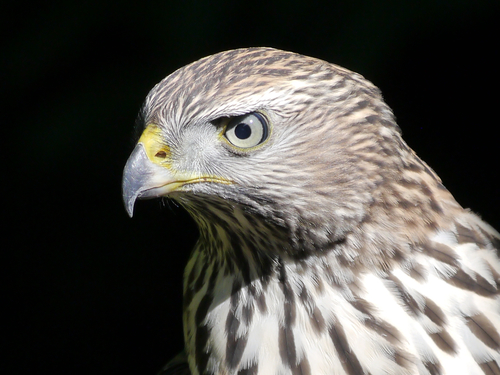 American Goshawk
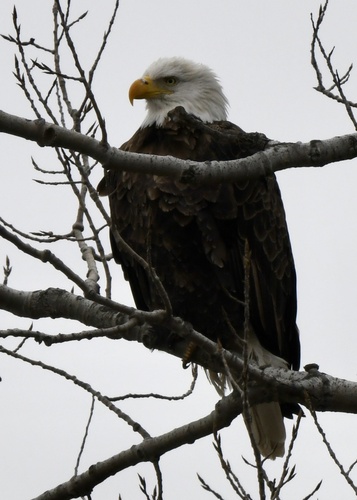 Bald Eagle
In short
The most reliable field mark between American Goshawk and Bald Eagle, especially for immature birds in flight, is overall size and structure: Bald Eagles are vastly larger, with massive heads and bills, and extremely broad, plank-like wings, while American Goshawks are much smaller, with proportionally shorter, rounded wings and long tails. Juvenile plumage can cause confusion, as both species are brownish with pale streaking, but the eagle's bulk, huge bill, and flat, straight-edged wings are unmistakable when seen well. Goshawks show heavier, vertical streaking on the underparts as juveniles, while immature Bald Eagles have messy white mottling and never show the even, vertical streaks of a juvenile goshawk. Even at a distance, the eagle's sheer size and proportions should rule out a goshawk, but confusion can occur with distant or poorly seen immatures.
Identification tips
- Size is the first check: If the bird is truly eagle-sized, with a massive head and bill, it is a Bald Eagle. Goshawks are much smaller, closer to a large buteo or small eagle at most.
- Wing shape in flight: Bald Eagles have long, broad, plank-like wings with straight trailing edges, held flat when soaring. Goshawks have shorter, rounded wings and a proportionally longer tail, giving a different silhouette.
- Bill size and shape: Bald Eagles have a huge, deep, pale bill that is obvious even at a distance. Goshawks have a much smaller, hooked bill typical of accipiters.
- Head projection: In flight, Bald Eagles show a large, protruding head and neck well ahead of the wings. Goshawks have a smaller head that does not project as far.
- Tail shape and length: Goshawks have a long, rounded tail, often with a broad white tip in juveniles. Bald Eagles have a shorter, wedge-shaped tail (immatures dark, adults white).
- Juvenile underpart pattern: Juvenile goshawks show heavy, even, vertical streaking on the chest and belly. Juvenile Bald Eagles have messy, irregular white mottling and never show even streaks.
- Adult plumage: Adult Bald Eagles are unmistakable with a white head and tail. Adult goshawks are gray above and finely barred below, never with white head or tail.
- Flight style: Goshawks fly with deep, deliberate wingbeats and are agile in wooded habitats. Bald Eagles soar with slow, steady wingbeats and rarely maneuver through dense trees.
- Perched posture: Bald Eagles are massive and often perch in the open, especially near water. Goshawks are more compact and secretive, usually perched in or near forest cover.
- Habitat context: If seen over open water, especially in a group or scavenging, it is almost certainly a Bald Eagle. Goshawks are rarely found far from forest.
- Age confusion: Immature Bald Eagles can be mistaken for other large raptors but are always much larger than any goshawk. Goshawk juveniles are never as mottled or as large as a young eagle.
- Proportion check: Even at a distance, the eagle's huge head and bill, long wings, and overall bulk are diagnostic. Goshawks look more compact, with a shorter neck and smaller bill.
- Overlap with other raptors: Goshawks may be confused with large buteos or even gyrfalcons, but never approach eagle size. Bald Eagles are only likely to be confused with Golden Eagles at a distance.
- Seasonal context: Bald Eagles are present year-round in many areas but are most numerous near water in winter. Goshawks are more likely in forested areas, especially during the breeding season.
- Voice is not helpful: Vocalizations are not diagnostic between these two; identification should rely on structure, plumage, and context.
Size
Bald Eagles are among the largest raptors in North America, with an average body mass of 4740 g (and Alaskan females reaching over 7000 g), a wingspan up to 2.44 m, and a huge, deep bill. American Goshawks are much smaller, with no overlap in wing or tail length, and are closer in size to large buteos or small eagles at most. Even the largest female goshawk is dwarfed by a Bald Eagle. In the field, a Bald Eagle will appear several times larger than a goshawk, with a much more massive head and bill. Weight overlap is impossible; even a small Bald Eagle is far heavier than any goshawk.
Plumage
- Juvenile/Immature: Juvenile American Goshawks have heavy, even, vertical streaking on the chest and belly, with brown upperparts and a relatively short tail for their broad body. Juvenile Bald Eagles are dark brown overall with messy, irregular white streaking and mottling, especially on the underwing and belly, and lack the clean vertical streaks of a goshawk. The eagle's head is large and protruding, and the bill is enormous and pale, even in immatures. Goshawk juveniles never show the extensive white mottling of a young eagle.
- Adult: Adult Bald Eagles are unmistakable with a white head and tail contrasting with a dark brown body and wings. Adult American Goshawks are gray above with pale underparts barred finely with gray, never showing rusty or brownish barring. No adult Bald Eagle could be confused with a goshawk.
- Flight feathers: Bald Eagles have broad, plank-like wings with straight trailing edges, while goshawks have shorter, rounded wings and a long tail. No distinctive upperwing panels or 'W' patterns are noted for either, but the eagle's wing shape and size are diagnostic.
- Aging: Bald Eagles take up to five years to reach adult plumage, so immatures are variable but always huge and heavy-billed. Goshawks mature faster and never show the eagle's white mottling.
Behaviour
Bald Eagles often soar with flat, straight wings and slow, deep wingbeats, sometimes perching conspicuously in open areas or near water. They may be seen scavenging or stealing food from other birds. American Goshawks are more secretive, flying with deeper, more deliberate wingbeats than other Astur hawks, and are typically seen in or near forests, often flying low and fast through trees. Goshawks rarely soar in the open for long periods and are much less likely to be seen perched in the open than eagles.
Habitat
Bald Eagles are associated with large bodies of water, rivers, lakes, and coasts, often nesting in tall trees or on cliffs near water. They are widespread across North America, especially near suitable aquatic habitats. American Goshawks prefer dense forests, especially mature coniferous or mixed woodlands, and are less likely to be found in open areas or near large water bodies. Overlap can occur in migration or winter, but typical habitat preferences are quite different.