

Motmot

Aleutian Tern vs Lesser Frigatebird

Onychoprion aleuticus versus Fregata ariel

Play a quiz with Aleutian Tern and Lesser Frigatebird

Aleutian Tern (Onychoprion aleuticus) Aleutian Tern
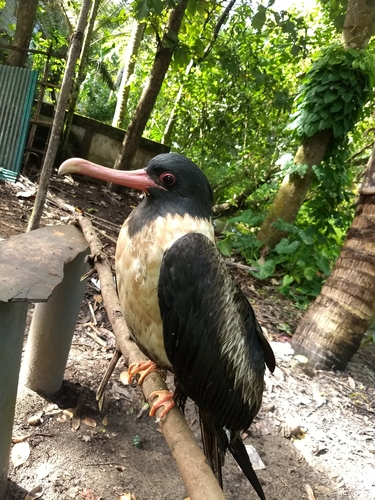
Lesser Frigatebird (Fregata ariel) Lesser Frigatebird

Media

Loading…

In short

The most reliable field mark to separate Aleutian Tern from Lesser Frigatebird is overall structure: Aleutian Tern is a compact, medium-sized tern with a short, pointed bill and moderately forked tail, while Lesser Frigatebird is a much larger, long-winged seabird with a deeply forked tail and long, slender bill. In flight, Aleutian Tern (especially adults) shows a pale underwing with a dark bar on the secondaries, while Lesser Frigatebird (all ages) has long, narrow wings and a distinctive white spur in the underwing 'armpit' area (especially in juveniles and females). Adult Aleutian Tern has a white forehead and black cap; Lesser Frigatebird males are all black with a red throat sac, while females and juveniles have extensive white on the underparts and collar. These two are extremely unlikely to be confused side-by-side, but distant or immature birds in flight can cause confusion if only general shape and wing pattern are glimpsed.

Identification tips

  1. Size and shape: Lesser Frigatebird is enormous compared to Aleutian Tern—look for a bird nearly twice as long, with a wingspan more than double, and a dramatically long, deeply forked tail. Terns are compact, with short bills and less exaggerated tails.
  2. Bill shape: Aleutian Tern has a short, pointed, black bill; Lesser Frigatebird has a long, slender, hooked bill (pale in females/juveniles, dark in males). This is visible even at a distance if the bird is perched or flying low.
  3. Tail fork: Aleutian Tern has a moderately forked tail, often held closed. Lesser Frigatebird's tail is extremely long and deeply forked, often trailing behind in a V or scissor shape, especially noticeable in flight.
  4. Underwing pattern (age-specific): Adult Aleutian Tern shows a pale underwing with a dark bar on the secondaries; juveniles usually lack this bar. Lesser Frigatebird (all ages) shows a white 'spur' or patch in the underwing 'armpit' area (especially in females and juveniles), never a dark bar. If you see a dark secondary bar, it's Aleutian Tern (adult); if you see a white spur, it's Lesser Frigatebird.
  5. Forehead and cap: Aleutian Tern (all ages) has a white forehead and black cap; Lesser Frigatebird never shows this pattern. Frigatebird males are all black-headed, females have a white collar and breast, and juveniles have extensive white but never a white forehead with black cap.
  6. Upperwing pattern: Aleutian Tern has uniform grey upperwings with dark-tipped primaries; Lesser Frigatebird males have a pale bar on the upperwing, but the wing is much longer and narrower overall.
  7. Leg color: Aleutian Tern has black legs; Lesser Frigatebird's legs are short and not easily seen, but are not a field mark for separation.
  8. Flight style: Aleutian Tern flies with rapid, shallow wingbeats, often close to the water. Lesser Frigatebird soars and glides effortlessly, often high above the water, with slow, elastic wingbeats and long glides.
  9. Perched posture: Aleutian Tern perches on the ground or low posts, looking compact and upright. Lesser Frigatebird rarely perches except in trees or on cliffs/islands, and looks gangly and long-winged when at rest.
  10. Red throat sac: Only adult male Lesser Frigatebird shows a red gular sac, and only when displaying. If you see this, it's diagnostic for frigatebird.
  11. White collar and underparts: Female and juvenile Lesser Frigatebird have a white collar and breast, but so do juvenile Aleutian Terns (with a white collar and underparts). However, the overall structure and underwing pattern will still separate them.
  12. Habitat and range: Aleutian Tern is found in subarctic Alaska/Siberia, nearshore or in colonies; Lesser Frigatebird is strictly tropical/subtropical and pelagic. If you are in the subarctic, it's almost certainly not a frigatebird.
  13. Kleptoparasitism: If you observe a bird harassing other seabirds in flight to steal food, it's likely a frigatebird, not a tern.
  14. Sex differences: Aleutian Tern sexes are similar; Lesser Frigatebird females are larger, with a white collar and breast, and a red eye-ring, while males are all black with a red throat sac.
  15. Juvenile confusion: Both species' juveniles show white in the head/neck area, but only Aleutian Tern juveniles have a white forehead with black cap and a compact tern shape; frigatebird juveniles are lanky, with a white underwing spur and no black cap.

Size

Lesser Frigatebird is vastly larger and bulkier than Aleutian Tern. Aleutian Tern weighs about 112 g and is 32–39 cm long with a 75–80 cm wingspan. Lesser Frigatebird is 806 g (male/female range 625–955 g), 66–81 cm long, and has a wingspan of 155–193 cm—nearly double the tern's. The frigatebird's wings are much longer and narrower, and its tail is more dramatically forked. Even at a distance, the size and proportions of the frigatebird are strikingly different from any tern.

Plumage

Juvenile and adult Aleutian Terns both show a white forehead and black cap, but juveniles have a white collar and extensive white on the forehead, with white underparts and a gray tail edged white. Adults in breeding plumage have a diagnostic white forehead, black cap, mid-grey mantle, darkish grey underparts, and a white rump and tail; the underwing is whitish with a dark bar on the secondaries (adults), but juveniles usually lack this dark bar. Non-breeding adults are poorly known but thought to resemble breeding birds, with a white-speckled crown and gray tail. Lesser Frigatebird males are mostly all black with a white flank patch extending as a spur onto the underwing, and a pale bar on the upperwing; their red throat sac is only visible in display. Females have a black head and neck, white collar and breast, and a white spur on the underwing; a narrow red eye-ring is also present. Juveniles and immatures show white in the underwing 'armpit' area (spur), which is a key mark. Frigatebirds never show the white forehead or compact tern-like pattern of Aleutian Tern, and their underwing pattern is dominated by the white spur, not a dark secondary bar.

Behaviour

Aleutian Tern forages by flying low over water and surface-dipping for small fish, rarely plunge-diving or swimming. It is agile but not as aerially specialized as a frigatebird. Lesser Frigatebird is a master of the air, rarely landing on water, with a buoyant, effortless flight and long glides. It often soars high, and is famous for kleptoparasitism—harassing other seabirds to steal food—though it also catches flying fish and squid from the surface. Aleutian Tern is more likely to be seen in coastal colonies or nearshore waters, while Lesser Frigatebird is often seen soaring high over open tropical or subtropical seas.

Habitat

Aleutian Tern breeds in subarctic Alaska and eastern Siberia, usually in coastal colonies, and forages in shallow nearshore waters, tidal rips, and sometimes rivers or freshwater ponds. It is a bird of northern, cooler regions. Lesser Frigatebird is strictly tropical and subtropical, found over warm oceans and islands in the Indian, Pacific, and Atlantic (Brazil) Oceans. It rarely comes to land except to breed on remote islands. The two species do not overlap in typical breeding or foraging habitats.

Submit a better description

Use the same sections as the comparison. Your text is published immediately.

The most reliable field mark to separate Aleutian Tern from Lesser Frigatebird is overall structure: Aleutian Tern is a compact, medium-sized tern with a short, pointed bill and moderately forked tail, while Lesser Frigatebird is a much larger, long-winged seabird with a deeply forked tail and long, slender bill. In flight, Aleutian Tern (especially adults) shows a pale underwing with a dark bar on the secondaries, while Lesser Frigatebird (all ages) has long, narrow wings and a distinctive white spur in the underwing 'armpit' area (especially in juveniles and females). Adult Aleutian Tern has a white forehead and black cap; Lesser Frigatebird males are all black with a red throat sac, while females and juveniles have extensive white on the underparts and collar. These two are extremely unlikely to be confused side-by-side, but distant or immature birds in flight can cause confusion if only general shape and wing pattern are glimpsed.

  1. Size and shape: Lesser Frigatebird is enormous compared to Aleutian Tern—look for a bird nearly twice as long, with a wingspan more than double, and a dramatically long, deeply forked tail. Terns are compact, with short bills and less exaggerated tails.
  2. Bill shape: Aleutian Tern has a short, pointed, black bill; Lesser Frigatebird has a long, slender, hooked bill (pale in females/juveniles, dark in males). This is visible even at a distance if the bird is perched or flying low.
  3. Tail fork: Aleutian Tern has a moderately forked tail, often held closed. Lesser Frigatebird's tail is extremely long and deeply forked, often trailing behind in a V or scissor shape, especially noticeable in flight.
  4. Underwing pattern (age-specific): Adult Aleutian Tern shows a pale underwing with a dark bar on the secondaries; juveniles usually lack this bar. Lesser Frigatebird (all ages) shows a white 'spur' or patch in the underwing 'armpit' area (especially in females and juveniles), never a dark bar. If you see a dark secondary bar, it's Aleutian Tern (adult); if you see a white spur, it's Lesser Frigatebird.
  5. Forehead and cap: Aleutian Tern (all ages) has a white forehead and black cap; Lesser Frigatebird never shows this pattern. Frigatebird males are all black-headed, females have a white collar and breast, and juveniles have extensive white but never a white forehead with black cap.
  6. Upperwing pattern: Aleutian Tern has uniform grey upperwings with dark-tipped primaries; Lesser Frigatebird males have a pale bar on the upperwing, but the wing is much longer and narrower overall.
  7. Leg color: Aleutian Tern has black legs; Lesser Frigatebird's legs are short and not easily seen, but are not a field mark for separation.
  8. Flight style: Aleutian Tern flies with rapid, shallow wingbeats, often close to the water. Lesser Frigatebird soars and glides effortlessly, often high above the water, with slow, elastic wingbeats and long glides.
  9. Perched posture: Aleutian Tern perches on the ground or low posts, looking compact and upright. Lesser Frigatebird rarely perches except in trees or on cliffs/islands, and looks gangly and long-winged when at rest.
  10. Red throat sac: Only adult male Lesser Frigatebird shows a red gular sac, and only when displaying. If you see this, it's diagnostic for frigatebird.
  11. White collar and underparts: Female and juvenile Lesser Frigatebird have a white collar and breast, but so do juvenile Aleutian Terns (with a white collar and underparts). However, the overall structure and underwing pattern will still separate them.
  12. Habitat and range: Aleutian Tern is found in subarctic Alaska/Siberia, nearshore or in colonies; Lesser Frigatebird is strictly tropical/subtropical and pelagic. If you are in the subarctic, it's almost certainly not a frigatebird.
  13. Kleptoparasitism: If you observe a bird harassing other seabirds in flight to steal food, it's likely a frigatebird, not a tern.
  14. Sex differences: Aleutian Tern sexes are similar; Lesser Frigatebird females are larger, with a white collar and breast, and a red eye-ring, while males are all black with a red throat sac.
  15. Juvenile confusion: Both species' juveniles show white in the head/neck area, but only Aleutian Tern juveniles have a white forehead with black cap and a compact tern shape; frigatebird juveniles are lanky, with a white underwing spur and no black cap.

Lesser Frigatebird is vastly larger and bulkier than Aleutian Tern. Aleutian Tern weighs about 112 g and is 32–39 cm long with a 75–80 cm wingspan. Lesser Frigatebird is 806 g (male/female range 625–955 g), 66–81 cm long, and has a wingspan of 155–193 cm—nearly double the tern's. The frigatebird's wings are much longer and narrower, and its tail is more dramatically forked. Even at a distance, the size and proportions of the frigatebird are strikingly different from any tern.

Juvenile and adult Aleutian Terns both show a white forehead and black cap, but juveniles have a white collar and extensive white on the forehead, with white underparts and a gray tail edged white. Adults in breeding plumage have a diagnostic white forehead, black cap, mid-grey mantle, darkish grey underparts, and a white rump and tail; the underwing is whitish with a dark bar on the secondaries (adults), but juveniles usually lack this dark bar. Non-breeding adults are poorly known but thought to resemble breeding birds, with a white-speckled crown and gray tail. Lesser Frigatebird males are mostly all black with a white flank patch extending as a spur onto the underwing, and a pale bar on the upperwing; their red throat sac is only visible in display. Females have a black head and neck, white collar and breast, and a white spur on the underwing; a narrow red eye-ring is also present. Juveniles and immatures show white in the underwing 'armpit' area (spur), which is a key mark. Frigatebirds never show the white forehead or compact tern-like pattern of Aleutian Tern, and their underwing pattern is dominated by the white spur, not a dark secondary bar.

Aleutian Tern forages by flying low over water and surface-dipping for small fish, rarely plunge-diving or swimming. It is agile but not as aerially specialized as a frigatebird. Lesser Frigatebird is a master of the air, rarely landing on water, with a buoyant, effortless flight and long glides. It often soars high, and is famous for kleptoparasitism—harassing other seabirds to steal food—though it also catches flying fish and squid from the surface. Aleutian Tern is more likely to be seen in coastal colonies or nearshore waters, while Lesser Frigatebird is often seen soaring high over open tropical or subtropical seas.

Aleutian Tern breeds in subarctic Alaska and eastern Siberia, usually in coastal colonies, and forages in shallow nearshore waters, tidal rips, and sometimes rivers or freshwater ponds. It is a bird of northern, cooler regions. Lesser Frigatebird is strictly tropical and subtropical, found over warm oceans and islands in the Indian, Pacific, and Atlantic (Brazil) Oceans. It rarely comes to land except to breed on remote islands. The two species do not overlap in typical breeding or foraging habitats.

Discard your changes?

You have unsaved edits. If you leave now, those changes will be lost.

Aleutian Tern · Lesser Frigatebird · My Tricky Birds