

Motmot

Ainley's Storm-Petrel vs Tristram's Storm-Petrel

Hydrobates cheimomnestes versus Hydrobates tristrami

Play a quiz with Ainley's Storm-Petrel and Tristram's Storm-Petrel

Ainley's Storm-Petrel (Hydrobates cheimomnestes) Ainley's Storm-Petrel
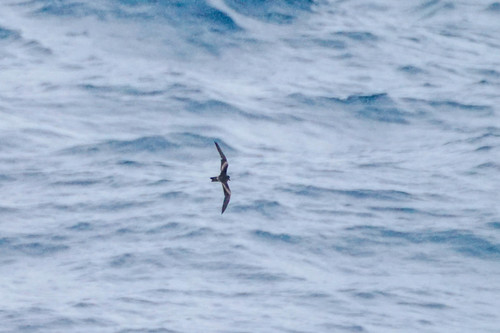
Tristram's Storm-Petrel (Hydrobates tristrami) Tristram's Storm-Petrel

Media

Loading…

In short

The most reliable field mark to separate Ainley's Storm-Petrel from Tristram's Storm-Petrel is the rump and upperwing pattern: Ainley's shows a distinct white rump patch (U-shaped, often with a central dark area), while Tristram's is overall dark with only a slightly pale rump and a pale grey bar on the upper wing. Tristram's is also much larger and bulkier, with long, angular wings and a heavier build. Both species are dark storm-petrels, but their size, tail shape, and rump contrast are key in flight. Structure and flight style further help: Ainley's is medium-sized and more delicate, while Tristram's is the largest storm-petrel, with a powerful, sooty look.

Identification tips

  1. White rump patch (Ainley's only): In all ages and seasons, Ainley's Storm-Petrel shows a bold, U-shaped white rump patch, often with a central dark area. This is the single most reliable mark in flight. Tristram's never shows a bright white rump—only a slightly paler area.
  2. Upperwing pattern: Tristram's Storm-Petrel has a pale grey bar on the upperwing, visible in good light, while Ainley's upperwing is uniformly dark. This helps separate distant birds when the rump is not visible.
  3. Overall size: Tristram's is much larger and bulkier (24.5–27 cm, ~84 g) than Ainley's (18 cm, much lighter). In mixed flocks or with experience, Tristram's stands out as the largest storm-petrel present.
  4. Wing shape: Tristram's has long, angular wings, giving a more powerful and steady flight. Ainley's wings are long but have blunt points, and its flight is more fluttery and delicate.
  5. Tail shape: Ainley's tail is moderately long and forked, often obvious in flight. Tristram's tail is less deeply forked, appearing more squared-off or shallowly notched.
  6. Plumage tone: Both are dark sooty-brown to blackish, but Ainley's can look browner when worn. Tristram's is uniformly sooty, with little contrast except for the subtle pale rump and wing bar.
  7. Bill structure: Tristram's has a stouter bill, suited to its diet of cephalopods. This is subtle at a distance but may be seen in close photos or with a scope.
  8. Feet projection: Ainley's feet do not extend beyond the tail in flight. No such note for Tristram's, but this is not a primary field mark.
  9. Flight style: Tristram's flies with strong, steady wingbeats and glides, befitting its size. Ainley's is more buoyant and fluttery, with less direct flight.
  10. Habitat and range: Ainley's is found off western Mexico and south to the Galápagos; Tristram's is in the north Pacific, especially around Hawaii and Japan. Out-of-range records should be scrutinized.
  11. Breeding context: Ainley's breeds only on Guadalupe Island in winter; Tristram's breeds on islands in the northwest Pacific. At colonies, both are nocturnal.
  12. No strong age-specific marks: Both species lack described juvenile or first-winter upperwing patterns that differ from adults; the rump and wing bar are reliable at all ages.
  13. No strong sexual dimorphism: Males and females are similar in both species.
  14. Beware worn plumage: Both can look browner when worn, but rump and wing pattern remain diagnostic.
  15. No useful vocal differences described: Field separation is visual; calls are not a practical aid in identification.

Size

Tristram's Storm-Petrel is dramatically larger than Ainley's: Tristram's measures 24.5–27 cm in length and averages 84 g in mass, making it the largest storm-petrel. Ainley's is medium-sized for the group, around 18 cm long (no mass data, but clearly much lighter). In the field, Tristram's looks heavier and more robust, with a longer wingspan and a stouter bill. Ainley's is noticeably smaller and more delicate, with proportionally shorter wings and tail.

Plumage

For all ages, Ainley's Storm-Petrel is sooty-brown to blackish overall but always shows a prominent white rump patch, U-shaped with a central dark area, and a moderately long, forked tail. The white rump is diagnostic in flight at all ages and seasons. Tristram's Storm-Petrel is uniformly dark sooty-brown to blackish, with only a slightly pale rump (never a bold white patch) and a pale grey bar on the upperwing. Its tail is less deeply forked and appears more squared-off or shallowly notched. Tristram's lacks the strong rump contrast of Ainley's, and its upperwing shows a pale bar, which Ainley's lacks. Both species may look browner when plumage is worn, but the rump and wing pattern remain reliable. No age-specific juvenile or immature upperwing marks are described for either, but the rump and wing bar are consistent across ages.

Behaviour

Both species are pelagic and spend most of their lives at sea, coming to land only to breed. Ainley's Storm-Petrel breeds on Guadalupe Island and is nocturnal at colonies, similar to Leach's Storm-Petrel. Tristram's Storm-Petrel is also nocturnal at colonies and breeds on remote islands in the Northwest Hawaiian Islands and south of Japan. In flight, Tristram's appears more powerful and steady, befitting its larger size, while Ainley's is lighter and more fluttery. Feeding behavior is broadly similar (surface-feeding on small marine prey), but Tristram's is noted for a stouter bill, adapted for cephalopods.

Habitat

Ainley's Storm-Petrel breeds in winter on Guadalupe Island off Mexico and ranges south to the Galápagos, favoring the eastern Pacific. Tristram's Storm-Petrel breeds in the Northwest Hawaiian Islands and islands south of Japan, ranging widely across the north Pacific in tropical seas. There is no overlap in breeding range, and at sea, Tristram's is found further west and north. Both are strictly pelagic outside the breeding season.

Submit a better description

Use the same sections as the comparison. Your text is published immediately.

The most reliable field mark to separate Ainley's Storm-Petrel from Tristram's Storm-Petrel is the rump and upperwing pattern: Ainley's shows a distinct white rump patch (U-shaped, often with a central dark area), while Tristram's is overall dark with only a slightly pale rump and a pale grey bar on the upper wing. Tristram's is also much larger and bulkier, with long, angular wings and a heavier build. Both species are dark storm-petrels, but their size, tail shape, and rump contrast are key in flight. Structure and flight style further help: Ainley's is medium-sized and more delicate, while Tristram's is the largest storm-petrel, with a powerful, sooty look.

  1. White rump patch (Ainley's only): In all ages and seasons, Ainley's Storm-Petrel shows a bold, U-shaped white rump patch, often with a central dark area. This is the single most reliable mark in flight. Tristram's never shows a bright white rump—only a slightly paler area.
  2. Upperwing pattern: Tristram's Storm-Petrel has a pale grey bar on the upperwing, visible in good light, while Ainley's upperwing is uniformly dark. This helps separate distant birds when the rump is not visible.
  3. Overall size: Tristram's is much larger and bulkier (24.5–27 cm, ~84 g) than Ainley's (18 cm, much lighter). In mixed flocks or with experience, Tristram's stands out as the largest storm-petrel present.
  4. Wing shape: Tristram's has long, angular wings, giving a more powerful and steady flight. Ainley's wings are long but have blunt points, and its flight is more fluttery and delicate.
  5. Tail shape: Ainley's tail is moderately long and forked, often obvious in flight. Tristram's tail is less deeply forked, appearing more squared-off or shallowly notched.
  6. Plumage tone: Both are dark sooty-brown to blackish, but Ainley's can look browner when worn. Tristram's is uniformly sooty, with little contrast except for the subtle pale rump and wing bar.
  7. Bill structure: Tristram's has a stouter bill, suited to its diet of cephalopods. This is subtle at a distance but may be seen in close photos or with a scope.
  8. Feet projection: Ainley's feet do not extend beyond the tail in flight. No such note for Tristram's, but this is not a primary field mark.
  9. Flight style: Tristram's flies with strong, steady wingbeats and glides, befitting its size. Ainley's is more buoyant and fluttery, with less direct flight.
  10. Habitat and range: Ainley's is found off western Mexico and south to the Galápagos; Tristram's is in the north Pacific, especially around Hawaii and Japan. Out-of-range records should be scrutinized.
  11. Breeding context: Ainley's breeds only on Guadalupe Island in winter; Tristram's breeds on islands in the northwest Pacific. At colonies, both are nocturnal.
  12. No strong age-specific marks: Both species lack described juvenile or first-winter upperwing patterns that differ from adults; the rump and wing bar are reliable at all ages.
  13. No strong sexual dimorphism: Males and females are similar in both species.
  14. Beware worn plumage: Both can look browner when worn, but rump and wing pattern remain diagnostic.
  15. No useful vocal differences described: Field separation is visual; calls are not a practical aid in identification.

Tristram's Storm-Petrel is dramatically larger than Ainley's: Tristram's measures 24.5–27 cm in length and averages 84 g in mass, making it the largest storm-petrel. Ainley's is medium-sized for the group, around 18 cm long (no mass data, but clearly much lighter). In the field, Tristram's looks heavier and more robust, with a longer wingspan and a stouter bill. Ainley's is noticeably smaller and more delicate, with proportionally shorter wings and tail.

For all ages, Ainley's Storm-Petrel is sooty-brown to blackish overall but always shows a prominent white rump patch, U-shaped with a central dark area, and a moderately long, forked tail. The white rump is diagnostic in flight at all ages and seasons. Tristram's Storm-Petrel is uniformly dark sooty-brown to blackish, with only a slightly pale rump (never a bold white patch) and a pale grey bar on the upperwing. Its tail is less deeply forked and appears more squared-off or shallowly notched. Tristram's lacks the strong rump contrast of Ainley's, and its upperwing shows a pale bar, which Ainley's lacks. Both species may look browner when plumage is worn, but the rump and wing pattern remain reliable. No age-specific juvenile or immature upperwing marks are described for either, but the rump and wing bar are consistent across ages.

Both species are pelagic and spend most of their lives at sea, coming to land only to breed. Ainley's Storm-Petrel breeds on Guadalupe Island and is nocturnal at colonies, similar to Leach's Storm-Petrel. Tristram's Storm-Petrel is also nocturnal at colonies and breeds on remote islands in the Northwest Hawaiian Islands and south of Japan. In flight, Tristram's appears more powerful and steady, befitting its larger size, while Ainley's is lighter and more fluttery. Feeding behavior is broadly similar (surface-feeding on small marine prey), but Tristram's is noted for a stouter bill, adapted for cephalopods.

Ainley's Storm-Petrel breeds in winter on Guadalupe Island off Mexico and ranges south to the Galápagos, favoring the eastern Pacific. Tristram's Storm-Petrel breeds in the Northwest Hawaiian Islands and islands south of Japan, ranging widely across the north Pacific in tropical seas. There is no overlap in breeding range, and at sea, Tristram's is found further west and north. Both are strictly pelagic outside the breeding season.

Discard your changes?

You have unsaved edits. If you leave now, those changes will be lost.

Ainley's Storm-Petrel · Tristram's Storm-Petrel · My Tricky Birds