

African Yellow-Warbler vs Olive-tree Warbler
Iduna natalensis versus Hippolais olivetorum
Play a quiz with African Yellow-Warbler and Olive-tree Warbler
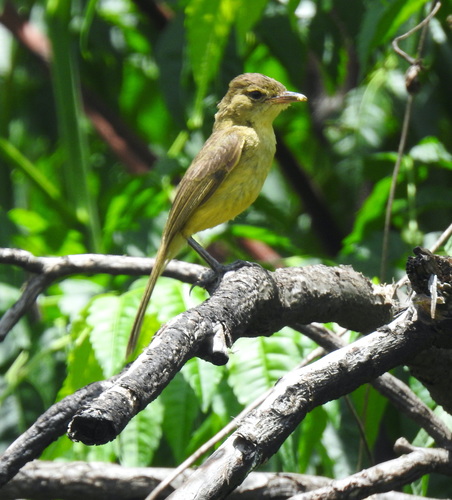 African Yellow-Warbler
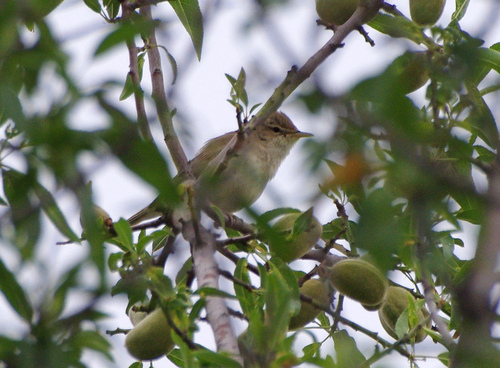 Olive-tree Warbler
In short
The most reliable way to separate African Yellow-Warbler from Olive-tree Warbler is by overall color: African Yellow-Warbler is bright yellow below and yellowish-brown above, while Olive-tree Warbler is much duller, with pale olive-grey upperparts and whitish underparts. In flight or perched, look for the African Yellow-Warbler’s yellow-edged wings and bright yellow underparts, versus the Olive-tree Warbler’s pale wing panel and long, dark tail. Structure also helps: Olive-tree Warbler is notably larger and heavier, with a long, thick bill and longer tail. Juveniles of both species are similar to adults but African Yellow-Warbler young are buffier below. Bill color and leg color can help at close range.
Identification tips
- Underparts color: African Yellow-Warbler always shows bright yellow underparts (adults and juveniles), sometimes with an olive wash on the sides; Olive-tree Warbler is whitish below with no yellow tones at any age.
- Upperparts color: African Yellow-Warbler is yellowish-brown above with a yellower rump, while Olive-tree Warbler is pale olive-grey, lacking any yellow or rufous tones.
- Wing pattern: African Yellow-Warbler’s wings are brown with yellow edges, sometimes giving a subtle yellowish panel (especially in fresh plumage); Olive-tree Warbler has a pale wing panel but it is not yellow, and the rest of the wing is plain.
- Tail color and length: Olive-tree Warbler has a long, dark grey tail; African Yellow-Warbler’s tail is yellowish-brown and shorter in proportion to the body.
- Bill structure and color: Olive-tree Warbler’s bill is long, thick, and has a conspicuous orange-yellow lower mandible; African Yellow-Warbler’s bill is paler above and blackish below, and is finer overall.
- Leg color: African Yellow-Warbler has blackish legs; Olive-tree Warbler’s leg color is not specified but is not noted as blackish.
- Size: Olive-tree Warbler is much larger and heavier (18 cm, 17.5–23 g) than African Yellow-Warbler (13 cm, 10–15 g). Use this when seen side-by-side or with familiar species for scale.
- Juvenile plumage: Juvenile African Yellow-Warbler is buffier below but still shows yellow tones; Olive-tree Warbler juveniles are not described as yellow or buffy, so any yellowish or buffy underparts point to African Yellow-Warbler.
- Sex differences: Female African Yellow-Warbler is duller below but still yellowish; Olive-tree Warbler does not show strong sexual dimorphism in plumage.
- Flight views: In flight, look for yellowish edges to the wing and a yellow rump in African Yellow-Warbler; Olive-tree Warbler shows a pale wing panel but lacks yellow tones and has a longer, darker tail.
- Habitat context: If seen in dense, wet vegetation in sub-Saharan Africa, African Yellow-Warbler is more likely; Olive-tree Warbler prefers drier, more open habitats when breeding, but both can overlap in Africa during migration/winter.
- Jizz: Olive-tree Warbler’s larger size, long tail, and heavier bill give it a bulkier, more deliberate appearance; African Yellow-Warbler is smaller, more agile, and lighter in build.
- Bill color in the field: At close range, the orange-yellow lower mandible of Olive-tree Warbler is distinctive; African Yellow-Warbler’s bill is never orange.
- Pitfalls: Do not rely on overall dullness alone—faded or worn African Yellow-Warblers can appear less bright, but will not show the pale olive-grey and white contrast of Olive-tree Warbler.
- Not diagnostic: Vocalizations are not described in the notes and should not be relied upon for separation in this context.
Size
Olive-tree Warbler is significantly larger and heavier than African Yellow-Warbler. Olive-tree Warbler reaches 18 cm in length and weighs 17.5–23 g, while African Yellow-Warbler is smaller at 13 cm and 10–15 g. The Olive-tree Warbler also has a longer wingspan (24–26 cm) and a noticeably longer tail. In the field, this size difference is often apparent if both species are seen in similar contexts.
Plumage
Juvenile and adult African Yellow-Warblers are yellowish-brown above with a yellower rump, and have bright yellow underparts with an olive wash on the sides and flanks. Their wings are brown with yellow edges, which can show as a subtle yellowish panel in flight or when perched. Juveniles are buffier below but still show yellow tones. In contrast, Olive-tree Warbler of all ages is much duller: upperparts are pale olive-grey, the underparts are whitish, and there is a distinct pale wing panel (not yellow-edged) on otherwise plain wings. The tail is long and dark grey. The bill of Olive-tree Warbler is thick and has a conspicuous orange-yellow lower mandible, while African Yellow-Warbler has a paler upper mandible and a blackish lower mandible. Females of African Yellow-Warbler are duller below but still yellowish, never approaching the pale, washed-out look of Olive-tree Warbler.
Behaviour
No direct behavioral differences are given in the notes. Both are Acrocephalid warblers, likely to move actively through vegetation, but structure may influence their movement: Olive-tree Warbler’s larger size and longer tail may give it a heavier, more deliberate jizz compared to the smaller, more agile African Yellow-Warbler.
Habitat
African Yellow-Warbler is resident in sub-Saharan Africa, while Olive-tree Warbler breeds in southeast Europe and the Near East, wintering in eastern and southern Africa. In Africa, both can occur in similar regions during the non-breeding season, but Olive-tree Warbler is a migrant and less likely to be found in dense, wet habitats preferred by African Yellow-Warbler. Habitat alone is not always diagnostic where ranges overlap, but context may help.
African Yellow-Warbler · Olive-tree Warbler · My Tricky Birds