

African Pipit vs Long-billed Pipit
Anthus cinnamomeus versus Anthus similis
Play a quiz with African Pipit and Long-billed Pipit
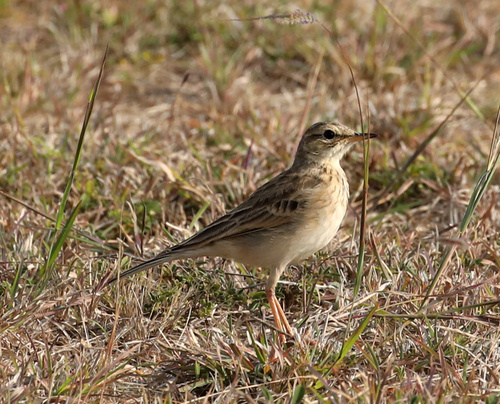 African Pipit
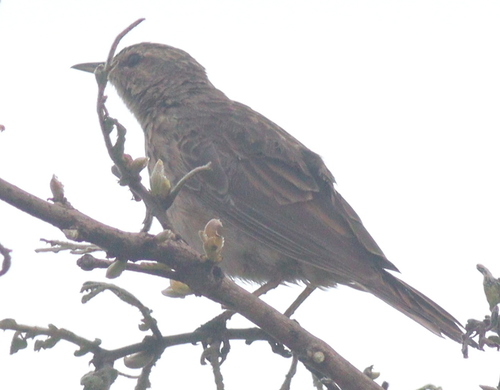 Long-billed Pipit
In short
The most reliable field separation between African Pipit and Long-billed Pipit is structural: Long-billed Pipit is noticeably larger and bulkier, with a distinctly longer bill and tail, while African Pipit is more slender and upright. Plumage differences are subtle but African Pipit shows a bolder face pattern with a strong pale supercilium and dark malar stripe, and more obvious breast streaking, especially in juveniles. In flight, both show white outer tail feathers, but African Pipit’s smaller size and more delicate build are apparent. Be cautious: both species are variable and overlap in many features, so focus on structure and face pattern, especially in perched birds.
Identification tips
- Structure is key: Long-billed Pipit is larger, bulkier, and has a longer tail and bill than African Pipit. Use this especially when birds are side by side or when you get a prolonged view.
- Bill shape and color: African Pipit’s bill is slender and dark with a yellowish base to the lower mandible; Long-billed Pipit’s bill is longer, heavier, and darker overall. This is most useful in good light at close range.
- Face pattern: African Pipit shows a bold pale supercilium (eyebrow) and a distinct dark malar stripe, giving the face a strongly marked look. Long-billed Pipit’s face is plainer, lacking these strong contrasts.
- Breast streaking: African Pipit (especially juveniles and immatures) has more obvious breast streaking and sometimes streaks on the flanks. Long-billed Pipit is generally plainer below, with less streaking.
- Juvenile pattern: If you see a bird with a blotched breast and scalloped upperparts, it is likely a juvenile African Pipit. Long-billed Pipit juveniles are not described as having such strong markings.
- Tail pattern in flight: Both species show white outer tail feathers, so this is not a reliable separator.
- Leg color: African Pipit has long, pinkish legs, which may be slightly more noticeable than the legs of Long-billed Pipit, but this is subtle and not always diagnostic.
- Posture: African Pipit tends to stand more upright and looks more delicate; Long-billed Pipit is more horizontal and appears heavier.
- Habitat context: If the bird is in lush, open grassland, African Pipit is more likely; if on rocky, dry slopes with scattered bushes, lean toward Long-billed Pipit.
- Flight style: African Pipit’s flight is lighter and more undulating, especially when singing; Long-billed Pipit’s flight is stronger and more direct.
- Song and calls: Listen for African Pipit’s twittering song and Long-billed Pipit’s slower, more varied 'sri...churr' song or 'chupp' call. Use only if you are confident in the vocalization.
- Size impression: In mixed flocks or when seen together, Long-billed Pipit should stand out as the larger, more robust bird.
- Plumage pitfalls: Both species are variable and can appear similar in worn plumage or poor light. Do not rely on color alone; focus on structure and face pattern.
- Subspecies confusion: Both species have multiple subspecies and can be variable across their ranges. When in doubt, prioritize structural and face pattern differences.
- Season and molt: No strong seasonal or sex-based plumage differences are described for these species, so use the above marks year-round.
Size
Long-billed Pipit is the larger of the two, measuring 16–17.5 cm in length and weighing around 23 g [wikidata], while African Pipit is smaller at 15–17 cm (no mass data available, but consistently described as more slender) [wikipedia]. The difference is subtle but usually apparent with direct comparison: Long-billed Pipit appears heavier-bodied and longer-tailed, with a proportionally longer bill. African Pipit is more upright and daintier, with a finer bill and shorter tail.
Plumage
Juvenile African Pipits have a blotched breast, scalloped upperparts, and some streaking on the flanks, making them look more patterned than Long-billed Pipit juveniles, which are not described as having such strong markings. Adult African Pipits are buffy-brown above with dark streaks and have a boldly marked face: a strong pale eyebrow (supercilium) and a dark malar stripe stand out. The underparts are white or pale buff with a streaked breast and plain belly/flanks. Long-billed Pipit adults are sandy grey above and pale below, with less obvious streaking and a plainer face, lacking the strong supercilium and malar stripe of African Pipit. Both species show white outer tail feathers in flight, so this is not a useful separator. Bill color is also subtly different: African Pipit has a dark bill with a yellowish base to the lower mandible, while Long-billed Pipit's bill is longer and darker overall.
Behaviour
African Pipit often adopts a more upright stance and can appear more alert and active, frequently seen on open ground or low perches. Long-billed Pipit tends to look heavier and more horizontal, moving with slower, less nervous movements. In flight, Long-billed Pipit is described as having a strong, direct flight, while African Pipit may appear lighter and more fluttery. Both species forage on the ground for seeds and insects, but African Pipit is more likely to be seen in open grassland, sometimes singing from a low perch or during an undulating song-flight.
Habitat
African Pipit favors open grasslands and grassveld, often in areas with shorter vegetation. Long-billed Pipit prefers dry, open slopes with rocks and low vegetation, sometimes in more arid or stony environments. There is some overlap in open country, but African Pipit is more closely tied to grassy habitats, while Long-billed Pipit is more typical of rocky or bushy slopes.
Voice
African Pipit's song is a repeated series of twittering notes, delivered during an undulating song-flight or from a low perch. Long-billed Pipit gives a characteristic 'chupp' call, reminiscent of a desert lark, and its song is slower and more varied than African Pipit's, described as 'sri...churr...sri...churr.' These differences are subtle and may be hard to use unless the bird is singing at length.