

African Penduline Tit vs Little Rush Warbler
Anthoscopus caroli versus Bradypterus baboecala
Play a quiz with African Penduline Tit and Little Rush Warbler
 African Penduline Tit
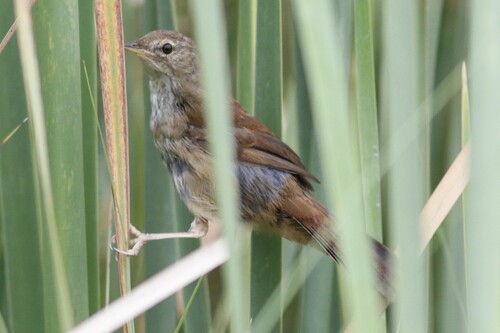 Little Rush Warbler
In short
The most reliable way to separate African Penduline Tit from Little Rush Warbler is by overall structure and behavior: the tit is a tiny, compact, active bird often seen in open, dry habitats, while the warbler is a more secretive, slender skulker of dense, wet vegetation. The tit shows a short, stubby bill and a round-headed look, contrasting with the warbler's longer, thinner bill and flat crown. Plumage differences are subtle at a distance, but the tit is generally greyer and paler, while the warbler is browner and more uniform. If you see the bird actively foraging acrobatically in dry scrub, it's likely the tit; if it's creeping low in reeds or rushes, it's probably the warbler.
Identification tips
- Habitat is often decisive: If the bird is in dry, open woodland or savanna, think African Penduline Tit; if it is in dense, wet reeds or marsh, think Little Rush Warbler.
- Size and shape: The tit is much smaller, rounder, and more compact, with a short tail and a stubby bill. The warbler is larger, more elongated, with a longer tail and a thin, pointed bill.
- Bill structure: The tit’s bill is short, thick, and conical, suited for picking insects and seeds from twigs. The warbler’s bill is long, slender, and slightly decurved, adapted for probing in dense vegetation.
- Head shape: African Penduline Tit has a round head and a gentle, almost fluffy appearance. Little Rush Warbler has a flatter crown and a more streamlined head.
- Plumage tone: The tit is pale grey above and paler below, sometimes with a faint mask or pale face. The warbler is uniform brown above and buffy below, with little contrast and no facial markings.
- Facial pattern: The tit may show a faint pale supercilium or mask; the warbler’s face is plain and unmarked.
- Behavior: Tits are active, acrobatic, and often in small groups, foraging openly. Warblers are solitary or in pairs, creeping low in dense cover and rarely seen in the open.
- Tail: The tit’s tail is short and often cocked; the warbler’s tail is longer and usually held straight or slightly drooped.
- Flight style: The tit’s flight is bouncy and direct between perches; the warbler rarely flies far and usually drops quickly back into cover.
- Vocalizations: Not described in the notes, but generally, penduline tits give high, thin calls, while rush warblers have a more insect-like, reeling song (not diagnostic here).
- Group size: Tits are often in small, noisy parties; warblers are typically alone or with a mate.
- Context: If you see the bird constructing a hanging nest, it is certainly a penduline tit; warblers build nests low in reeds or grass.
- Season and sex: No strong seasonal or sexual plumage differences in either species; all tips apply year-round and to both sexes.
- Juvenile/immature confusion: No distinctive age-specific wing or flight marks are described for either species, so rely on structure and habitat for young birds.
- Common pitfalls: Do not rely on subtle plumage tones alone, as light can make the tit appear browner or the warbler greyer; always check habitat, structure, and behavior.
Size
African Penduline Tit is one of the smallest passerines in Africa, noticeably smaller and more compact than Little Rush Warbler. The tit is tiny and round-bodied, with a short tail and a stubby bill. In contrast, Little Rush Warbler is larger, more elongated, with a longer tail and a noticeably longer, finer bill. Even without precise measurements, the tit will appear much daintier and more delicate, while the warbler is closer to a typical small warbler in proportions.
Plumage
- Juvenile and immature plumages are not described in detail for either species in the provided notes, and there are no references to distinctive upperwing patterns, panels, or flight marks for either species at any age.
- Adult African Penduline Tit is generally pale grey above with paler underparts, sometimes showing a faint mask or pale supercilium, and lacks strong streaking or patterning. The overall impression is of a soft, pale, and slightly fluffy bird.
- Little Rush Warbler is uniformly brown above and buffy below, with little contrast or patterning. It lacks any facial mask or supercilium and appears plain and unmarked. The warbler’s plumage is more rufous or warm brown compared to the tit’s colder grey tones.
- In both species, sex differences are not prominent in the field.
Behaviour
African Penduline Tit is highly active, often seen hanging upside down or foraging acrobatically among twigs and branches in open, dry woodland or savanna. It is usually in small groups or pairs, rarely alone, and is not shy. Little Rush Warbler, by contrast, is secretive and skulking, rarely venturing far from dense, wet vegetation such as reeds, rushes, or thick grass near water. It moves quietly and low, often remaining hidden except for brief views as it creeps through cover. The tit’s bold, energetic movements contrast sharply with the warbler’s furtive, creeping behavior.
Habitat
African Penduline Tit favors dry savanna, open woodland, and dry forest, usually away from water and dense reedbeds. It is most often found in arid or semi-arid regions with scattered trees and bushes. Little Rush Warbler is strongly tied to wet habitats: dense reedbeds, marshes, and moist grasslands, often close to water. If you find a small bird in dry scrub or woodland, it is almost certainly the tit; if it is in reeds or marshy ground, it is almost certainly the warbler.
African Penduline Tit · Little Rush Warbler · My Tricky Birds