

African Palm Swift vs Lesser Striped Swallow
Cypsiurus parvus versus Cecropis abyssinica
Play a quiz with African Palm Swift and Lesser Striped Swallow
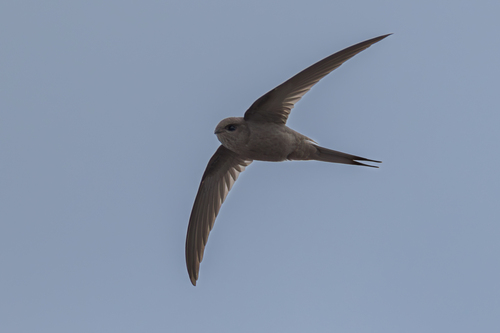 African Palm Swift
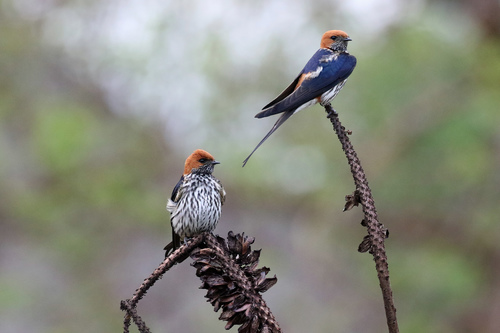 Lesser Striped Swallow
In short
The most reliable way to separate African Palm Swift from Lesser Striped Swallow is by their overall structure and flight style: palm swifts are slender, long-winged, and sickle-shaped in flight, with a deeply forked tail usually held closed, while swallows are bulkier with broader wings and a more classic swallow tail. Juvenile swallows have shorter outer tail feathers, but never match the swift’s boomerang-like silhouette. Plumage is also distinctive: swifts are plain pale brown, while swallows show blue upperparts, a rufous crown, and boldly streaked white underparts. If perched, swallows will sit on wires or branches, while palm swifts almost never perch except clinging vertically to palms. Calls differ: swifts give a shrill scream, swallows a nasal 'zeh zeh zeh'.
Identification tips
- Flight silhouette: Look for the African Palm Swift’s extremely slender, sickle-shaped wings and slim body; Lesser Striped Swallow is bulkier, with broader wings and a less extreme tail fork.
- Tail shape: Palm Swift has a deeply forked tail, but it is usually held closed and may appear pointed; Swallow’s tail is also forked, with long outer feathers (especially in adult males), but always appears broader and more classic 'swallow-like.'
- Plumage color: Palm Swift is plain pale brown overall, with no strong color contrasts. Swallow is strikingly marked: blue upperparts, rufous crown/nape, red rump, white underparts with bold dark streaks.
- Underparts: Swallow shows white underparts with heavy dark streaking (variable by subspecies), never matched by the swift’s plain brown.
- Head pattern: Swallow has a rufous-chestnut crown and nape, contrasting with blue upperparts; palm swift’s head is the same pale brown as the rest of the body.
- Juvenile confusion: Juvenile swallow is duller and browner, with shorter tail streamers, but still shows some streaking below and a rufous crown. Juvenile palm swift is just a shorter-tailed version of the adult, remaining plain brown.
- Perching behavior: Swallows frequently perch on wires, branches, or buildings. Palm swifts almost never perch except clinging vertically to palm fronds or similar surfaces.
- Nesting sites: Swallows build mud nests with tubular entrances under overhangs or man-made structures. Palm swifts glue feather nests to the underside of palm fronds.
- Flight style: Palm swifts are fast, direct, and rarely glide; swallows have a more erratic, swooping flight, often gliding between flaps.
- Voice: Listen for a shrill scream from palm swift; a nasal 'zeh zeh zeh' from swallow.
- Habitat association: Palm swifts are closely tied to palms, especially oil palms, but also occur in wooded savannah and cultivated land. Swallows are more flexible, often near human structures.
- Wing pattern in flight: Neither species shows strong contrasting wing panels, but palm swift’s wings are narrower and more crescent-shaped, while swallow’s are broader and blackish-brown.
- Size impression: Swallow appears heavier and more robust, especially when perched; palm swift is always slender and light.
- Season/sex: Swallow’s long tail streamers are most pronounced in adult males, but even females and juveniles never match the swift’s tail shape or overall structure.
- Common pitfalls: Distant or fast-flying birds can confuse, especially juvenile swallows with shorter tails. Look for any sign of streaked underparts or rufous crown for swallow, or the uniform brown and sickle-winged shape for swift.
Size
African Palm Swift is a small, very lightweight bird (body mass ~14g [wikidata]), with a length of about 16 cm [wikipedia]. Lesser Striped Swallow is longer (15–19 cm [wikipedia]) and noticeably heavier-bodied, with a more robust appearance. In the field, swallows look chunkier and broader-winged, while palm swifts are extremely slender and sickle-shaped. The swallow’s tail streamers can make it appear longer, especially in adults, but the swift’s tail is deeply forked though usually held closed and less obvious unless spread.
Plumage
-
Juveniles: Juvenile Lesser Striped Swallow is duller and browner than adults, with less contrast and shorter outer tail feathers, but still shows some streaking below and a rufous crown. Juvenile African Palm Swift mainly differs from adults by having a shorter tail, but remains plain pale brown overall.
-
Adults: African Palm Swift is uniformly pale brown, with long, swept-back wings and a deeply forked tail (usually held closed). No strong color contrasts or markings. Lesser Striped Swallow is much more colorful: dark blue upperparts, rufous-chestnut crown/nape/sides of head, deep red rump, white underparts with heavy dark streaking, and blackish-brown wings and tail. Underwing coverts are tawny. The swallow’s tail has very long outer feathers (especially in males), but always with a blackish color.
-
Wing pattern in flight: Palm Swift’s wings are long, narrow, and crescent-shaped, lacking any contrasting panels or bars. Swallow’s wings are broader, with blackish-brown flight feathers and no pale panels; underwing coverts are tawny but not strongly marked. Swallow’s flight feathers contrast with the blue upperparts and rufous rump when seen from above.
Behaviour
African Palm Swifts spend nearly all their time in the air, rarely perching except to cling vertically to palm fronds or similar surfaces. Their flight is fast, direct, and sickle-winged, often high but sometimes low over open country. Lesser Striped Swallows have a more erratic, swooping flight typical of swallows, and are often seen perching on wires, branches, or buildings. Swallows build mud nests with tubular entrances under overhangs or man-made structures, while palm swifts glue their nests to the underside of palm fronds using saliva.
Habitat
Both species can occur in open country and near human habitation, but African Palm Swift is strongly associated with palms (especially oil palms), wooded savannah, thornbush, and cultivated land. Lesser Striped Swallow breeds widely in Sub-Saharan Africa, often near buildings, bridges, and culverts, as well as natural overhangs. Swallows are more likely to be seen perching in open or semi-open areas, while palm swifts are almost always airborne unless at the nest.
Voice
African Palm Swift gives a loud, shrill scream, which is piercing and distinctive. Lesser Striped Swallow has a nasal 'zeh zeh zeh zeh zeh' call, quite different in tone from the swift’s scream. If you hear a repeated nasal call, it’s likely a swallow; a piercing scream points to palm swift.
African Palm Swift · Lesser Striped Swallow · My Tricky Birds