

Motmot

African Openbill vs Abdim's Stork

Anastomus lamelligerus versus Ciconia abdimii

Play a quiz with African Openbill and Abdim's Stork
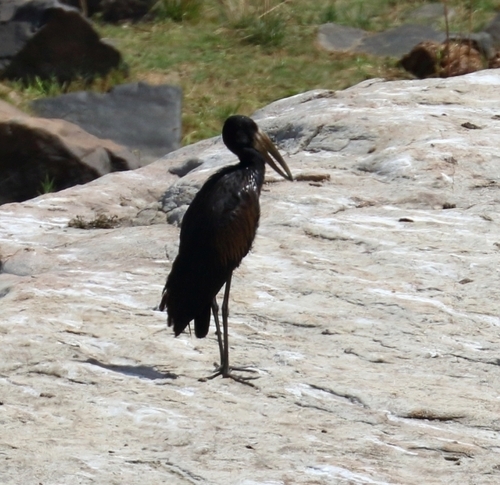
African Openbill (Anastomus lamelligerus) African Openbill

Abdim's Stork (Ciconia abdimii) Abdim's Stork

Media

Loading…

In short

The most reliable field mark to separate African Openbill from Abdim's Stork is the bill: African Openbill has a unique, strongly gapped bill with a visible opening between the mandibles, while Abdim's Stork shows a straight, normal stork bill. In flight or at rest, Abdim's Stork is easily picked out by its striking white belly and underwing coverts contrasting with otherwise dark plumage, whereas African Openbill is uniformly dark and iridescent with no white on the underparts. Both species occur widely in Sub-Saharan Africa, but their structure, feeding behavior, and plumage details are quite different. Juvenile and immature plumages are not described in detail for either species, so focus on adult and general field marks.

Identification tips

  1. Bill shape is diagnostic: African Openbill has a distinctive, gapped bill with a visible space between the mandibles (best seen from the side, especially when the bill is closed). Abdim's Stork has a straight, normal stork bill with no gap. This is the single most reliable field mark at any distance where the bill is visible.
  2. Underparts color: Abdim's Stork has bold white underparts and underwing coverts, creating a strong contrast with the dark upperparts and flight feathers. African Openbill is entirely dark, with no white on the belly or underwings. This is obvious in flight and when perched.
  3. Leg and foot color: Abdim's Stork shows grey legs with red knees and feet, especially obvious in breeding adults. African Openbill has dark legs without red highlights. This is best seen at close range or in good light.
  4. Facial skin: In breeding season, Abdim's Stork shows red skin in front of the eye and blue skin near the bill. African Openbill lacks any colored facial skin, remaining uniformly dark.
  5. Iridescence: African Openbill has a glossy, iridescent greenish sheen on wings and chest, especially in good light, due to its unique feather structure. Abdim's Stork is less glossy and lacks this greenish iridescence.
  6. Overall color impression: African Openbill appears uniformly dark and glossy at all ages. Abdim's Stork always shows a white belly and underwing, giving a two-toned black-and-white look.
  7. Flight profile: Both species soar with neck and head extended, but African Openbill is noted for its agility and acrobatic descents. Abdim's Stork is more likely to be seen gliding steadily over open country.
  8. Feeding behavior: African Openbill is often seen near water, probing for snails and molluscs. Abdim's Stork is more likely to be foraging for insects in open fields or grasslands.
  9. Habitat context: If seen in a wetland or along water, especially with snails present, suspect African Openbill. In dry, open country or agricultural fields, Abdim's Stork is more likely.
  10. Juvenile/immature confusion: No detailed information is available for immature plumages, but the presence or absence of white on the belly and underwing should remain reliable at all ages.
  11. Size impression: Abdim's Stork is the smallest stork and may appear more compact and lighter than African Openbill, but size alone is not a safe separator unless seen side by side.
  12. Leg color in flight: Red knees and feet of Abdim's Stork may be visible when legs are extended in flight; African Openbill's legs remain dark.
  13. No white in openbill: If you see any white on the belly or underwing, rule out African Openbill.
  14. No bill gap in Abdim's: If the bill appears straight and closed with no gap, rule out African Openbill.
  15. Contextual clues: Both species can occur together, but use a combination of bill shape, underpart color, and leg/facial skin color for confident identification.

Size

Abdim's Stork is the smallest stork species, measuring about 73 cm (29 in) and weighing just over 1 kg (2.2 lb) [wikipedia]. African Openbill is described as smaller than most storks but no precise measurements are given; both are medium-sized for storks, but Abdim's is notably more compact and lighter. In the field, both may appear similar in size, but Abdim's is distinctly slighter and less bulky than most other storks.

Plumage

Adult African Openbill is entirely dark with a glossy, iridescent greenish sheen on wings and chest, created by unique ribbon-like feathers. There is no white on the underparts or underwings. Abdim's Stork, by contrast, is black above but has prominent white underparts and underwing coverts, making a bold contrast in flight and when perched. Abdim's also shows red knees and feet, and in breeding season, red facial skin in front of the eye and blue skin near the bill. Juvenile and immature plumages are not described for either species, so these contrasts apply to adults and likely to older immatures as well. In all ages, the presence or absence of white on the belly and underwing is a key separator.

Behaviour

African Openbill is adapted for feeding on molluscs, especially snails, using its specialized gapped bill. It is agile in flight, capable of steep dives and acrobatics, and often soars on thermals. Abdim's Stork feeds mainly on insects and is more likely to be seen foraging in open habitats. Both species soar, but African Openbill is noted for its agility and acrobatic descents. Nestling behavior is described for African Openbill: young cover their food with wings and have flexible mandibles for swallowing large prey, but these behaviors are not field marks for older birds.

Habitat

Both species are widespread in Sub-Saharan Africa. African Openbill is patchily distributed but can be locally abundant, especially near wetlands and water bodies where molluscs are available. Abdim's Stork is found in open habitats, including grasslands and agricultural areas, and is also widespread but may be more likely away from water compared to African Openbill. Both can occur together, but context may help: Openbill is more tied to wetland edges, Abdim's to open country.

Submit a better description

Use the same sections as the comparison. Your text is published immediately.

The most reliable field mark to separate African Openbill from Abdim's Stork is the bill: African Openbill has a unique, strongly gapped bill with a visible opening between the mandibles, while Abdim's Stork shows a straight, normal stork bill. In flight or at rest, Abdim's Stork is easily picked out by its striking white belly and underwing coverts contrasting with otherwise dark plumage, whereas African Openbill is uniformly dark and iridescent with no white on the underparts. Both species occur widely in Sub-Saharan Africa, but their structure, feeding behavior, and plumage details are quite different. Juvenile and immature plumages are not described in detail for either species, so focus on adult and general field marks.

  1. Bill shape is diagnostic: African Openbill has a distinctive, gapped bill with a visible space between the mandibles (best seen from the side, especially when the bill is closed). Abdim's Stork has a straight, normal stork bill with no gap. This is the single most reliable field mark at any distance where the bill is visible.
  2. Underparts color: Abdim's Stork has bold white underparts and underwing coverts, creating a strong contrast with the dark upperparts and flight feathers. African Openbill is entirely dark, with no white on the belly or underwings. This is obvious in flight and when perched.
  3. Leg and foot color: Abdim's Stork shows grey legs with red knees and feet, especially obvious in breeding adults. African Openbill has dark legs without red highlights. This is best seen at close range or in good light.
  4. Facial skin: In breeding season, Abdim's Stork shows red skin in front of the eye and blue skin near the bill. African Openbill lacks any colored facial skin, remaining uniformly dark.
  5. Iridescence: African Openbill has a glossy, iridescent greenish sheen on wings and chest, especially in good light, due to its unique feather structure. Abdim's Stork is less glossy and lacks this greenish iridescence.
  6. Overall color impression: African Openbill appears uniformly dark and glossy at all ages. Abdim's Stork always shows a white belly and underwing, giving a two-toned black-and-white look.
  7. Flight profile: Both species soar with neck and head extended, but African Openbill is noted for its agility and acrobatic descents. Abdim's Stork is more likely to be seen gliding steadily over open country.
  8. Feeding behavior: African Openbill is often seen near water, probing for snails and molluscs. Abdim's Stork is more likely to be foraging for insects in open fields or grasslands.
  9. Habitat context: If seen in a wetland or along water, especially with snails present, suspect African Openbill. In dry, open country or agricultural fields, Abdim's Stork is more likely.
  10. Juvenile/immature confusion: No detailed information is available for immature plumages, but the presence or absence of white on the belly and underwing should remain reliable at all ages.
  11. Size impression: Abdim's Stork is the smallest stork and may appear more compact and lighter than African Openbill, but size alone is not a safe separator unless seen side by side.
  12. Leg color in flight: Red knees and feet of Abdim's Stork may be visible when legs are extended in flight; African Openbill's legs remain dark.
  13. No white in openbill: If you see any white on the belly or underwing, rule out African Openbill.
  14. No bill gap in Abdim's: If the bill appears straight and closed with no gap, rule out African Openbill.
  15. Contextual clues: Both species can occur together, but use a combination of bill shape, underpart color, and leg/facial skin color for confident identification.

Abdim's Stork is the smallest stork species, measuring about 73 cm (29 in) and weighing just over 1 kg (2.2 lb) [wikipedia]. African Openbill is described as smaller than most storks but no precise measurements are given; both are medium-sized for storks, but Abdim's is notably more compact and lighter. In the field, both may appear similar in size, but Abdim's is distinctly slighter and less bulky than most other storks.

Adult African Openbill is entirely dark with a glossy, iridescent greenish sheen on wings and chest, created by unique ribbon-like feathers. There is no white on the underparts or underwings. Abdim's Stork, by contrast, is black above but has prominent white underparts and underwing coverts, making a bold contrast in flight and when perched. Abdim's also shows red knees and feet, and in breeding season, red facial skin in front of the eye and blue skin near the bill. Juvenile and immature plumages are not described for either species, so these contrasts apply to adults and likely to older immatures as well. In all ages, the presence or absence of white on the belly and underwing is a key separator.

African Openbill is adapted for feeding on molluscs, especially snails, using its specialized gapped bill. It is agile in flight, capable of steep dives and acrobatics, and often soars on thermals. Abdim's Stork feeds mainly on insects and is more likely to be seen foraging in open habitats. Both species soar, but African Openbill is noted for its agility and acrobatic descents. Nestling behavior is described for African Openbill: young cover their food with wings and have flexible mandibles for swallowing large prey, but these behaviors are not field marks for older birds.

Both species are widespread in Sub-Saharan Africa. African Openbill is patchily distributed but can be locally abundant, especially near wetlands and water bodies where molluscs are available. Abdim's Stork is found in open habitats, including grasslands and agricultural areas, and is also widespread but may be more likely away from water compared to African Openbill. Both can occur together, but context may help: Openbill is more tied to wetland edges, Abdim's to open country.

Discard your changes?

You have unsaved edits. If you leave now, those changes will be lost.

African Openbill · Abdim's Stork · My Tricky Birds