

African Green-Pigeon vs Namaqua Sandgrouse
Treron calvus versus Pterocles namaqua
Play a quiz with African Green-Pigeon and Namaqua Sandgrouse
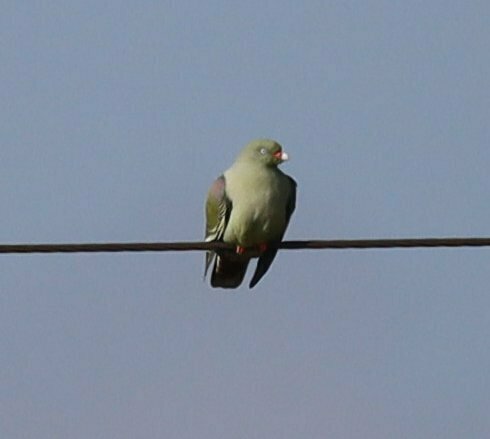 African Green-Pigeon
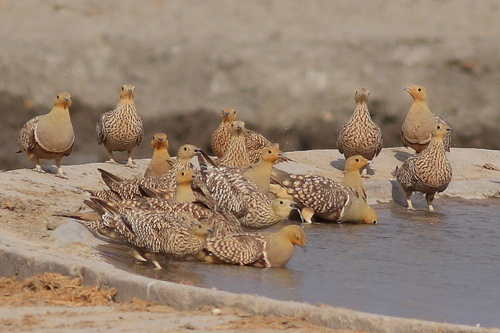 Namaqua Sandgrouse
In short
The most reliable field mark to separate African Green-Pigeon from Namaqua Sandgrouse is the combination of overall greenish plumage with maroon wing patches (adult green-pigeon) versus cryptic sandy-brown, white-speckled upperparts and two long black tail filaments (male sandgrouse). Juvenile green-pigeons are olive above and lack the maroon wing patch, but still appear greenish and lack the sandgrouse's speckled pattern and tail streamers. Structure and behavior are also highly distinctive: green-pigeons are arboreal, parrot-like climbers, while sandgrouse are ground-dwelling with a plump, short-legged look. Habitat is a strong clue—green-pigeons are in trees near water, sandgrouse in dry open country.
Identification tips
- Juvenile/immature plumage: Juvenile African Green-Pigeons are olive above, lack the adult maroon wing patch, but still appear greenish overall and never show the sandgrouse's speckled brown-and-white pattern or tail filaments. Juvenile sandgrouse are cryptic brown with white specks, never greenish.
- Adult wing pattern: Adult green-pigeons have a maroon patch on the upperwing, visible when perched or in flight. Sandgrouse never show maroon on the wing.
- Tail shape: Male Namaqua Sandgrouse have two long, black, filamentous tail streamers—unique and visible in flight or on the ground. Green-pigeons have a short, rounded tail with no streamers.
- Overall color: Green-pigeons are greenish to yellowish-green above, with yellow thighs and red feet/bill (bill tipped white). Sandgrouse are sandy to brown above, heavily speckled with white, and never greenish.
- Head and chest pattern (male sandgrouse): Males have orangish-buff head, throat, and chest, sharply separated by a narrow white and dark brown band. No green-pigeon shows this pattern.
- Leg and foot color: Green-pigeon has yellow thighs and red feet, often visible when perched. Sandgrouse legs are short and not brightly colored.
- Bill: Green-pigeon’s bill is red with a white tip; sandgrouse has a small, inconspicuous bill.
- Posture and structure: Green-pigeons perch upright in trees, often high in the canopy, and move with agility among branches. Sandgrouse are always on the ground, with a plump, squat profile and short legs.
- Flight style: Green-pigeons fly between trees with strong, direct flight but are usually seen perching or climbing. Sandgrouse fly in fast, direct flocks over open country, often to water.
- Habitat: Green-pigeons are in wooded areas, especially near fruiting trees; sandgrouse are in open, arid landscapes, never in forest or dense woodland.
- Feeding behavior: Green-pigeons feed on fruit in trees, rarely on the ground. Sandgrouse forage on the ground for seeds.
- Voice: Green-pigeon’s call is a flowing whistle ('thweeeloo, thweeeoo'); sandgrouse calls are not described here but are not whistled.
- Group behavior: Sandgrouse often gather in flocks, especially at water; green-pigeons may be in small groups but are less gregarious.
- Sex differences: Male sandgrouse are more strikingly marked than females or juveniles; green-pigeons are less sexually dimorphic.
- Common pitfalls: Immature green-pigeons lacking maroon wing patches may seem dull, but will never show sandgrouse’s speckled pattern or tail streamers. Sandgrouse, even at their greenest, are never truly green or yellowish, and never perch in trees.
Size
African Green-Pigeon is slightly heavier (202.5g) than Namaqua Sandgrouse (176g) [wikidata], but both are medium-sized birds and can appear similar in bulk at a distance. Sandgrouse reach about 28 cm in length, but the green-pigeon’s more compact, arboreal build contrasts with the sandgrouse’s longer, plumper, ground-dwelling profile. In the field, jizz and structure are more useful than size for separation.
Plumage
Juvenile African Green-Pigeons are olive above and lack the adult's maroon wing patch, but still show a uniform greenish cast and yellow thighs, with red feet and bill tipped white. Adults have grayish- to yellowish-green upperparts, yellow thighs, and distinctive maroon patches on the upperwing. In contrast, Namaqua Sandgrouse males have orangish-buff head, throat, and chest, sharply separated by a narrow white and dark brown band, with back and wings mottled brown and large white specks, plus two long black tail filaments. Females and juveniles are more cryptic, with brown and white-speckled upperparts but never greenish or maroon. No age or sex of sandgrouse shows green or maroon, and no green-pigeon shows sandgrouse-like speckling or tail streamers.
Behaviour
African Green-Pigeons are almost always seen in trees, often high in the canopy, moving with parrot-like agility to reach fruit. They rarely come to the ground. Namaqua Sandgrouse are strictly ground-dwelling, usually seen walking or running on open ground, often in groups, and never climbing in trees. Their flight is direct and fast, often in flocks, and they may fly long distances to water. Behavior alone is often enough to separate them if seen well.
Habitat
African Green-Pigeon is found in riparian forest, woodland, savanna, and even urban parks, always associated with fruiting trees. Namaqua Sandgrouse inhabits arid, open regions of southwestern Africa—deserts, semi-deserts, and dry plains, far from dense woodland or forest. If you are in a fruiting fig tree, expect green-pigeon; if you are in dry, open country, sandgrouse is far more likely.
Voice
African Green-Pigeon gives a series of flowing whistles, described as 'thweeeloo, thweeeoo'. No vocalization is described for Namaqua Sandgrouse in these notes, but sandgrouse generally have short, clipped calls quite unlike the green-pigeon’s whistles. If you hear a melodious whistle, it points to green-pigeon.