

African Grass-Owl vs African Scops Owl
Tyto capensis versus Otus senegalensis
Play a quiz with African Grass-Owl and African Scops Owl
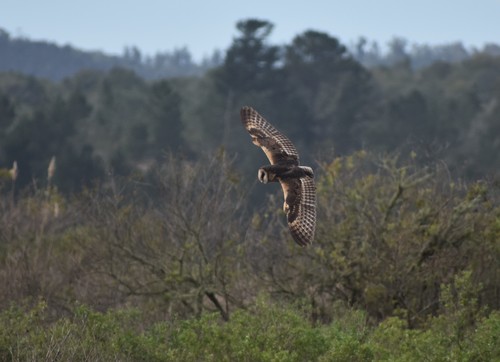 African Grass-Owl
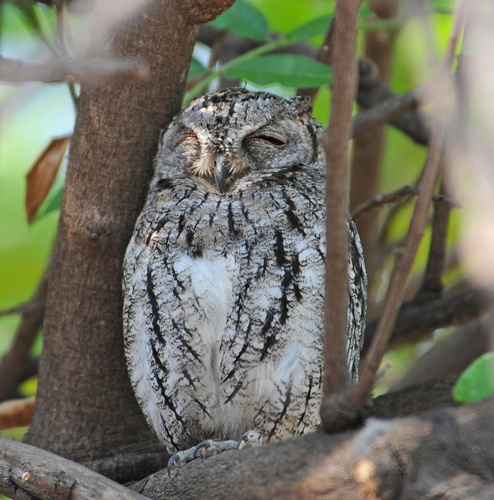 African Scops Owl
In short
The most reliable way to separate African Grass-Owl from African Scops Owl is by size and structure: Grass-Owl is much larger, with a long-legged, long-winged, and long-tailed silhouette, while Scops Owl is tiny, compact, and short-tailed. Grass-Owl has a striking heart-shaped white facial disc and dark eyes, whereas Scops Owl shows a smaller, rounder face with yellow eyes and often-visible ear tufts. In flight, Grass-Owl's wings and tail are broad and rounded, while Scops Owl's are short and narrow. Plumage is also a giveaway: Grass-Owl is sooty-black above with scattered white spots, while Scops Owl is cryptically streaked and mottled grey or rufous. Voice and habitat can help, but size and face pattern are the fastest field clues.
Identification tips
- Size is the fastest clue: Grass-Owl is more than twice the length of Scops Owl and much heavier. Even at a distance, Grass-Owl looks lanky and long-winged, while Scops Owl is tiny and compact. Size alone can rule out confusion in most field views.
- Facial disc shape and color: Grass-Owl has a large, heart-shaped, whitish-cream facial disc with a narrow yellowish-buff rim and dark spotting. Scops Owl has a smaller, rounder grey facial disc with a narrow black edge. The bold white face of Grass-Owl stands out, especially in low light.
- Eye color: Grass-Owl has dark brownish-black eyes; Scops Owl has striking yellow eyes. This is often visible in torchlight or close views.
- Ear tufts: Scops Owl has small ear tufts, usually kept flat but can be raised when alert or disturbed. Grass-Owl lacks ear tufts entirely. If you see tufts, it's not Grass-Owl.
- Upperparts pattern: Grass-Owl is uniformly sooty blackish-brown above with small white spots and grey flecks. Scops Owl is cryptically streaked and mottled in grey or rufous, blending into bark or leaves. The Grass-Owl's upperparts are much darker and less patterned.
- Underparts: Grass-Owl's underparts are whitish to buff with dark spots, while Scops Owl's are streaked and mottled, matching the cryptic upperparts.
- Wing and tail shape: Grass-Owl has long, broad wings and a relatively long, rounded tail. Scops Owl's wings and tail are short and rounded, giving a compact appearance in flight and when perched.
- Legs and stance: Grass-Owl has long, pale, feathered legs and often stands upright, sometimes appearing almost stilted. Scops Owl has much shorter legs and a squat, compact posture.
- Flight style: Grass-Owl flies with slow, buoyant wingbeats and glides low over grass. Scops Owl's flight is rapid, direct, and close to cover, with short bursts between trees.
- Habitat context: Grass-Owl is found in open grassland and marsh edges, rarely in trees. Scops Owl is found in woodland, savanna, and sometimes gardens, rarely in open grassland. The setting can be a strong clue.
- Voice: Grass-Owl screeches like a barn owl (but less harsh); Scops Owl gives a soft, repeated 'prrrp' or 'whu'. If you hear a screech, it's not Scops Owl.
- Bill color: Grass-Owl has a whitish to pale pink bill; Scops Owl's bill color is not distinctive in the notes, but this is a minor point.
- Sexual dimorphism: Grass-Owl females are larger than males, but both sexes are much larger than any Scops Owl.
- Juvenile/immature confusion: No specific juvenile or immature wing pattern marks are described for either species, so rely on structure and face pattern for all ages.
- Common pitfalls: At dusk or in poor light, Scops Owl's cryptic plumage may make it hard to see, while Grass-Owl's white face often catches the light. Beware of misjudging size if the bird is seen alone without a reference.
Size
African Grass-Owl is dramatically larger, measuring 38–42 cm in length with a wing length of 283–345 mm and weighing 355–520 g. In contrast, African Scops Owl is only 15–17 cm long, with a wingspan of about 45 cm and a much lighter build. Even at a distance, Grass-Owl appears lanky and long-winged, while Scops Owl is tiny, compact, and almost half the length of the Grass-Owl. This size difference is obvious in any direct comparison or when seen perched on similar-sized perches.
Plumage
No age-specific wing or flight pattern marks are described for either species, so focus is on overall plumage and facial features. Adult and immature African Grass-Owls are sooty blackish-brown above, with scattered small white spots and greyish flecks, and have a distinctive heart-shaped whitish-cream facial disc with a narrow yellowish-buff rim densely spotted dark. Their eyes are brownish-black. The underparts are whitish to buff with dark spots. The wings are pale brownish-grey with dark bars, and the tail is short with brown central feathers fading to paler outer feathers, showing about four dark bars. In contrast, African Scops Owl is cryptically marked in greyish-brown, sometimes pale rufous or warmer brown, with streaks and mottling for camouflage. Its facial disc is grey with a narrow black edge, and the eyes are yellow. Ear tufts are present and usually kept lowered, but can be raised when the bird is alert. Scops Owl's plumage is much more patterned for camouflage, lacking the bold white face and dark upperparts of Grass-Owl.
Behaviour
Grass-Owl often hunts by quartering low over grasslands, flying with slow, buoyant wingbeats and long glides, and may be seen perched on low posts or even on the ground. Its long legs and upright stance are distinctive when perched. Scops Owl is more strictly nocturnal and secretive, usually roosting close to tree trunks during the day, relying on its camouflage. When disturbed, it may elongate its body and raise its ear tufts to mimic a broken branch. In flight, Scops Owl is rapid and direct, with short, rounded wings and a short tail.
Habitat
African Grass-Owl is strongly associated with rank grasslands, marsh edges, and open country, often where grass is tall and dense. It avoids wooded areas. African Scops Owl, on the other hand, is a woodland species, found in savanna, open woodland, and sometimes gardens or wooded parks, but rarely in open grassland. Seeing an owl in open grassland strongly favors Grass-Owl, while one in a tree or woodland is more likely Scops Owl.
Voice
Grass-Owl gives a screeching call similar to Barn Owl, but less harsh, and a high-pitched sibilant tremolo (thought to be the male's song). Scops Owl has a very different voice, producing a soft, repeated 'prrrp' or 'whu' note at intervals, typical of scops owls. If you hear a classic barn-owl-like screech, it's Grass-Owl; if you hear a soft, tooting call, it's Scops Owl.