

steller's sea-eagle vs pigargo
Haliaeetus pelagicus versus Haliaeetus albicilla
Jogue um quiz com steller's sea-eagle e pigargo
 steller's sea-eagle
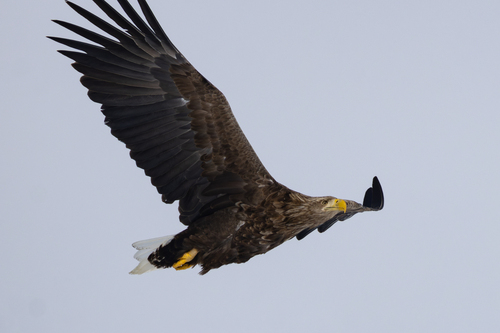 pigargo
Em resumo
A marca de campo mais confiável para separar o steller's sea-eagle do pigargo é o padrão branco marcante no adulto steller's: branco ousado nos ombros, coxas, coberturas de asa inferior e uma longa cauda branca em forma de diamante, em comparação com a cauda mais sutil, mais curta e em forma de cunha do pigargo e a plumagem marrom geralmente uniforme. As aves juvenis e imaturas são mais complicadas, mas o steller's é mais robusto, com um bico muito mais pesado e corpo mais escuro e uniforme. Em voo, o steller's exibe asas em forma de pá e uma cauda mais longa em forma de diamante, enquanto as asas do pigargo parecem mais quadradas e a cauda é mais curta. Sempre considere a idade, pois aves jovens de ambas as espécies podem parecer semelhantes, mas o steller's é, em geral, mais escuro e mais maciço, com um bico mais robusto.
Dicas de identificação
- O adulto steller's sea-eagle mostra manchas brancas ousadas nos ombros, coxas, coberturas de asa inferior e uma longa cauda branca em forma de diamante—esse padrão pied é único e diagnóstico em qualquer distância. Os adultos do pigargo são marrons no geral, com apenas a cauda branca, e a cauda é mais curta e em forma de cunha.
- O juvenil steller's sea-eagle é mais escuro e mais uniforme do que o juvenil pigargo, com um corpo marrom fuliginoso e apenas manchas claras em uma cauda predominantemente branca (preta na ponta). O juvenil pigargo é mais claro, com uma cauda bagunçada, creme acinzentado e contraste corporal mais variável.
- O steller's sea-eagle tem um bico muito mais maciço e profundo (amarelo brilhante em adultos, acinzentado em juvenis) em comparação com o bico amplo, mas mais fino do pigargo. Isso é frequentemente visível mesmo à distância.
- A forma da cauda em voo é uma pista forte: o steller's tem uma cauda mais longa, em forma de diamante; a cauda do pigargo é mais curta, em forma de cunha, e pode parecer atarracada em adultos.
- A forma da asa em voo: as asas do steller's são em forma de pá e mais largas, dando uma impressão pesada e desajeitada; as asas do pigargo são mais quadradas e profundamente divididas, com pelo menos seis 'dedos' visíveis nas pontas.
- A asa inferior do adulto steller's é marcadamente pied com manchas brancas, especialmente nas coberturas; a asa inferior do pigargo é mais uniforme marrom com menos contraste.
- Cor das pernas e pés: o adulto steller's tem pés e pernas amarelos brilhantes; os do pigargo variam de amarelo sujo (juvenil) a amarelo (adulto), mas menos vívidos.
- Cor da cabeça e pescoço: o adulto pigargo tem uma cabeça e pescoço pálidos, contrastando com o corpo marrom; o steller's tem cabeça escura em todas as plumagens, exceto por raras morfologias escuras, que são quase totalmente escuras.
- Cor do bico juvenil: o steller's é marrom escuro; o pigargo é metade marrom escuro, metade amarelo acinzentado ou pálido.
- Padrão da cauda juvenil: o steller's é predominantemente branco com preto na ponta; o pigargo é bagunçado, sujo e esbranquiçado com bordas pretas e, às vezes, listras.
- Postura empoleirada: o steller's parece mais robusto, mais ereto, e o bico parece enorme; o pigargo é grande, mas mais esguio e menos imponente.
- Postura em voo: o steller's é mais pesado, com batidas de asa mais lentas e profundas e um voo mais desajeitado; o pigargo ainda é ponderado, mas pode mostrar batidas de asa mais rápidas intercaladas com planagens.
- Contexto de habitat: se visto na Eurásia temperada, longe do Extremo Oriente Russo, é quase certamente um pigargo. No Extremo Oriente Russo, ambos podem ocorrer, mas o steller's domina habitats costeiros e ribeirinhos.
- A rara morfologia escura do steller's carece da maior parte do branco, exceto pela cauda, mas é extremamente rara; nesses casos, confie no tamanho, bico e estrutura.
- Progressão da idade: o steller's atinge a plumagem adulta entre 4 e 5 anos; o pigargo leva até 8 anos para ter uma cauda totalmente branca e cabeça pálida. O pigargo subadulto pode mostrar manchas brancas nas partes inferiores e na asa inferior, mas nunca o padrão pied ousado do adulto steller's.
Tamanho
O steller's sea-eagle é visivelmente maior e mais pesado do que o pigargo, com uma massa corporal média de cerca de 6675 g contra 4793 g [wikidata]. No campo, o steller's parece mais robusto e imponente, com um bico muito mais grosso e poderoso. Ambos são águias muito grandes, mas o steller's é a maior do gênero Haliaeetus, e essa diferença é frequentemente aparente mesmo à distância, especialmente quando empoleirados lado a lado ou vistos em voo juntos.
Plumagem
As aves juvenis e imaturas de ambas as espécies podem ser confusas, mas há diferenças-chave:
-
O juvenil steller's sea-eagle é predominantemente marrom escuro uniforme com listras acinzentadas ocasionais na cabeça e pescoço, bases de penas brancas e manchas claras na cauda (que é branca com manchas pretas na ponta). O bico é marrom escuro, as pernas são esbranquiçadas e os olhos são marrons escuros. O efeito geral é de uma ave muito escura, quase negra, com um bico maciço e uma cauda relativamente longa em forma de diamante. Os jovens steller's são mais escuros e mais uniformes do que os pigargos, e sua cauda é branca mais limpa com preto apenas na ponta, não bagunçada ou listrada.
-
O juvenil pigargo também é marrom escuro, mas tipicamente mais claro e mais variável, com uma cauda creme acinzentada desbotada que é marcada de forma bagunçada com bordas e pontas de penas acinzentadas, às vezes levemente listradas. A cabeça é marrom escura e uniforme, mas o corpo pode mostrar mais contraste e variação do que o steller's. O bico é metade marrom escuro, metade amarelo acinzentado ou pálido, e os pés são amarelos sujos. Os juvenis têm caudas mais longas do que os adultos, mas a cauda é mais curta e mais em forma de cunha do que a do steller's.
-
O adulto steller's sea-eagle é inconfundível: marrom escuro a preto no geral, com branco ousado nas coberturas superiores menores e medianas, coberturas de asa inferior, coxas, coberturas de cauda inferior e uma longa cauda branca em forma de diamante. O bico, os olhos e os pés são amarelos brilhantes. Morfologias escuras raras carecem da maior parte do branco, exceto pela cauda, mas são extremamente raras.
-
O adulto pigargo é marrom no geral, com uma cabeça e pescoço pálidos, e uma cauda branca curta em forma de cunha. As asas são largas e com pontas quadradas, e a asa inferior é menos contrastante do que a do steller's. O bico é grande, mas menos maciço do que o do steller's, e o amarelo é menos vívido.
-
Em voo: o steller's exibe asas em forma de pá e uma longa cauda em forma de diamante; o pigargo tem asas mais quadradas e uma cauda mais curta em forma de cunha. O padrão da asa inferior do steller's é mais marcadamente pied em adultos.
Comportamento
Ambas as espécies são águias poderosas e de voo lento que planam e deslizam com batidas de asa profundas e constantes. O steller's sea-eagle tende a parecer ainda mais pesado e desajeitado em voo, com asas mais largas e uma postura mais desajeitada. Quando empoleirado, o steller's parece mais robusto e ereto, com um bico enorme que é óbvio mesmo à distância. O pigargo empoleira-se em uma posição mais ereta em galhos ou rochas, mas no chão pode sentar-se mais horizontalmente. Ambas as espécies podem ser vistas caçando sobre a água ou empoleiradas perto de costas e rios, mas o steller's frequentemente parece mais dominante e imponente em reuniões de águias mistas.
Habitat
O pigargo é amplamente distribuído pela Eurásia temperada e é encontrado em uma variedade de habitats próximos a grandes corpos d'água, incluindo lagos, rios e áreas costeiras. O steller's sea-eagle é mais restrito ao Extremo Oriente Russo e regiões adjacentes, favorecendo áreas costeiras, foz de rios e estuários, especialmente no inverno. Ambas as espécies podem se sobrepor em partes do leste da Rússia, mas o steller's está mais associado a costas acidentadas e grandes sistemas fluviais, enquanto o pigargo é mais flexível em habitat. Em áreas mistas, o steller's é a águia maior e mais dominante.