

オオワシ 対 オジロワシ
Haliaeetus pelagicus 対 Haliaeetus albicilla
オオワシとオジロワシのクイズ
 オオワシ
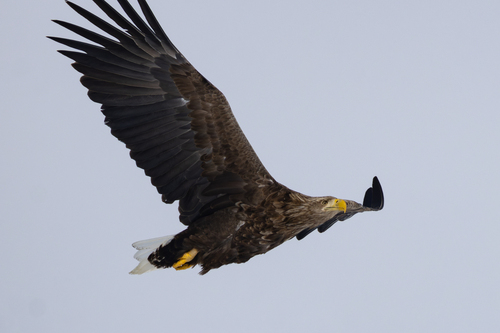 オジロワシ
要点
The most reliable field mark to separate Steller's Sea-Eagle from White-tailed Eagle is the striking white patterning on the adult Steller's: bold white on the shoulders, thighs, underwing coverts, and a long, diamond-shaped white tail, compared to the White-tailed Eagle's more subdued, shorter, wedge-shaped tail and generally uniform brown plumage. Juvenile and immature birds are trickier, but Steller's is bulkier, with a much heavier bill and darker, more uniform body. In flight, Steller's shows paddle-shaped wings and a longer, diamond-shaped tail, while White-tailed Eagle's wings look squarer and the tail is shorter. Always consider age, as young birds of both species can look similar, but Steller's is overall darker and more massive, with a stouter bill.
識別のコツ
- Adult Steller's Sea-Eagle shows bold white patches on the shoulders, thighs, underwing coverts, and a long, diamond-shaped white tail—this pied pattern is unique and diagnostic at any range. White-tailed Eagle adults are brown overall with only the tail white, and the tail is shorter and wedge-shaped.
- Juvenile Steller's Sea-Eagle is darker and more uniform than juvenile White-tailed Eagle, with a sooty-brown body and only light mottling on a mostly white tail (black at the tip). Juvenile White-tailed is paler, with a messy, greyish-cream tail and more variable body contrast.
- Steller's Sea-Eagle has a much more massive, deeper bill (bright yellow in adults, blackish in juveniles) compared to the ample but slimmer bill of White-tailed. This is often visible even at a distance.
- Tail shape in flight is a strong clue: Steller's has a longer, diamond-shaped tail; White-tailed's tail is shorter, wedge-shaped, and can look stubby in adults.
- Wing shape in flight: Steller's wings are paddle-shaped and broader, giving a heavy, lumbering impression; White-tailed's wings are squarer and deeply fingered, with at least six visible 'fingers' at the tips.
- Adult Steller's underwing is boldly pied with white patches, especially on the coverts; White-tailed's underwing is more uniform brown with less contrast.
- Leg and foot color: Adult Steller's has bright yellow feet and legs; White-tailed's are dirty yellow (juvenile) to yellow (adult), but less vivid.
- Head and neck color: Adult White-tailed Eagle has a pale head and neck, contrasting with the brown body; Steller's is dark-headed in all plumages except for rare dark morphs, which are almost entirely dark.
- Juvenile bill color: Steller's is blackish-brown; White-tailed is half dark brown, half dull yellowish or grey.
- Juvenile tail pattern: Steller's is mostly white with black at the tip; White-tailed is messy, dirty whitish with black edges and sometimes barring.
- Perched jizz: Steller's looks bulkier, more upright, and the bill appears huge; White-tailed is large but slimmer and less imposing.
- Flight jizz: Steller's is heavier, with slower, deeper wingbeats and a more lumbering flight; White-tailed is still ponderous but can show faster wingbeats interspersed with gliding.
- Habitat context: If seen in temperate Eurasia away from the Russian Far East, it is almost certainly White-tailed Eagle. In the Russian Far East, both may occur, but Steller's dominates coastal and riverine habitats.
- Rare dark morph Steller's lacks most white except the tail, but is extremely rare; in these cases, rely on size, bill, and structure.
- Age progression: Steller's reaches adult plumage by year 4–5; White-tailed takes up to 8 years for a fully white tail and pale head. Subadult White-tailed can show blotchy white on underparts and underwing, but never the bold pied pattern of adult Steller's.
大きさ
Steller's Sea-Eagle is noticeably larger and heavier than White-tailed Eagle, with an average body mass of about 6675 g versus 4793 g [wikidata]. In the field, Steller's appears bulkier and more imposing, with a much thicker, more powerful bill. Both are very large eagles, but Steller's is the largest Haliaeetus, and this difference is often apparent even at a distance, especially when perched side by side or seen in flight together.
羽色
Juvenile and immature birds of both species can be confusing, but there are key differences:
-
Juvenile Steller's Sea-Eagle is mostly uniform dark soot-brown with occasional grey-brown streaking on the head and neck, white feather bases, and light mottling on the tail (which is white with black mottling at the tip). The bill is blackish-brown, the legs are whitish, and the eyes are dark brown. The overall effect is a very dark, almost blackish bird with a massive bill and a relatively long, diamond-shaped tail. Young Steller's are darker and more uniform than White-tailed, and their tail is cleaner white with black only at the tip, not messy or barred.
-
Juvenile White-tailed Eagle is also dark brown but typically paler and more variable, with a washed-out greyish-cream tail that is messily marked with blackish feather edges and tips, sometimes faintly barred. The head is blackish-brown and uniform, but the body can show more contrast and variation than Steller's. The bill is half dark brown, half dull yellowish or grey, and the feet are dirty yellow. Juveniles are longer-tailed than adults, but the tail is shorter and more wedge-shaped than Steller's.
-
Adult Steller's Sea-Eagle is unmistakable: dark brown to black overall, with bold white on the lesser and median upperwing coverts, underwing coverts, thighs, under-tail coverts, and a long, diamond-shaped white tail. The bill, eyes, and feet are bright yellow. Rare dark morphs lack most white except the tail, but are extremely rare.
-
Adult White-tailed Eagle is brown overall with a pale head and neck, and a short, wedge-shaped white tail. The wings are broad and square-tipped, and the underwing is less contrasting than Steller's. The bill is large but less massive than Steller's, and the yellow is less vivid.
-
In flight: Steller's shows paddle-shaped wings and a long, diamond-shaped tail; White-tailed has squarer wings and a shorter, wedge-shaped tail. The underwing pattern of Steller's is more strikingly pied in adults.
行動
Both species are powerful, slow-flying eagles that soar and glide with deep, steady wingbeats. Steller's Sea-Eagle tends to look even more ponderous and heavy in flight, with broader wings and a more lumbering jizz. When perched, Steller's appears bulkier and more upright, with a huge bill that is obvious even at a distance. White-tailed Eagle perches in a more upright position on branches or rocks, but on the ground may sit more horizontally. Both species can be seen hunting over water or perched near coasts and rivers, but Steller's often appears more dominant and imposing in mixed eagle gatherings.
生息環境
White-tailed Eagle is widely distributed across temperate Eurasia and is found in a range of habitats near large bodies of water, including lakes, rivers, and coastal areas. Steller's Sea-Eagle is more restricted to the Russian Far East and adjacent regions, favoring coastal areas, river mouths, and estuaries, especially in winter. Both species can overlap in parts of eastern Russia, but Steller's is more associated with rugged coasts and large river systems, while White-tailed is more flexible in habitat. In mixed areas, Steller's is the larger, more dominant eagle.