

scarlet-chested sunbird vs southern double-collared sunbird
Chalcomitra senegalensis versus Cinnyris chalybeus
Jogue um quiz com scarlet-chested sunbird e southern double-collared sunbird
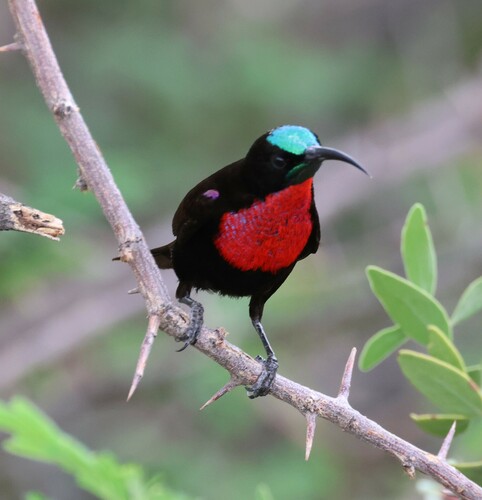 scarlet-chested sunbird
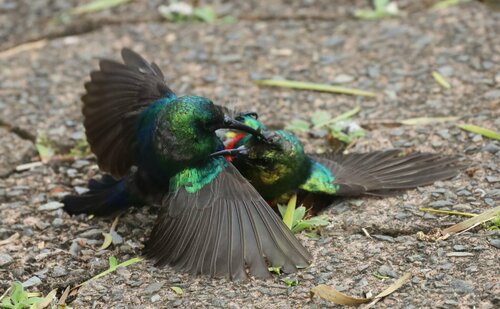 southern double-collared sunbird
Em resumo
A marca de campo mais confiável entre o scarlet-chested sunbird e o southern double-collared sunbird é o padrão e a extensão do vermelho no peito do macho: o scarlet-chested apresenta um peito escarlate amplo e ininterrupto, enquanto o southern double-collared tem uma faixa vermelha mais estreita, nitidamente contornada acima por uma linha azul metálica e abaixo por branco. As fêmeas de ambos são marrons por cima, mas as fêmeas do southern double-collared são mais claras e acinzentadas por baixo, enquanto as fêmeas do scarlet-chested são mais escuras e mais uniformemente marrons. As diferenças estruturais são sutis, mas o southern double-collared é ligeiramente menor e mais compacto. Os pássaros imaturos se assemelham às fêmeas, então o tom das partes inferiores e o padrão do peito são fundamentais. Ambas as espécies se sobrepõem no sul da África, mas o southern double-collared é mais localizado no extremo sul.
Dicas de identificação
- O padrão do peito do macho é o separador mais claro: Machos do scarlet-chested sunbird têm um peito escarlate amplo e sólido, sem borda azul; machos do southern double-collared mostram uma faixa de peito vermelha muito mais estreita, nitidamente contornada acima por uma linha azul metálica e abaixo por branco. Isso é mais confiável em pássaros empoleirados em boa luz.
- Cor da cabeça e do peito superior nos machos: Machos do scarlet-chested têm uma coroa verde e peito superior, enquanto machos do southern double-collared têm cabeça, garganta e peito superior verde metálico, mas o verde é interrompido pelas faixas de peito azul e vermelha.
- Cor das partes inferiores das fêmeas: Fêmeas do scarlet-chested são marrons escuras por cima e por baixo, sem supercílios. Fêmeas do southern double-collared são marrons por cima, mas distintamente mais claras e amareladas-acinzentadas por baixo. Use essa diferença ao observar fêmeas ou imaturos.
- Semelhança juvenil: Os juvenis do southern double-collared sunbird se parecem com a fêmea—marrons por cima, amareladas-acinzentadas por baixo. Juvenis do scarlet-chested não são descritos em detalhes, mas espere que se assemelhem à fêmea mais escura e mais uniformemente marrom.
- Sem padrão de asa ou voo distintivo: Nenhuma das espécies tem uma marca de asa ou voo única para imaturos ou adultos, então concentre-se na coloração do corpo e das partes inferiores.
- Tamanho e estrutura: O scarlet-chested é ligeiramente maior e mais pesado, mas a sobreposição de tamanho é considerável. O southern double-collared é mais compacto, mas isso é sutil e melhor usado como evidência de apoio.
- Formato do bico: Ambos têm bicos longos e curvados, típicos dos sunbirds, sem diferença significativa observada entre essas duas espécies.
- Habitat e distribuição: Se você estiver no extremo sul da África, ambos são possíveis, mas o southern double-collared é mais provável. Em outras partes da África Subsaariana, o scarlet-chested é o padrão.
- Comportamento: Ambas as espécies se alimentam de néctar e insetos, frequentemente empoleirando-se para se alimentar. O southern double-collared pode pairar brevemente, mas isso não é diagnóstico.
- Vocalizações: Se você ouvir uma canção aguda e tilintante ou um chamado 'chee-chee', isso indica southern double-collared. A voz do scarlet-chested não é descrita aqui.
- Tufts nos ombros (machos em exibição): Machos do southern double-collared podem mostrar tufos de penas amarelas nos ombros ao exibir, o que o scarlet-chested não faz.
- Supercílios: Nenhuma fêmea de ambas as espécies tem um supercílios forte, mas o scarlet-chested é especificamente notado como não tendo um.
- Contraste das partes inferiores: O southern double-collared tem um contraste nítido entre a faixa vermelha do peito e a barriga branca, enquanto as partes inferiores do scarlet-chested são mais uniformemente coloridas nos machos.
- Tamanho do grupo: Ambos são geralmente vistos sozinhos ou em pequenos grupos; a aglomeração não ajuda a separá-los.
- Estação e muda: Nenhuma diferença de plumagem sazonal ou relacionada à muda é descrita que ajude a separar essas duas espécies.
Tamanho
O scarlet-chested sunbird é ligeiramente maior, medindo 13–15 cm de comprimento, enquanto o southern double-collared sunbird tem cerca de 12 cm. A massa corporal média para o southern double-collared é em torno de 8,0 g, o que se enquadra na faixa inferior dos machos do scarlet-chested (7,5–17,2 g) e fêmeas (6,8–15,3 g), mas o scarlet-chested pode ser visivelmente mais pesado na extremidade superior. No campo, essa diferença de tamanho é sutil e muitas vezes mascarada pela postura ou distância, mas o scarlet-chested pode parecer um pouco mais longo e mais robusto.
Plumagem
- Machos adultos: Machos do scarlet-chested sunbird têm um peito escarlate amplo e vívido e uma coroa verde iridescente, com o vermelho se estendendo por todo o peito em uma mancha sólida. Machos do southern double-collared sunbird têm cabeça, garganta e peito superior verde metálico, mas seu vermelho é uma faixa muito mais estreita atravessando o peito, nitidamente separada do verde acima por uma fina linha azul metálica e da barriga branca abaixo.
- Fêmeas e juvenis: Ambos são marrons por cima, mas fêmeas do scarlet-chested são marrons escuras, sem sobrancelha pálida ou supercílios, e são mais uniformemente marrons por baixo. Fêmeas do southern double-collared são mais claras, com partes inferiores amareladas-acinzentadas, e juvenis se assemelham à fêmea. O southern double-collared é distintamente mais acinzentado por baixo do que o scarlet-chested, que é mais uniformemente escuro.
- Padrão de voo/asa: Nenhum padrão de asa ou voo específico para idade é descrito para qualquer uma das espécies, então a separação depende da coloração do corpo e das partes inferiores.
Comportamento
Ambas as espécies são alimentadoras ativas de néctar, frequentemente vistas sozinhas ou em pequenos grupos. O southern double-collared sunbird é notado por um voo rápido e direto em asas curtas e frequentemente se empoleira para se alimentar, embora possa pairar brevemente como um beija-flor. O comportamento do scarlet-chested sunbird é semelhante, frequentando jardins e bordas de florestas, mas nenhuma diferença comportamental única é notada que separaria confiavelmente no campo.
Habitat
O scarlet-chested sunbird é amplamente distribuído pela África Subsaariana, habitando florestas e jardins até 2.400 metros. O southern double-collared sunbird é mais restrito ao sul da África, reproduzindo-se no extremo sul e sendo principalmente residente, com alguma migração parcial no nordeste de sua distribuição. Se você estiver fora do extremo sul da África, o scarlet-chested é muito mais provável. Ambas as espécies usam jardins e habitats de borda, então o contexto é útil, mas não definitivo.
Voz
O southern double-collared sunbird emite um chamado 'chee-chee' forte e uma canção aguda e tilintante que dura de 3 a 5 segundos ou mais. Nenhuma vocalização distintiva é descrita para o scarlet-chested sunbird nas notas fornecidas, então a voz não é um separador confiável, a menos que a canção do southern double-collared seja ouvida.
scarlet-chested sunbird · southern double-collared sunbird · Minhas aves difíceis