

Scarlet-chested Sunbird vs Southern Double-collared Sunbird
Chalcomitra senegalensis contro Cinnyris chalybeus
Fai un quiz con Scarlet-chested Sunbird e Southern Double-collared Sunbird
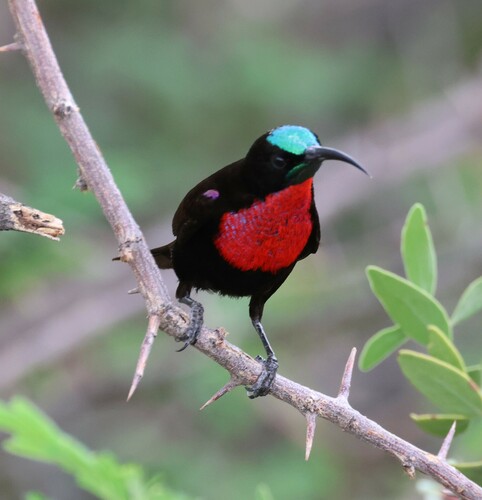 Scarlet-chested Sunbird
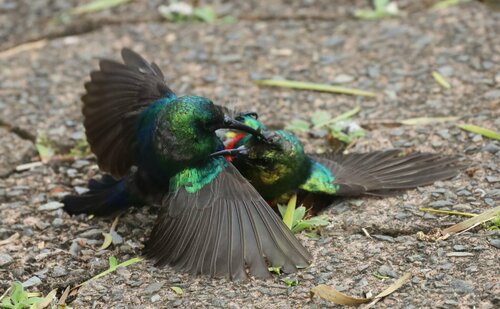 Southern Double-collared Sunbird
In breve
The most reliable field mark between Scarlet-chested Sunbird and Southern Double-collared Sunbird is the pattern and extent of red on the male's chest: Scarlet-chested shows a broad, uninterrupted scarlet breast, while Southern Double-collared has a narrower red band sharply bordered above by a metallic blue line and below by white. Females of both are brown above, but Southern Double-collared females are paler and greyer below, while Scarlet-chested females are darker and more uniformly brown. Structural differences are subtle, but Southern Double-collared is slightly smaller and more compact. Immature birds resemble females, so underpart tone and chest pattern are key. Both species overlap in southern Africa, but Southern Double-collared is more localized to the far south.
Consigli di identificazione
- Male chest pattern is the clearest separator: Scarlet-chested Sunbird males have a broad, solid scarlet breast with no blue border; Southern Double-collared males show a much narrower red chest band, sharply bordered above by a metallic blue line and below by white. This is most reliable on perched birds in good light.
- Head and upper breast color in males: Scarlet-chested males have a green crown and upper breast, while Southern Double-collared males have a metallic green head, throat, and upper breast, but the green is interrupted by the blue and red chest bands.
- Female underpart color: Scarlet-chested females are dark brown above and below with no supercilium. Southern Double-collared females are brown above but distinctly paler and yellowish-grey below. Use this difference when viewing females or immatures.
- Juvenile resemblance: Juvenile Southern Double-collared Sunbirds look like the female—brown above, yellowish-grey below. Scarlet-chested juveniles are not described in detail, but expect them to resemble the darker, more uniformly brown female.
- No distinctive wing or flight pattern: Neither species has a unique upperwing or flight mark for immatures or adults, so focus on body and underpart coloration.
- Size and structure: Scarlet-chested is slightly larger and heavier, but size overlap is considerable. Southern Double-collared is more compact, but this is subtle and best used as supporting evidence.
- Bill shape: Both have long, decurved bills typical of sunbirds, with no major difference noted between these two species.
- Habitat and range: If you are in the far south of Africa, both are possible, but Southern Double-collared is more likely. Elsewhere in Sub-Saharan Africa, Scarlet-chested is the default.
- Behavior: Both species feed on nectar and insects, often perching to feed. Southern Double-collared may hover briefly, but this is not diagnostic.
- Vocalizations: If you hear a high-pitched, tinkling song or 'chee-chee' call, it points to Southern Double-collared. Scarlet-chested's voice is not described here.
- Shoulder tufts (displaying males): Southern Double-collared males can show yellow feather tufts on the shoulders when displaying, which Scarlet-chested does not.
- Supercilium: Neither species' female has a strong supercilium, but Scarlet-chested is specifically noted as lacking one.
- Underpart contrast: Southern Double-collared has a sharp contrast between the red chest band and the white belly, while Scarlet-chested's underparts are more uniformly colored in males.
- Group size: Both are usually seen singly or in small groups; flocking does not help separate them.
- Season and molt: No seasonal or molt-related plumage differences are described that help separate these two species.
Taglia
Scarlet-chested Sunbird is slightly larger, measuring 13–15 cm in length, while Southern Double-collared Sunbird is about 12 cm. The average body mass for Southern Double-collared is around 8.0 g, which falls within the lower range of Scarlet-chested males (7.5–17.2 g) and females (6.8–15.3 g), but Scarlet-chested can be noticeably heavier at the upper end. In the field, this size difference is subtle and often masked by posture or distance, but Scarlet-chested may appear a bit longer and heavier-bodied.
Piumaggio
- Adult males: Scarlet-chested Sunbird males have a broad, vivid scarlet breast and an iridescent green crown, with the red extending across the whole chest in a solid patch. Southern Double-collared Sunbird males have a metallic green head, throat, and upper breast, but their red is a much narrower band across the chest, sharply separated from the green above by a thin metallic blue line, and from the white belly below.
- Females and juveniles: Both are brown above, but Scarlet-chested females are dark brown with no pale eyebrow or supercilium and are more uniformly brown below. Southern Double-collared females are paler, with yellowish-grey underparts, and juveniles resemble the female. The Southern Double-collared is distinctly greyer below than Scarlet-chested, which is more uniformly dark.
- Flight/wing pattern: No distinctive age-specific upperwing or flight pattern is described for either species, so separation relies on body and underpart coloration.
Comportamento
Both species are active nectar feeders, often seen singly or in small groups. Southern Double-collared Sunbird is noted for a fast, direct flight on short wings and often perches to feed, though it can hover briefly like a hummingbird. Scarlet-chested Sunbird's behavior is similar, frequenting gardens and woodland edges, but no unique behavioral differences are noted that would reliably separate them in the field.
Habitat
Scarlet-chested Sunbird is widespread across Sub-Saharan Africa, inhabiting woodlands and gardens up to 2,400 meters. Southern Double-collared Sunbird is more restricted to southern Africa, breeding in the far south and being mainly resident, with some partial migration in the northeast of its range. If you are outside the far south of Africa, Scarlet-chested is much more likely. Both species use gardens and edge habitats, so context is helpful but not definitive.
Voce
Southern Double-collared Sunbird gives a hard 'chee-chee' call and a high-pitched, tinkling song lasting 3–5 seconds or more. No distinctive vocalization is described for Scarlet-chested Sunbird in the provided notes, so voice is not a reliable separator unless Southern Double-collared's song is heard.
Scarlet-chested Sunbird · Southern Double-collared Sunbird · I miei uccelli difficili