

Suimanga Pechiescarlata vs Suimanga Acerado
Chalcomitra senegalensis frente a Cinnyris chalybeus
Juega un quiz con Suimanga Pechiescarlata y Suimanga Acerado
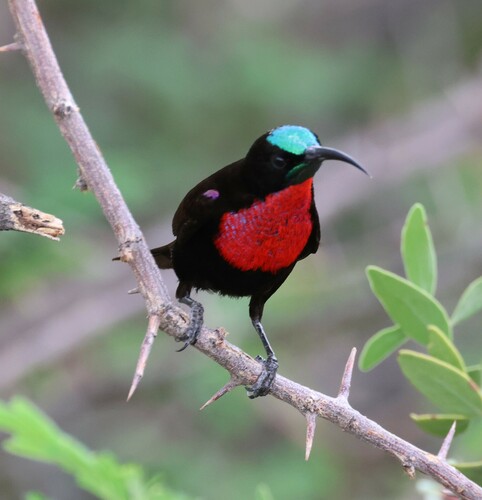 Suimanga Pechiescarlata
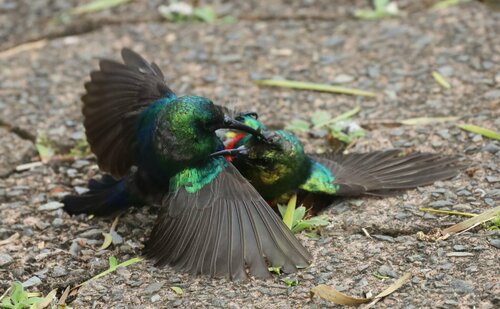 Suimanga Acerado
En breve
La marca de campo más confiable entre el Suimanga Pechiescarlata y el Suimanga Acerado es el patrón y la extensión de rojo en el pecho del macho: el Suimanga Pechiescarlata muestra un pecho escarlata amplio e ininterrumpido, mientras que el Suimanga Acerado tiene una banda roja más estrecha, claramente delimitada arriba por una línea azul metálica y abajo por blanco. Las hembras de ambos son marrones por encima, pero las hembras del Suimanga Acerado son más pálidas y grises por debajo, mientras que las hembras del Suimanga Pechiescarlata son más oscuras y de color marrón más uniforme. Las diferencias estructurales son sutiles, pero el Suimanga Acerado es ligeramente más pequeño y compacto. Las aves inmaduras se asemejan a las hembras, por lo que el tono de las partes inferiores y el patrón del pecho son clave. Ambas especies se superponen en el sur de África, pero el Suimanga Acerado es más localizado en el extremo sur.
Consejos de identificación
- El patrón del pecho del macho es el separador más claro: Los machos del Suimanga Pechiescarlata tienen un pecho escarlata amplio y sólido sin borde azul; los machos del Suimanga Acerado muestran una banda de pecho roja mucho más estrecha, claramente delimitada arriba por una línea azul metálica y abajo por blanco. Esto es más confiable en aves posadas con buena luz.
- Color de la cabeza y el pecho superior en machos: Los machos del Suimanga Pechiescarlata tienen una corona verde y un pecho superior, mientras que los machos del Suimanga Acerado tienen una cabeza, garganta y pecho superior verde metálico, pero el verde está interrumpido por las bandas de pecho azul y roja.
- Color de las partes inferiores de las hembras: Las hembras del Suimanga Pechiescarlata son de color marrón oscuro por encima y por debajo sin supercilio. Las hembras del Suimanga Acerado son marrones por encima pero claramente más pálidas y amarillentas-grises por debajo. Usa esta diferencia al observar hembras o inmaduros.
- Semejanza juvenil: Los juveniles del Suimanga Acerado se parecen a la hembra: marrones por encima, amarillentos-grises por debajo. Los juveniles del Suimanga Pechiescarlata no se describen en detalle, pero se espera que se asemejen a la hembra más oscura y de color marrón más uniforme.
- Sin patrón de alas o vuelo distintivo: Ninguna de las especies tiene una marca de ala o vuelo única para inmaduros o adultos, así que enfócate en la coloración del cuerpo y las partes inferiores.
- Tamaño y estructura: El Suimanga Pechiescarlata es ligeramente más grande y pesado, pero la superposición de tamaño es considerable. El Suimanga Acerado es más compacto, pero esto es sutil y se utiliza mejor como evidencia de apoyo.
- Forma del pico: Ambos tienen picos largos y curvados típicos de los suimangas, sin que se note una diferencia importante entre estas dos especies.
- Hábitat y distribución: Si estás en el extremo sur de África, ambas son posibles, pero el Suimanga Acerado es más probable. En otras partes de África subsahariana, el Suimanga Pechiescarlata es el predeterminado.
- Comportamiento: Ambas especies se alimentan de néctar e insectos, a menudo posándose para alimentarse. El Suimanga Acerado puede flotar brevemente, pero esto no es diagnóstico.
- Vocalizaciones: Si escuchas una canción aguda y tintineante o un llamado 'chee-chee', apunta al Suimanga Acerado. La voz del Suimanga Pechiescarlata no se describe aquí.
- Mechones en los hombros (machos en exhibición): Los machos del Suimanga Acerado pueden mostrar mechones de plumas amarillas en los hombros al exhibirse, lo cual el Suimanga Pechiescarlata no hace.
- Supercilio: Ninguna de las hembras de las especies tiene un supercilio fuerte, pero se señala específicamente que el Suimanga Pechiescarlata carece de uno.
- Contraste de las partes inferiores: El Suimanga Acerado tiene un contraste agudo entre la banda roja del pecho y el vientre blanco, mientras que las partes inferiores del Suimanga Pechiescarlata son de color más uniforme en los machos.
- Tamaño del grupo: Ambas se ven generalmente solas o en pequeños grupos; el agrupamiento no ayuda a separarlas.
- Temporada y muda: No se describen diferencias de plumaje relacionadas con la temporada o la muda que ayuden a separar estas dos especies.
Tamaño
El Suimanga Pechiescarlata es ligeramente más grande, midiendo de 13 a 15 cm de longitud, mientras que el Suimanga Acerado mide alrededor de 12 cm. La masa corporal promedio para el Suimanga Acerado es de alrededor de 8.0 g, que se encuentra dentro del rango inferior de los machos del Suimanga Pechiescarlata (7.5–17.2 g) y las hembras (6.8–15.3 g), pero el Suimanga Pechiescarlata puede ser notablemente más pesado en el extremo superior. En el campo, esta diferencia de tamaño es sutil y a menudo está enmascarada por la postura o la distancia, pero el Suimanga Pechiescarlata puede parecer un poco más largo y con un cuerpo más pesado.
Plumaje
- Machos adultos: Los machos del Suimanga Pechiescarlata tienen un pecho escarlata amplio y vívido y una corona verde iridiscente, con el rojo extendiéndose por todo el pecho en un parche sólido. Los machos del Suimanga Acerado tienen una cabeza, garganta y pecho superior verde metálico, pero su rojo es una banda mucho más estrecha a través del pecho, separada claramente del verde arriba por una delgada línea azul metálica, y del vientre blanco abajo.
- Hembras y juveniles: Ambos son marrones por encima, pero las hembras del Suimanga Pechiescarlata son de color marrón oscuro sin ceja pálida o supercilio y son más uniformemente marrones por debajo. Las hembras del Suimanga Acerado son más pálidas, con partes inferiores amarillentas-grises, y los juveniles se asemejan a la hembra. El Suimanga Acerado es claramente más gris por debajo que el Suimanga Pechiescarlata, que es más uniformemente oscuro.
- Patrón de vuelo/alas: No se describe un patrón de alas o vuelo específico por edad para ninguna de las especies, por lo que la separación depende de la coloración del cuerpo y las partes inferiores.
Comportamiento
Ambas especies son alimentadoras activas de néctar, a menudo vistas solas o en pequeños grupos. El Suimanga Acerado es conocido por un vuelo rápido y directo en alas cortas y a menudo se posa para alimentarse, aunque puede flotar brevemente como un colibrí. El comportamiento del Suimanga Pechiescarlata es similar, frecuentando jardines y bordes de bosques, pero no se notan diferencias de comportamiento únicas que separen de manera confiable en el campo.
Hábitat
El Suimanga Pechiescarlata es común en toda África subsahariana, habitando bosques y jardines hasta 2,400 metros. El Suimanga Acerado está más restringido al sur de África, reproduciéndose en el extremo sur y siendo principalmente residente, con alguna migración parcial en el noreste de su rango. Si estás fuera del extremo sur de África, el Suimanga Pechiescarlata es mucho más probable. Ambas especies utilizan jardines y hábitats de borde, por lo que el contexto es útil pero no definitivo.
Voz
El Suimanga Acerado emite un llamado fuerte 'chee-chee' y una canción aguda y tintineante que dura de 3 a 5 segundos o más. No se describe ninguna vocalización distintiva para el Suimanga Pechiescarlata en las notas proporcionadas, por lo que la voz no es un separador confiable a menos que se escuche la canción del Suimanga Acerado.
Suimanga Pechiescarlata · Suimanga Acerado · Mis aves difíciles