

choquinha-lisa vs slaty antwren
Dysithamnus mentalis versus Myrmotherula schisticolor
Jogue um quiz com choquinha-lisa e slaty antwren
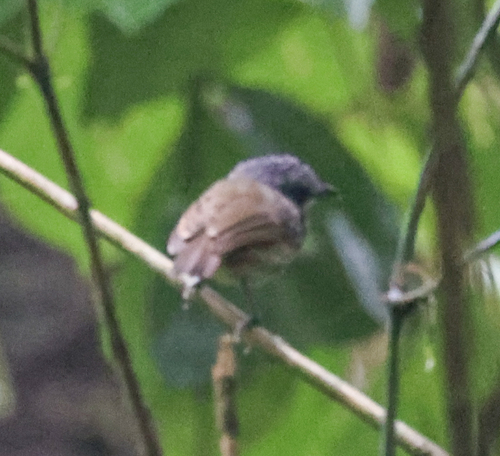 choquinha-lisa
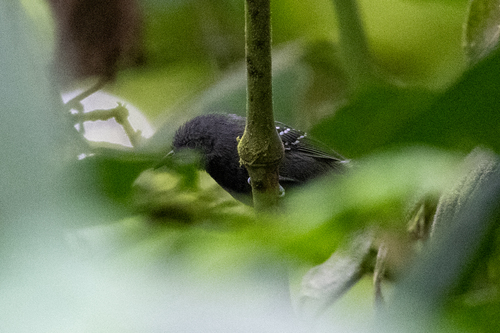 slaty antwren
Em resumo
A maneira mais confiável de separar a choquinha-lisa do slaty antwren é pela sua estrutura e plumagem: a choquinha-lisa é mais robusta, com uma cabeça maior e cauda mais curta, enquanto o slaty antwren é visivelmente menor e mais esbelto. Os machos de ambas as espécies são principalmente cinzas, mas o macho do antwren tem uma garganta e parte superior do peito pretas, e o macho da choquinha-lisa apresenta uma garganta manchada de branco e tons mais oliva. As fêmeas são mais complicadas, mas as fêmeas da choquinha-lisa são mais quentes e mais oliva ou canela por cima, enquanto as fêmeas do antwren são mais cinzas por cima, com uma garganta canela pálida e partes inferiores canela-tawny. Em voo ou empoleiradas, verifique o tamanho menor e a construção mais delicada do antwren em comparação com a aparência robusta da choquinha-lisa. Ambas podem mostrar coberturas de asas com pontas brancas, mas o equilíbrio geral de cores e a estrutura são fundamentais. Ambas as espécies se sobrepõem amplamente na América Central e no norte da América do Sul, portanto, uma observação cuidadosa é necessária.
Dicas de identificação
- A estrutura é fundamental: A choquinha-lisa é mais robusta, com uma cabeça grande e cauda curta, enquanto o slaty antwren é menor, mais esbelto e mais delicado. Esta é frequentemente a pista mais rápida em campo, especialmente em bandos mistos.
- Garganta e peito do macho: O macho do slaty antwren tem uma garganta e parte superior do peito pretas, contrastando com o cinza do resto do corpo. O macho da choquinha-lisa tem uma garganta e parte superior do peito brancas com manchas cinzas claras, não pretas sólidas.
- Partes superiores do macho: Os machos da choquinha-lisa são oliva cinzentos por cima, frequentemente com uma mancha branca oculta nas escápulas. Os machos do antwren são mais uniformemente cinza escuro, com uma mancha branca oculta no ombro.
- Coroa e partes superiores da fêmea: A fêmea da choquinha-lisa tem uma coroa canela-tawny e partes superiores mais oliva. A fêmea do slaty antwren é oliva cinzenta por cima, com uma cauda mais marrom e asas mais marrons com bordas ruivas.
- Partes inferiores da fêmea: A fêmea da choquinha-lisa tem mais amarelo abaixo, enquanto a fêmea do antwren tem uma garganta canela pálida e partes inferiores canela-tawny, tornando-se marrom amarelado no crissum.
- Coberturas de asas: Ambas as espécies podem mostrar coberturas de asas com pontas brancas, mas as do antwren estão em um fundo de asa mais escuro e cinza, enquanto as da choquinha-lisa estão em um fundo mais oliva.
- Padrão da cauda: Ambas têm caudas escuras com algumas brancas, mas a cauda do antwren é mais curta e tem bordas brancas finas; a da choquinha-lisa é mais longa e tem pontas brancas estreitas.
- Bico e cabeça: A choquinha-lisa tem uma cabeça proporcionalmente maior e um bico mais pesado, dando uma aparência mais robusta. O bico do antwren é mais fino e a cabeça menor.
- Comportamento: O antwren é mais ativo, frequentemente se movendo rapidamente pela folhagem, enquanto a choquinha-lisa é mais deliberada e frequentemente fica parada por períodos mais longos.
- Diferenças sexuais: Ambas as espécies mostram dimorfismo sexual, mas a fêmea do antwren é mais cinza e mais canela abaixo, enquanto a fêmea da choquinha-lisa é mais oliva e amarela.
- Variação de subespécies: Esteja ciente de que ambas as espécies têm subespécies com diferenças sutis, mas os principais contrastes acima se aplicam à maior parte de sua distribuição.
- Mancha branca nas escápulas/ombros: Ambas podem mostrar uma mancha branca oculta entre as escápulas/ombros, portanto, isso não é diagnóstico por si só.
- Armadilhas de plumagem: Em luz fraca, o cinza e o preto do antwren podem parecer oliva, e o oliva da choquinha-lisa pode parecer cinza—use a estrutura e a cor da garganta como respaldo.
- Sobreposição de habitat: Ambas as espécies ocorrem em habitats semelhantes, portanto, não confie apenas na localização ou no contexto.
- Tamanho em bandos mistos: Quando ambas estão presentes, a diferença de tamanho e aparência é marcante— a choquinha-lisa é mais volumosa e mais lenta, o antwren é menor e mais ativo.
Tamanho
choquinha-lisa is distinctly larger and heavier (10–13 cm, 12–16 g) than Slaty Antwren (9–12 cm, 8.5–10 g) [wikipedia][wikidata]. In the field, the antvireo looks chunkier, with a noticeably larger head and thicker body, while the antwren is more petite and slim. The antwren's tail is proportionally shorter, making it appear even smaller and more delicate. When seen together, the size and bulk difference is obvious, but with a single bird, use structure as much as length.
Plumagem
No distinctive juvenile or immature upperwing pattern is described for either species, so focus on adult and sex differences.
Adult males: choquinha-lisa males have a dark gray forehead and crown, blackish ear coverts, grayish olive upperparts, and a white-spotted throat and upper breast. Their wings are dark grayish olive with olive edges and white-tipped coverts, and the tail is dark grayish olive with narrow white tips. Slaty Antwren males are mostly dark gray, with a hidden white shoulder patch, black throat and upper breast, and dark gray tail with thin white edges. Their wings are dark gray with white-tipped coverts.
Adult females: choquinha-lisa females have a cinnamon-tawny crown, more olive upperparts and wings, and more extensive yellow on the underparts. They lack the white interscapular patch. Slaty Antwren females are grayish olive above with a browner tail, browner wings with rufous edges, a pale cinnamon throat, olive-brown sides/flanks, and tawny-cinnamon underparts that become yellowish brown on the crissum.
Subspecific variation exists in both, but the above covers the main contrasts. Both species can show white-tipped wing coverts, but the antwren's overall gray and black (male) or gray and cinnamon (female) palette is distinct from the antvireo's olive and yellow tones.
Comportamento
Ambas as espécies forrageiam em vegetação densa, frequentemente no sub-bosque ou sub-bosque, e podem se juntar a bandos de espécies mistas. O slaty antwren é especialmente ativo, frequentemente visto coletando insetos e aranhas de folhas e vinhas, às vezes saindo para capturar presas. A choquinha-lisa é mais robusta e se move de forma mais deliberada, frequentemente empoleirando-se em silêncio e fazendo pequenos saltos ou saídas. O antwren pode forragear mais alto (até 12 m), mas geralmente está entre 1–6 m acima do solo. Ambas podem se juntar a bandos mistos, mas o antwren é mais provável de ser visto em pequenos grupos ou pares, enquanto a choquinha-lisa é frequentemente em pares ou sozinha.
Habitat
Ambas as espécies se sobrepõem amplamente em distribuição, ocorrendo do México através da América Central até o norte da América do Sul. Ambas preferem sub-bosques densos e úmidos, bordas e crescimento secundário. Não há uma separação forte de habitat nas notas, portanto, o contexto não é confiável para separação onde ambas ocorrem.