

nicaraguan seed-finch vs variable seedeater
Sporophila nuttingi versus Sporophila corvina
Jogue um quiz com nicaraguan seed-finch e variable seedeater
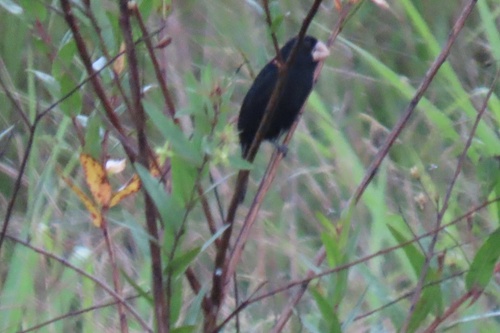 nicaraguan seed-finch
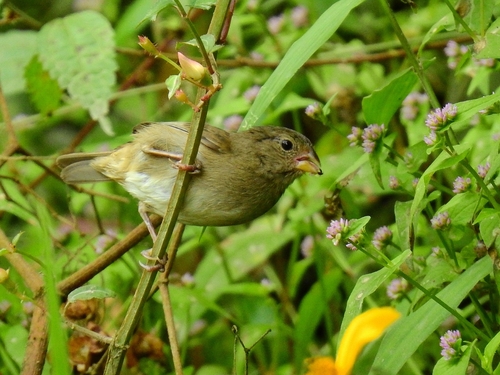 variable seedeater
Em resumo
A marca de campo mais confiável entre nicaraguan seed-finch e variable seedeater é o bico: nicaraguan seed-finch tem um bico maciço, de base profunda e pálido (de marfim a rosa) em machos adultos, enquanto variable seedeater sempre apresenta um bico menor e menos profundo que é escuro em ambos os sexos. O macho adulto de nicaraguan seed-finch é totalmente preto com um bico pálido impressionante, enquanto os machos de variable seedeater variam por subespécie, mas frequentemente mostram branco nas asas ou partes inferiores e sempre têm um bico escuro. Fêmeas e juvenis de ambas as espécies são acastanhados, mas o seed-finch é de um marrom mais rico e mais robusto, enquanto as fêmeas de variable seedeater são mais pálidas e mais oliva, às vezes com um tom amarelado. Pássaros imaturos são especialmente complicados, mas o tamanho e a cor do bico, juntamente com pistas sutis de plumagem e estrutura, são fundamentais.
Dicas de identificação
- Tamanho e cor do bico (todas as idades): Nicaraguan seed-finch tem um bico muito grande, de base profunda e pálido (de marfim a rosa) em machos adultos; fêmeas têm um bico escuro com uma base de marfim rosado. Variable seedeater sempre tem um bico menor, menos profundo e escuro em ambos os sexos e todas as idades. Esta é a marca de campo mais confiável em todas as estações.
- Branco nas asas (todas as idades): Variable seedeater (todas as subespécies, ambos os sexos, todas as idades) mostra forros brancos nas asas em voo, e em muitos machos, um pequeno especulo branco (mancha) é visível mesmo quando empoleirado. Nicaraguan seed-finch nunca mostra branco nas asas ou forros das asas—suas asas são uniformemente escuras.
- Plumagem do macho adulto: Machos de nicaraguan seed-finch são totalmente pretos com um bico pálido e sem branco em lugar algum. Machos de variable seedeater variam: S. c. corvina é todo preto, mas com um bico escuro e branco nas asas; outras subespécies têm branco na barriga, rabo ou garganta. Sempre verifique se há branco e a cor do bico.
- Cor de fêmea/juvenil: Fêmeas e juvenis de nicaraguan seed-finch são mais escuras, com um marrom mais rico acima e abaixo, às vezes canela profunda, com um bico mais pesado. Fêmeas e juvenis de variable seedeater são mais pálidas, mais oliva-marrom, e frequentemente mostram um leve tom amarelo abaixo (especialmente em S. c. hoffmannii, hicksii, ophthalmica). Seu bico é sempre menor e escuro.
- Tamanho e estrutura: Seed-finch é visivelmente maior e mais robusto, com um bico pesado e de base profunda e um corpo robusto. Variable seedeater é menor, mais delicado e compacto, com um bico proporcionalmente menor.
- Visões em voo: Fique atento a forros brancos nas asas ou uma mancha branca na asa em variable seedeater quando o pássaro voa ou agita suas asas. Nicaraguan seed-finch não tem branco nas asas—isso é especialmente útil para imaturos e fêmeas.
- Postura empoleirada: Seed-finch frequentemente parece desproporcional ou pesado na frente devido ao seu bico maciço, enquanto variable seedeater é mais proporcionalmente equilibrado.
- Variação de subespécies em variable seedeater: Esteja ciente de que alguns machos de variable seedeater (hoffmannii, hicksii, ophthalmica) mostram branco extenso nas partes inferiores ou garganta, nunca igualado por seed-finch. No entanto, machos de S. c. corvina são todos pretos, então a cor do bico e o padrão das asas se tornam críticos.
- Confusão juvenil: Os juvenis de ambas as espécies são acastanhados, mas verifique o tamanho e a cor do bico, e procure por branco nas asas (presente apenas em variable seedeater). Juvenis de seed-finch são sempre mais robustos e de um marrom mais rico.
- Dimorfismo sexual: Ambas as espécies são dimórficas sexualmente, mas o contraste é mais acentuado em seed-finch (macho todo preto, fêmea marrom) do que em variable seedeater, onde a fêmea é sempre mais pálida e mais oliva.
- Abundância/contexto local: Onde ambas ocorrem, variable seedeater é geralmente mais numeroso e disseminado, mas não confie nisso para identificação.
- Confusão taxonômica: Ambas as espécies têm histórias taxonômicas complexas e podem parecer semelhantes, especialmente em plumagens imaturas. Sempre priorize o tamanho/cor do bico e o padrão das asas sobre a impressão geral de cor.
- Nenhuma diferença vocal forte observada nas fontes: Use pistas visuais primeiro.
- Armadilhas: Machos de variable seedeater totalmente pretos (S. c. corvina) podem ser confundidos com machos de seed-finch, mas o bico é sempre escuro e menor em variable seedeater, e marcas brancas nas asas estão presentes. Por outro lado, seed-finch nunca mostra branco nas asas ou partes inferiores, e seu bico é sempre pálido em machos adultos.
- Quando em dúvida: Se o pássaro é acastanhado e não tem branco óbvio nas asas, concentre-se no tamanho e na cor do bico. Se o bico parecer maciço e de base pálida, é seed-finch; se for pequeno e escuro, é variable seedeater.
Tamanho
Nicaraguan seed-finch é distintamente maior e mais pesado (14–14,5 cm, ~24 g) do que variable seedeater, que é menor e mais leve (não especificado aqui, mas sempre visivelmente mais pequeno em comparação direta) [wikipedia]. O seed-finch parece mais robusto e mais forte no geral, especialmente devido ao seu bico maciço, enquanto variable seedeater tem uma construção mais delicada e compacta.
Plumagem
- Juvenis/imaturos: Os juvenis de ambas as espécies se assemelham às suas respectivas fêmeas, mas os juvenis de nicaraguan seed-finch são de um marrom mais rico no geral, com uma cabeça e partes superiores mais escuras, e um bico mais pesado e de base mais pálida (escuro com base de marfim rosado). Os juvenis de variable seedeater são mais pálidos, mais oliva-marrom, e têm um bico menor e mais escuro. Em voo, variable seedeater (todas as idades) mostra forros brancos nas asas e, em algumas subespécies, uma pequena mancha branca na asa; nicaraguan seed-finch não possui essas características brancas nas asas, mostrando asas uniformemente escuras com apenas teias internas cinzentas escuras nas primárias em machos.
- Machos adultos: Nicaraguan seed-finch é totalmente preto com um bico de marfim a rosa. Machos de variable seedeater variam: S. c. corvina é todo preto com um bico escuro e um pequeno especulo branco na asa e forros brancos nas asas; outras subespécies têm branco na barriga, rabo ou garganta, mas sempre mantêm um bico escuro. O seed-finch nunca mostra branco nas asas ou partes inferiores.
- Fêmeas adultas: Fêmeas de seed-finch são marrons escuras acima e abaixo, às vezes canela profunda, com um bico escuro e uma base de marfim rosado. Fêmeas de variable seedeater são oliva-marrom acima, mais pálidas abaixo, e geralmente têm um leve tom amarelo abaixo em algumas subespécies; seu bico é sempre escuro e menor.
- Chave em voo: Forros brancos nas asas e/ou mancha branca na asa em variable seedeater (todas as idades/sexos) estão ausentes em nicaraguan seed-finch.
Comportamento
Ambas as espécies são seedeaters e frequentemente forrageiam em habitats semelhantes de ervas daninhas ou gramados, às vezes em pequenos grupos. Nicaraguan seed-finch pode parecer mais deliberado e pesado em seus movimentos, combinando com sua construção mais robusta, enquanto variable seedeater é mais ativo e ágil. Nenhuma separação comportamental forte é observada nas fontes.
Habitat
Ambas as espécies se sobrepõem em alcance na Costa Rica e Panamá, favorecendo habitats abertos, gramados ou de ervas daninhas, frequentemente perto de água ou áreas perturbadas [wikipedia]. Nicaraguan seed-finch é mais localizado, principalmente na Nicarágua e regiões adjacentes, enquanto variable seedeater é amplamente distribuído do sul do México através da América Central até o noroeste da América do Sul. O habitat sozinho não é diagnóstico onde os alcances se sobrepõem.
nicaraguan seed-finch · variable seedeater · Minhas aves difíceis