

isthmian wren vs bay wren
Cantorchilus elutus versus Cantorchilus nigricapillus
Jogue um quiz com isthmian wren e bay wren
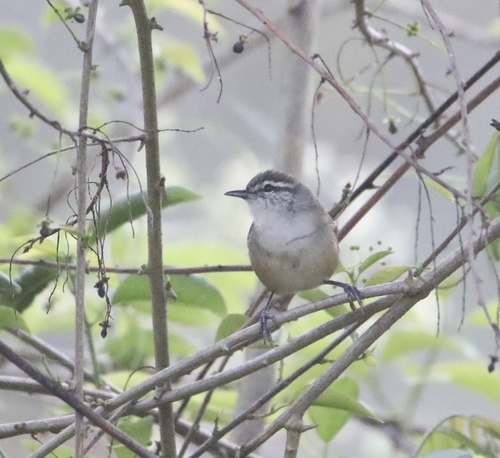 isthmian wren
 bay wren
Em resumo
The most reliable field mark to separate Isthmian Wren from Bay Wren is the head and upperpart coloration: Isthmian Wren shows a gray-brown crown and back with a pale russet rump, while Bay Wren has a striking black crown and face with rich chestnut upperparts. Bay Wren also features bold black barring on the underparts and tail, which is much less pronounced or absent in Isthmian Wren. Both species are similar in size and shape, but Bay Wren appears slightly heavier and more robust. Juvenile Bay Wrens resemble adults but are paler and less distinctly marked, while Isthmian Wren juveniles are not described in detail but are likely to lack the strong contrast of Bay Wren. Habitat overlap is significant in Costa Rica and Panama, so careful attention to plumage is essential.
Dicas de identificação
- Head and Crown Color (All Ages): Bay Wren has a black crown and face with a narrow white supercilium and white cheek patch; Isthmian Wren has a gray-brown crown and back, thin white supercilium, and mottled cheeks. This is the most immediate and reliable field mark.
- Upperparts (Adults): Bay Wren shows rich chestnut upperparts, sharply contrasting with the black crown and face. Isthmian Wren is more uniformly gray-brown above, with a pale russet rump but no chestnut mantle.
- Tail Pattern (All Ages): Bay Wren's tail is rich brown with bold black bars; Isthmian Wren's tail is russet brown with finer, less obvious barring.
- Underpart Barring (Adults): Bay Wren has strong black barring from the breast to the vent, including the flanks and lower belly. Isthmian Wren lacks this, showing mostly pale grayish underparts with buffy cinnamon flanks and little to no barring.
- Cheek Patch (Adults): Bay Wren has a distinct white patch at the back of the cheek, aiding quick separation. Isthmian Wren's cheeks are mottled and lack a clear white patch.
- Juvenile Plumage: Juvenile Bay Wrens are paler but still show the same pattern as adults, with some barring and facial contrast. Juvenile Isthmian Wrens are not described, but expect them to lack the bold contrast and barring of Bay Wren juveniles.
- Supercilium: Both species have a white supercilium, but it is narrower and more sharply defined in Bay Wren, especially against the black face.
- Size and Structure: Bay Wren is slightly heavier and more robust, but this is subtle and unreliable in the field unless birds are side by side.
- Habitat Preference: In areas of overlap, Bay Wren is more likely in dense thickets near water, while Isthmian Wren can occur in dense vegetation away from water. Use this only as a supporting clue.
- Song: Bay Wren's song is loud, rapid, and musical, with clear, ringing whistles and trills. If you hear this, suspect Bay Wren, but absence of song is not diagnostic.
- Nesting Behavior: Not useful for field ID, but Bay Wren's nests are often elbow-shaped with an entrance tube, while Isthmian Wren's are football-shaped with a side entrance. Only relevant if you find a nest and can see the birds attending.
- Flank Color: Isthmian Wren shows buffy cinnamon flanks, while Bay Wren's flanks are rufous brown and often barred.
- Face Pattern: Bay Wren's face is strikingly black with a white patch, while Isthmian Wren's is more subdued and mottled.
- Overall Impression: Bay Wren appears more boldly patterned and contrasting, while Isthmian Wren is plainer and more blended in appearance.
- Pitfalls: In poor light or quick views, the black crown and face of Bay Wren may look dark brown, and the barring may be missed. Always look for the combination of head pattern, underpart barring, and cheek patch for confirmation.
Tamanho
Both species are similar in length, with Isthmian Wren measuring 12.5–14 cm and Bay Wren 12.6–15.6 cm. However, Bay Wren is typically heavier (mean body mass about 23.9 g) and may appear slightly more robust in the field. This difference is subtle and not always reliable at a glance, especially when birds are fluffed or in dense cover.
Plumagem
- Juveniles: Bay Wren juveniles are paler versions of adults, with the same pattern but less sharply defined markings. Isthmian Wren juveniles are not specifically described, but based on adult plumage, they likely lack the bold contrast and barring of Bay Wren.
- Adults: Isthmian Wren shows a gray-brown crown and back, pale russet rump, and russet-brown tail with fine dark bars. The face is less contrasting, with a thin white supercilium and mottled cheeks. Underparts are mostly pale grayish with buffy cinnamon flanks and sides, and little to no barring. Bay Wren adults have a black crown and face, narrow white supercilium, white cheek patch, and rich chestnut upperparts. The tail is rich brown with bold black bars. Underparts are white on the throat and breast, rufous brown on the belly and flanks, and heavily barred black from breast to vent. This barring is a key field mark for Bay Wren and is absent or faint in Isthmian Wren.
Comportamento
Both species are active, skulking wrens that forage in dense vegetation, often low to the ground. Bay Wren is particularly tied to tangled thickets and vine tangles, especially near water, and may be more likely to be seen probing or gleaning in wet or riparian habitats. Isthmian Wren also favors dense vegetation but is not as closely associated with water. Both species may be difficult to see well, so brief views are common.
Habitat
Isthmian Wren is found in Costa Rica and Panama, typically in dense vegetation up to 3 meters above the ground. Bay Wren overlaps in this region but has a broader range extending from Nicaragua to Ecuador. Bay Wren is closely tied to watercourses, overgrown clearings, and dense thickets, especially where undergrowth is lush. In areas of overlap, Bay Wren is more likely near water or in vine tangles, while Isthmian Wren may be found in a wider range of dense habitats, not strictly riparian.
Voz
Bay Wren has a loud, rapid, and musical song made up of clear, ringing whistles, trills, and warbles, often delivered antiphonally. The vocalizations of Isthmian Wren are not described here, so song is not a reliable separation unless Bay Wren's distinctive, rich-toned song is heard. If you hear a rapid, ringing, and complex wren song, suspect Bay Wren, but do not rely solely on voice for separation in this pair.