

harris's sparrow vs leconte's sparrow
Zonotrichia querula versus Ammospiza leconteii
Jogue um quiz com harris's sparrow e leconte's sparrow
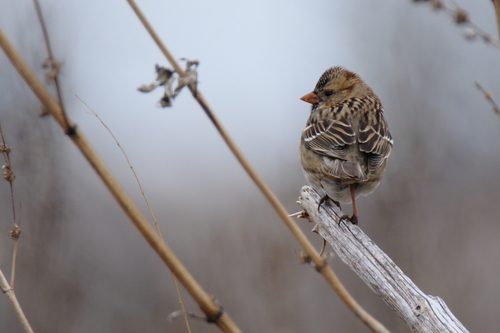 harris's sparrow
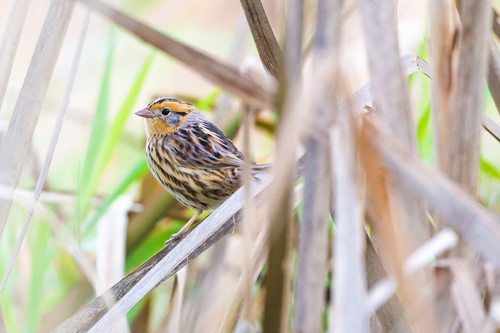 leconte's sparrow
Em resumo
A maneira mais confiável de separar o harris's sparrow do leconte's sparrow é pelo tamanho e pela estrutura geral: o harris's é muito maior e mais robusto, com um bico rosa pesado, enquanto o leconte's é pequeno e delicado, com um bico cinza curto. Em todas as plumagens, o harris's apresenta um rosto e um babador pretos marcantes (especialmente nos adultos), enquanto o leconte's tem um rosto laranja-amarelado com bochechas cinzas e uma faixa central branca na coroa. Os harris's imaturos podem ser confusos, mas ainda mostram uma construção maior e mais robusta e mais preto nas partes inferiores do que qualquer leconte's. O leconte's prefere ficar escondido na grama, enquanto o harris's é mais provável de ser visto empoleirado. Se você ver um pardal com um bico rosa grande e preto óbvio no rosto ou na garganta, é um harris's; se for um pardal pequeno e redondo com um rosto laranja-amarelado e uma faixa branca na coroa, é um leconte's.
Dicas de identificação
- Size is the fastest check: Harris's Sparrow is much larger and heavier than LeConte's. If the bird looks chunky and big for a sparrow, it's Harris's; if it's tiny and round, it's LeConte's. This works for all ages and seasons.
- Bill shape and color: Harris's has a large, conical, pink bill (all ages); LeConte's has a short, gray bill. Bill color is especially obvious in adults but size is always helpful.
- Face and throat pattern: Adult Harris's shows a bold black crown, face, throat, and upper breast, contrasting with gray sides of the head. LeConte's never shows black on the face or throat; instead, look for a buffy yellow-orange face with gray cheeks and a white central crown stripe (all ages).
- Immature/juvenile confusion: Immature Harris's can show less black, but still has a white chin/throat, black malar stripe, and a broad, smudgy black breast-band. LeConte's never shows a black malar or breast-band, instead has a clean buffy-orange face and streaked sides. If you see any black on the throat or breast, it's Harris's.
- Crown stripe: LeConte's always has a white central crown stripe bordered by dark brown, visible in all plumages. Harris's crown is black in adults, brownish with black streaks in juveniles, but never shows a clean white central stripe.
- Underparts: Harris's adults have white underparts with black on upper breast and some black mottling on flanks; immatures have more extensive black below. LeConte's has off-white belly and buffy orange-yellow breast/sides with brown streaks, never black.
- Back and wing bars: Harris's has a brown back with heavy black streaking and two white wing bars. LeConte's has a back streaked brown and beige, but no distinct wing bars.
- Tail: Harris's has a long tail; LeConte's has a short, pointed tail. In flight or perched, tail length is a useful clue.
- Posture and behavior: Harris's is often seen perched up, sometimes in flocks, and is not strictly ground-dwelling. LeConte's is secretive, stays low in dense grass, and rarely perches in the open except when singing.
- Habitat: Harris's is found in brushy edges, open woodlands, and fields, especially in winter. LeConte's is restricted to dense grasslands and weedy fields, rarely venturing into open or shrubby areas.
- Song: Harris's sings clear, whistled phrases from high perches; LeConte's song is a buzzy, insect-like trill, often delivered from within grass. If you hear a grasshopper-like buzz, it's LeConte's; clear whistles point to Harris's.
- Seasonal change: Harris's loses some black in non-breeding plumage, becoming more buffy and brown, but still shows a larger size and bill. LeConte's is similar year-round.
- Flock context: Harris's may join mixed sparrow flocks in winter and is often the largest sparrow present. LeConte's is usually solitary or in small groups, always in thick grass.
- Flight flush: LeConte's typically flushes from the ground, flies low, and drops quickly into cover. Harris's is less likely to flush this way and more likely to be seen flying between perches or feeding openly.
- When in doubt: If you see a sparrow with a pink bill and any black on the face or throat, it's Harris's. If it's tiny, round, with a buffy face and white crown stripe, and no black, it's LeConte's.
Tamanho
O harris's sparrow é dramaticamente maior que o leconte's sparrow. O harris's mede de 17 a 20 cm de comprimento, com uma envergadura de cerca de 27 cm e uma massa corporal variando de 26 a 49 g [wikipedia], tornando-se o maior pardal da América do Norte. O leconte's sparrow é um dos menores pardais, com apenas 12 cm de comprimento, 18 cm de envergadura e 13,8 g de massa [wikidata]. No campo, o harris's parece grande, corpulento e de cauda longa, enquanto o leconte's é pequeno, redondo e de cauda curta. Mesmo à distância ou em bandos mistos, a diferença de tamanho é impressionante.
Plumagem
- Juvenil/Imaturo: O juvenil harris's sparrow mostra uma coroa acastanhada listrada de preto e finas listras escuras abaixo, além de algumas marcas pretas mais largas na parte inferior. Os imaturos têm um queixo e garganta brancos, uma faixa malar preta e uma faixa peitoral preta larga e borrada. Os juvenis e imaturos do leconte's não são descritos em detalhes, mas todas as idades mostram um rosto laranja-amarelado com bochechas cinzas, uma coroa marrom escura com uma faixa central branca e um dorso listrado. Nenhuma idade do leconte's mostra preto no rosto ou na garganta.
- Adulto (Reprodução): Os adultos do harris's sparrow têm uma coroa, rosto, garganta e peito superior pretos marcantes, um bico rosa, lados da cabeça e pescoço cinzas, costas listradas de marrom e duas faixas brancas nas asas. As partes inferiores são brancas com algumas manchas pretas nas laterais. Os adultos do leconte's têm um rosto laranja-amarelado, bochechas cinzas, coroa marrom escura com uma faixa central branca, nuca lilás-cinza com listras castanhas e um dorso listrado de marrom/bege. As partes inferiores são off-white na barriga, laranja-amarelado no peito/lados com listras marrons.
- Adulto (Não-reprodução): O harris's torna-se mais laranja-amarelado e marrom, com preto reduzido na cabeça e na garganta, às vezes com escamas brancas. O leconte's permanece semelhante durante todo o ano.
- Padrão das asas em voo: Nenhum padrão distintivo de asa superior ou de voo é descrito para qualquer uma das espécies que seja diagnóstico para idade ou espécie.
Comportamento
O harris's sparrow é frequentemente visto empoleirado em arbustos ou árvores, especialmente quando canta ou em bandos de inverno. Pode ser encontrado em áreas abertas, mas não é estritamente terrestre. O leconte's sparrow é secreto, preferindo ficar escondido em gramíneas altas e densas, e raramente é visto empoleirado em aberto, exceto quando canta de um caule de grama. O harris's é mais provável de se juntar a bandos mistos de pardais e ser visível, enquanto o leconte's é mais provável de se levantar do chão e voltar para a cobertura.
Habitat
O harris's sparrow se reproduz no norte central do Canadá e inverna nas Grandes Planícies centrais (sul de Dakota do Sul até o Texas central), frequentemente em florestas abertas, bordas arbustivas e campos. O leconte's sparrow se reproduz em pastagens do norte e inverna no sul dos EUA, sempre favorecendo gramíneas densas e altas ou campos infestados de ervas daninhas. Se você encontrar um pardal em pastagem aberta ou pradaria, especialmente se ele se levantar do chão e desaparecer na cobertura, é mais provável que seja um leconte's. O harris's é mais provável de estar em habitats arbustivos, de borda ou florestais e é mais conspícuo.
Voz
O harris's sparrow canta uma série de assobios claros, altos e vacilantes, às vezes seguidos por outra série em um tom diferente, e emite um forte chamado metálico 'chink', além de um trinado musical. O canto do leconte's sparrow é um zumbido semelhante ao de um gafanhoto, com uma nota curta e estridente no início e um curto piar no final (tika-zzzzzzzzzzzz-tik), e seu chamado é um curto 'tsip'. O canto do harris's é musical e assobiado, enquanto o do leconte's é semelhante a um inseto e zumbido. O leconte's frequentemente canta de posições ocultas na grama, enquanto o harris's canta de altos poleiros.