

graveteiro vs cochicho
Phacellodomus ruber versus Anumbius annumbi
Jogue um quiz com graveteiro e cochicho
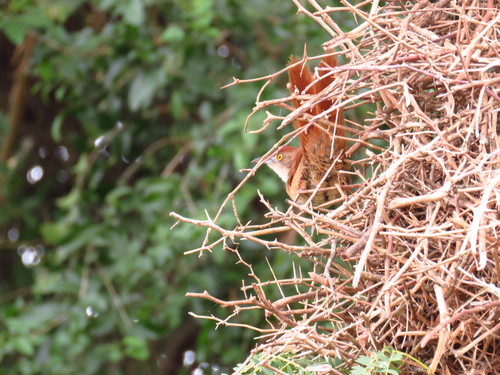 graveteiro
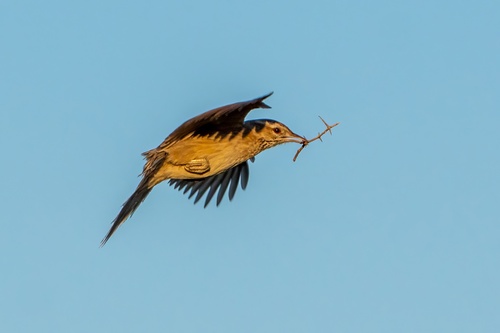 cochicho
Em resumo
The most reliable field mark between Greater Thornbird and Firewood-gatherer is the overall rufous-chestnut coloration of the Greater Thornbird, especially in the wings and tail, compared to the duller, streakier, and more brownish Firewood-gatherer. Juvenile plumages differ: young Greater Thornbirds show a less defined crown patch and brownish mottling on the breast, while juvenile Firewood-gatherers lack rufous on the forehead and have ochraceous throats with less distinct upperpart streaks. In flight or perched, look for the Greater Thornbird’s uniform rufous wings and tail versus the Firewood-gatherer’s brown wings and tail with contrasting white on the tail tips. Both species overlap in range and habitat, but their structure and plumage offer consistent separation.
Dicas de identificação
- Wing and tail color (all ages): Greater Thornbird shows uniform rufous-chestnut wings and tail, both in flight and perched. Firewood-gatherer’s wings are dull brown with darker centers/tips, and the tail is dark brown to blackish with white at the tips of the outer feathers—look for this contrast when the bird fans its tail or in flight.
- Juvenile plumage: Juvenile Greater Thornbird has a less distinct reddish crown patch and brownish mottling on the breast, but still shows rufous tones. Juvenile Firewood-gatherer lacks rufous on the forehead, has an ochraceous throat, and less distinct upperpart streaks—these features are subtle but useful if seen well.
- Crown and head pattern: Greater Thornbird’s crown is reddish chestnut with pale streaks, blending into a rich reddish back. Firewood-gatherer has a sandy brown crown with narrow blackish streaks, a dull rufous forehead, and a much more prominent, wide whitish supercilium.
- Facial pattern: Greater Thornbird’s face is rufescent brown with a paler supercilium and ear coverts, and a whitish malar area. Firewood-gatherer’s face is lighter brownish to grayish brown, with a wide whitish supercilium and a medium brownish post-ocular stripe.
- Underparts: Greater Thornbird’s underparts are pale with a light brownish tinge on the breast and whitish belly. Firewood-gatherer has a white throat with a line of black speckles on the sides, a slightly reddish light brown and buffy upper breast with blurry streaks, and a pale buffy belly.
- Tail shape: Firewood-gatherer’s central tail feathers are pointed, and the outer feathers are less pointed but show white at the tips. Greater Thornbird’s tail is more uniformly shaped and rufous-chestnut throughout.
- Overall color impression: Greater Thornbird is consistently rufous-chestnut and rich in color, especially on the wings and tail. Firewood-gatherer is duller, browner, and streakier, with less saturation and more contrast in the tail.
- Structure and jizz: Greater Thornbird appears bulkier and more robust, often moving deliberately. Firewood-gatherer is slimmer, more active, and can look pipit-like, especially when foraging in open areas.
- Bill color: Greater Thornbird’s bill is blackish to dark grayish horn above, pale gray to grayish green below. Firewood-gatherer’s bill is dull brownish above, gray to light gray with a dark tip below—this is subtle and rarely diagnostic in the field.
- Iris color: Greater Thornbird has a light yellow to orange iris; Firewood-gatherer’s iris is brown to reddish. This can be useful in close views but is variable.
- Leg color: Both species have grayish to olive or greenish legs, not a strong separation.
- Habitat context: If seen in dense riparian thickets or woodland edge, Greater Thornbird is more likely. In open country or grassy areas with scattered bushes, Firewood-gatherer is favored, but overlap is extensive.
- Nest placement (if seen): Greater Thornbird’s nest is a large, cone-shaped structure often hung over water. Firewood-gatherer’s nest is also large and bulky but not as consistently placed over water.
- Pitfalls: Beware of lighting conditions that can make the Firewood-gatherer appear more rufous or the Greater Thornbird duller. Juvenile plumages can be confusing, but the presence or absence of rufous on the forehead and the pattern of the throat and breast are helpful.
- Not diagnostic: Vocalizations, sex, and season are not reliably different in the field based on available sources.
Tamanho
Greater Thornbird is slightly larger and heavier, measuring 19–21 cm and weighing 35–51 g, making it the heaviest and largest thornbird in its range. Firewood-gatherer is a bit smaller at 18–20 cm and 27–45 g. In the field, this size difference is subtle but may be noticeable if both species are seen together. Greater Thornbird also appears bulkier and more robust, while Firewood-gatherer is slimmer and more pipit-like in build. [wikipedia]
Plumagem
- Juvenile/immature: Juvenile Greater Thornbirds have a less defined reddish crown patch and brownish mottling on the breast, but retain the overall rufous tones and uniform chestnut wings/tail. Juvenile Firewood-gatherers lack any rufous on the forehead, have an ochraceous (yellowish-brown) throat, less distinct streaking above, and darker underparts. These differences are most apparent in close views or with good light.
- Adults: Greater Thornbird adults are rich reddish brown to chestnut above, with a reddish chestnut crown (pale streaked), uniform rufous-chestnut wings, and a reddish chestnut tail. Their face is rufescent brown with a pale supercilium and ear coverts, and a whitish malar area. Underparts are pale with a light brown tinge on the breast, fading to whitish belly.
Firewood-gatherer adults are dull brown above with a dull rufous forehead, sandy brown crown with narrow blackish streaks, and a wide whitish supercilium. Their wings are dull brown with darker centers and tips, not rufous. The tail is dark brown to blackish brown, with the central pair pointed and the outer feathers showing white near the ends—a key mark in flight or when fanned. Underparts are streaked and buffy, with a white throat lined by black speckles and a reddish light brown upper breast. - Key contrasts: Greater Thornbird is much more uniform and rufous overall, especially in the wings and tail; Firewood-gatherer is streakier, duller, and shows tail patterning with white.
Comportamento
Greater Thornbird tends to appear bulkier and more deliberate in movement, often seen foraging or perched low in dense vegetation or near water. Firewood-gatherer is slimmer, more active, and sometimes gives a pipit-like impression, often seen in more open areas or on exposed perches. Both species build large, conspicuous stick nests, but the Greater Thornbird’s nest is typically cone-shaped and hung over water, while Firewood-gatherer’s nest is also bulky but not as consistently placed over water.
Habitat
Both species overlap widely in range (Argentina, Brazil, Paraguay, Uruguay) and can be found in similar habitats. Greater Thornbird favors areas with dense shrubby vegetation, often near water, and is more likely to be found in riparian thickets or woodland edges. Firewood-gatherer is more flexible, occurring in open country, grasslands with scattered bushes, and sometimes near human habitation. If seen in very open or grassy areas, Firewood-gatherer is more likely, but habitat alone is not diagnostic.