

crested guan vs black guan
Penelope purpurascens versus Chamaepetes unicolor
Jogue um quiz com crested guan e black guan
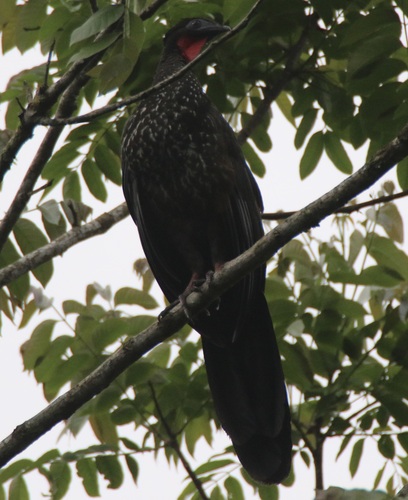 crested guan
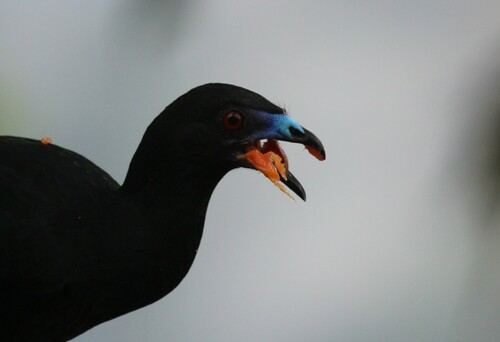 black guan
Em resumo
A marca de campo mais confiável para separar o Crested Guan do black guan é a cor geral da plumagem e a pele facial: o Crested Guan é principalmente de cor oliva-escura com penas do peito e da barriga com bordas brancas e uma pequena carúncula vermelha, enquanto o black guan é uniformemente preto com pele facial azul impressionante e sem carúncula. Os juvenis de Crested Guan apresentam um tom ruivo nas asas e na cauda, ao contrário das partes inferiores mais marrons dos juvenis de black guan. A estrutura também ajuda: o Crested Guan é muito maior e com cauda mais longa, com uma aparência mais semelhante à de um peru. Ambas as espécies podem ser confundidas em silhueta, mas a atenção próxima à cor da pele facial, à cor das pernas e à presença ou ausência de uma carúncula ajudará na identificação.
Dicas de identificação
- Cor da plumagem: O Crested Guan é de cor oliva-escura com penas do peito e da barriga com bordas brancas e partes inferiores castanhas; o black guan é uniformemente preto e brilhante, sem branco ou castanho em nenhum lugar. Esta é a verificação mais rápida em boa luz.
- Pele facial: O Crested Guan tem pele nua preta ardósia no rosto e uma pequena carúncula vermelha na garganta; o black guan tem pele facial azul brilhante ao redor do olho e sem carúncula. O rosto azul é exclusivo do black guan nesta região.
- Cor das pernas: Ambos têm pernas avermelhadas, mas as do black guan são vermelho-rosadas, enquanto as do Crested Guan são mais solidamente vermelhas. Nem sempre visíveis, mas podem ajudar em vistas próximas.
- Plumagem juvenil: O juvenil de Crested Guan apresenta um tom ruivo nas asas e na cauda e é manchado de marrom escuro; o juvenil de black guan é mais opaco que os adultos, com partes inferiores mais marrons, mas permanece uniformemente escuro. Se você ver tons ruivos nas asas/cauda de um jovem pássaro, é um Crested Guan.
- Tamanho e forma: O Crested Guan é muito maior e com cauda mais longa, com uma estrutura e movimento mais semelhantes aos de um peru. O black guan é menor, mais compacto e menos alongado na cauda.
- Comprimento da cauda: A cauda do Crested Guan é proporcionalmente mais longa e mais larga, especialmente notável em voo ou quando empoleirado com a cauda aberta.
- Carúncula: Apenas o Crested Guan tem uma pequena carúncula vermelha na garganta. Se você ver uma carúncula vermelha pendurada, não é um black guan.
- Cor da íris: Ambos têm olhos vermelhos, então isso não é útil para separação.
- Vocalizações: O Crested Guan é muito mais barulhento, com chamadas de honk, gritos e 'apito de vapor'. O black guan é mais silencioso, com chamadas suaves, um 'ro-rooo' baixo e uma exibição distinta de estalo de asas ao amanhecer/anoitecer. Ouça a diferença se o pássaro estiver chamando.
- Distribuição geográfica: Fora da Costa Rica e do Panamá, apenas o Crested Guan ocorre. Na Costa Rica e no oeste do Panamá, ambos são possíveis, então confie na plumagem e na pele facial.
- Habitat: O black guan é mais provável de ser encontrado em elevações mais altas na Costa Rica/Panamá, enquanto o Crested Guan é mais disseminado e pode ser encontrado em elevações mais baixas também.
- Sexos: Ambas as espécies são sexualmente monomórficas em plumagem, então o sexo não é útil para identificação em campo.
- Silhueta de voo: Ambos podem parecer semelhantes em voo, mas a cauda mais longa e o corpo mais volumoso do Crested Guan são pistas. O black guan parece mais compacto e uniforme.
- Armadilhas: Luz fraca pode fazer o Crested Guan parecer mais escuro e mais uniforme, mas a barriga com bordas brancas e os tons castanhos ainda devem ser visíveis a curta distância. O black guan nunca mostra branco ou castanho, mesmo em juvenis.
- Variação de subespécies: Algumas subespécies de Crested Guan são mais rufo, mas nunca se aproximam do preto uniforme do black guan. Sempre verifique se há penas com bordas brancas e carúncula.
Tamanho
O Crested Guan é significativamente maior, medindo 76–91,5 cm de comprimento e pesando 1,6–2,4 kg, com uma cauda longa e larga e pernas robustas. O black guan é menor, medindo 62–69 cm e cerca de 1,1 kg. No campo, o Crested Guan parece mais volumoso e mais alongado, enquanto o black guan é mais compacto e menos imponente. A diferença no comprimento da cauda é especialmente notável quando empoleirado ou em voo.
Plumagem
- Juvenis: Os juvenis de Crested Guan são manchados de marrom escuro e têm um tom ruivo nas penas das asas e da cauda, que não é visto no black guan. Os juvenis de black guan são mais opacos que os adultos, com partes inferiores mais marrons e menos brilho, mas permanecem uniformemente escuros sem tons ruivos.
- Adultos: O adulto de Crested Guan é principalmente de cor oliva-escura com uma leve iridescência esverdeada ou purpúrea, penas do peito e da barriga com bordas brancas, barriga e crissum castanhos, e uma pequena carúncula vermelha na garganta. A pele facial é preta ardósia, e a íris é vermelha. O adulto de black guan é todo preto com um brilho lustroso, pele facial azul brilhante ao redor de um olho vermelho, e pernas e pés vermelho-rosados. Não há carúncula. A uniformidade da plumagem do black guan, especialmente a falta de branco ou castanho, é uma diferença chave.
Comportamento
Ambas as espécies são arbóreas e frequentemente vistas em árvores, mas o tamanho maior e a cauda mais longa do Crested Guan lhe conferem um movimento mais pesado e semelhante ao de um peru, especialmente ao caminhar ao longo dos galhos ou deslizar entre as árvores. O black guan, sendo menor e mais compacto, pode parecer mais ágil e menos conspícuo. Ambos podem ser tímidos e se retirar para a folhagem densa quando perturbados.
Habitat
O Crested Guan tem uma faixa muito mais ampla, encontrado do centro do México através da América Central e em partes do norte da América do Sul, enquanto o black guan é restrito à Costa Rica e ao Panamá. Em áreas de sobreposição (Costa Rica, oeste do Panamá), ambos ocorrem em florestas úmidas, mas o black guan é mais frequentemente encontrado em elevações mais altas. Se visto fora da Costa Rica ou Panamá, é quase certamente um Crested Guan.
Voz
O Crested Guan é notavelmente barulhento e variado, com poderosas chamadas de 'apito de vapor', notas de honk 'quonk' e uma variedade de grunhidos e gritos. Suas chamadas de alarme são especialmente ruidosas. O black guan é mais silencioso, com chamadas suaves na época de reprodução, um 'ro-rooo' ou 'kowr' baixo quando perturbado, e um estalo agudo e crepitante de asas ao amanhecer e ao anoitecer. Se você ouvir um coro alto e barulhento, suspeite do Crested Guan; se a chamada for mais baixa, mais suave ou incluir um estalo de asas, considere o black guan.