

Pénélope panachée vs Pénélope unicolore
Penelope purpurascens contre Chamaepetes unicolor
Faire un quiz avec Pénélope panachée et Pénélope unicolore
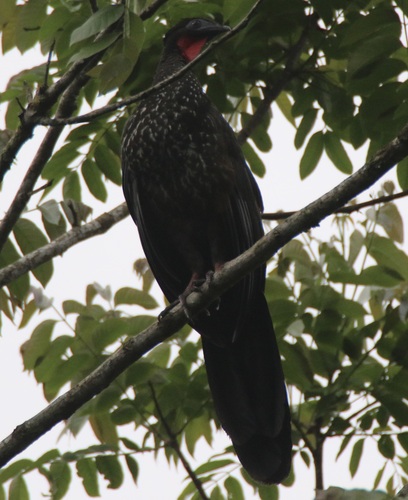 Pénélope panachée
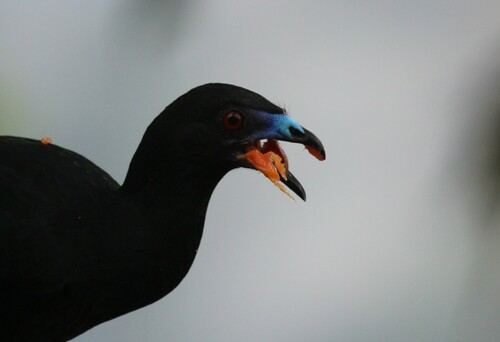 Pénélope unicolore
En bref
The most reliable field mark to separate Crested Guan from Black Guan is overall plumage color and facial skin: Crested Guan is mostly dusky olive-brown with white-edged breast and belly feathers and a small red wattle, while Black Guan is uniformly black with striking blue facial skin and no wattle. Juvenile Crested Guans show a rufous wash on wings and tail, unlike the browner underparts of juvenile Black Guans. Structure also helps: Crested Guan is much larger and longer-tailed, with a more turkey-like jizz. Both species can be confused in silhouette, but close attention to facial skin color, leg color, and the presence or absence of a wattle will clinch the ID.
Conseils d’identification
- Plumage color: Crested Guan is dusky olive-brown with white-edged breast and belly feathers and chestnut underparts; Black Guan is uniformly black and glossy with no white or chestnut anywhere. This is the fastest check in good light.
- Facial skin: Crested Guan has slaty black bare skin on the face and a small red wattle on the throat; Black Guan has bright blue facial skin around the eye and no wattle. The blue face is unique to Black Guan in this region.
- Leg color: Both have reddish legs, but Black Guan's are pinkish-red, while Crested Guan's are more solidly red. Not always visible, but can help in close views.
- Juvenile plumage: Juvenile Crested Guan shows a rufous wash on wings and tail and is mottled with blackish brown; juvenile Black Guan is duller than adults, with browner underparts but remains uniformly dark. If you see rufous tones in the wings/tail of a young bird, it's Crested Guan.
- Size and shape: Crested Guan is much larger and longer-tailed, with a more turkey-like structure and movement. Black Guan is smaller, more compact, and less elongated in the tail.
- Tail length: Crested Guan's tail is proportionally longer and broader, especially noticeable in flight or when perched with tail fanned.
- Wattle: Only Crested Guan has a small red wattle on the throat. If you see a dangling red wattle, it's not Black Guan.
- Iris color: Both have red eyes, so this is not helpful for separation.
- Vocalizations: Crested Guan is much louder, with honking, squawking, and 'steam-whistle' calls. Black Guan is quieter, with piping, low 'ro-rooo', and a distinctive wing-rattling display at dawn/dusk. Listen for the difference if the bird is calling.
- Geographic range: Outside Costa Rica and Panama, only Crested Guan occurs. In Costa Rica and western Panama, both are possible, so rely on plumage and facial skin.
- Habitat: Black Guan is more likely at higher elevations in Costa Rica/Panama, while Crested Guan is more widespread and can be found at lower elevations as well.
- Sexes: Both species are sexually monomorphic in plumage, so sex is not helpful for field ID.
- Flight silhouette: Both can appear similar in flight, but Crested Guan's longer tail and bulkier body are clues. Black Guan looks more compact and uniform.
- Pitfalls: Poor light can make Crested Guan look darker and more uniform, but the white-edged belly and chestnut tones should still be visible at close range. Black Guan never shows white or chestnut, even in juveniles.
- Subspecies variation: Some Crested Guan subspecies are more rufescent, but never approach the uniform black of Black Guan. Always check for white-edged feathers and wattle.
Taille
Crested Guan is significantly larger, measuring 76–91.5 cm in length and weighing 1.6–2.4 kg, with a long, broad tail and robust legs. Black Guan is smaller at 62–69 cm and about 1.1 kg. In the field, Crested Guan appears bulkier and more elongated, while Black Guan is more compact and less imposing. The difference in tail length is especially noticeable when perched or in flight.
Plumage
- Juveniles: Juvenile Crested Guans are mottled with blackish brown and have a rufous brown wash on the wing and tail feathers, which is not seen in Black Guan. Juvenile Black Guans are duller than adults, with browner underparts and less gloss, but remain uniformly dark without rufous tones.
- Adults: Adult Crested Guan is mostly dusky olive-brown with a faint greenish or purplish iridescence, white-edged breast and belly feathers, chestnut belly and crissum, and a small red wattle on the throat. The facial skin is slaty black, and the iris is red. Adult Black Guan is all black with a glossy sheen, bright blue facial skin around a red eye, and pinkish-red legs and feet. There is no wattle. The uniformity of the Black Guan's plumage, especially the lack of white or chestnut, is a key difference.
Comportement
Both species are arboreal and often seen in trees, but Crested Guan's larger size and longer tail give it a more ponderous, turkey-like movement, especially when walking along branches or gliding between trees. Black Guan, being smaller and more compact, may appear more agile and less conspicuous. Both can be shy and retreat into dense foliage when disturbed.
Habitat
Crested Guan has a much wider range, found from central Mexico through Central America and into parts of northern South America, while Black Guan is restricted to Costa Rica and Panama. In areas of overlap (Costa Rica, western Panama), both occur in humid forests, but Black Guan is more often found at higher elevations. If seen outside Costa Rica or Panama, it is almost certainly Crested Guan.
Voix
Crested Guan is notably loud and varied, with powerful 'steam-whistle' calls, honking 'quonk' notes, and a variety of grunts and squawks. Its alarm calls are especially raucous. Black Guan is quieter, with piping calls in the breeding season, a low 'ro-rooo' or 'kowr' when disturbed, and a sharp, crackling wing-rattle at dawn and dusk. If you hear a loud, honking chorus, suspect Crested Guan; if the call is lower, softer, or includes a wing-rattle, consider Black Guan.
Pénélope panachée · Pénélope unicolore · Mes oiseaux difficiles