

buff-headed coucal vs pacific koel
Centropus milo versus Eudynamys orientalis
Jogue um quiz com buff-headed coucal e pacific koel
 buff-headed coucal
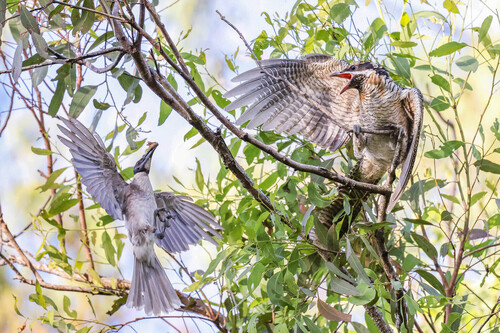 pacific koel
Em resumo
A marca de campo mais confiável entre buff-headed coucal e pacific koel é a cabeça e as partes inferiores de cor buff marcantes do buff-headed coucal em adultos, que nunca ocorrem no pacific koel de qualquer idade ou sexo. Os juvenis de buff-headed coucal também são distintos, sendo fortemente manchados e listrados de marrom, enquanto os juvenis e fêmeas de pacific koel são marrons por cima com manchas brancas e partes inferiores listradas ou barradas, mas carecem dos tons de buff e das listras fortes do coucal. Estruturalmente, o buff-headed coucal é um pássaro muito mais pesado e robusto, com um bico maciço e asas curtas, contrastando com o pacific koel mais esguio, de cauda longa e mais aerodinâmico. Se você ver um cuculo grande e de corpo pesado com uma cabeça e partes inferiores de cor buff, é um buff-headed coucal; um pássaro mais esguio, preto ou marrom com olhos vermelhos é um pacific koel.
Dicas de identificação
- Cabeça e partes inferiores de cor buff (adulto buff-headed coucal): Apenas o buff-headed coucal apresenta uma cabeça, parte superior das costas e partes inferiores de cor buff. O pacific koel nunca apresenta isso, independentemente da idade ou sexo.
- Asas e cauda pretas brilhantes (adulto buff-headed coucal): Contrasta com o corpo buff; os machos de pacific koel são todos pretos, mas sem o efeito bicolor.
- Plumagem juvenil: O juvenil de buff-headed coucal é marrom com manchas pretas e asas e cauda listradas de marrom avermelhado. O juvenil de pacific koel é marrom por cima com manchas brancas e partes inferiores creme com finas listras escuras—nunca tão fortemente listrado ou manchado como o coucal.
- Plumagem feminina: A fêmea de pacific koel é marrom por cima com manchas brancas e partes inferiores creme com listras pretas. As fêmeas de buff-headed coucal se parecem com os machos (buff e preto), nunca manchadas ou listradas por baixo.
- Estrutura do bico: O buff-headed coucal tem um bico maciço e pesado (cinza escuro em adultos, bicolor em juvenis). O bico do pacific koel é mais esguio e menos robusto.
- Estrutura do corpo: O buff-headed coucal é mais robusto, com um corpo pesado e asas curtas. O pacific koel é mais esguio e alongado, com uma cauda e asas mais longas.
- Estilo de voo: O coucal voa em explosões curtas, pesadas e laboriosas, frequentemente baixo ao chão. O koel voa de forma mais direta e rápida, geralmente mais alto na copa.
- Cor dos olhos: O adulto buff-headed coucal e o pacific koel têm ambos olhos vermelhos. O juvenil de coucal tem olhos marrom-acinzentados; o juvenil de koel tem olhos escuros.
- Cor do bico (juvenis): O juvenil de buff-headed coucal tem um bico bicolor (marrom por cima, chifre claro por baixo); os juvenis de koel têm um bico mais claro, mas não bicolor.
- Habitat: O buff-headed coucal é restrito às florestas centrais das Ilhas Salomão; o pacific koel é amplamente distribuído na Australásia e no Sudeste Asiático, em uma variedade de habitats florestais.
- Vocalização: Chamadas persistentes, altas e repetitivas indicam pacific koel. O buff-headed coucal é muito mais silencioso.
- Padrão da cauda: A cauda do koel é longa e muitas vezes parece graduada; a cauda do coucal é larga e menos alongada.
- Comportamento: O coucal é mais propenso a ser visto se arrastando através de vegetação densa ou ramos baixos; o koel é mais arbóreo e raramente visto no chão.
- Tamanho relativo: Se o pássaro parecer excepcionalmente grande e pesado para um cuculo, é provável que seja um buff-headed coucal.
- Contexto local: Se você estiver fora das Ilhas Salomão, é extremamente improvável encontrar um buff-headed coucal.
Tamanho
O buff-headed coucal é significativamente maior e mais pesado que o pacific koel. Mede de 60 a 69 cm de comprimento e pesa cerca de 769 g, tornando-se possivelmente a maior espécie de cuculo [wikipedia]. O pacific koel é grande para um cuculo, mas é mais esguio e leve, com um corpo e cauda mais alongados. O volume do coucal, seu bico pesado e asas curtas são óbvios mesmo à distância, enquanto o koel parece mais elegante e alongado, especialmente em voo.
Plumagem
- Juvenis: O juvenil de buff-headed coucal é marrom, manchado de preto, e tem asas e cauda de marrom avermelhado com listras pretas. A íris é marrom-acinzentada e o bico é bicolor (marrom por cima, chifre claro por baixo). Em contraste, o juvenil de pacific koel se assemelha à fêmea: marrom por cima com manchas brancas, partes inferiores creme com listras ou barras escuras, e olhos escuros. Sem tons de buff ou listras pesadas como no coucal.
- Machos adultos: Os adultos de buff-headed coucal têm uma cabeça, parte superior das costas e partes inferiores de cor buff, com asas pretas brilhantes, parte inferior das costas e cauda. Os machos adultos de pacific koel são todos pretos com brilho azul-esverdeado e olhos vermelhos—nunca buff ou bicolor.
- Fêmeas adultas: A fêmea de pacific koel é marrom por cima com manchas brancas e partes inferiores creme com finas listras pretas, sem a coloração buff do coucal. As fêmeas de buff-headed coucal se parecem com os machos (buff e preto).
- Cor da íris: O adulto buff-headed coucal tem olhos vermelhos; o juvenil tem olhos marrom-acinzentados. Os adultos de pacific koel (ambos os sexos) têm olhos vermelhos; os juvenis têm olhos escuros.
- Cor do bico: Os adultos de buff-headed coucal têm bicos cinza escuro; os juvenis têm bicos bicolores. O pacific koel tem um bico escuro nos machos, mais claro nas fêmeas e juvenis.
Comportamento
O buff-headed coucal é um habitante do solo ou de vegetação baixa, movendo-se pesadamente e muitas vezes desajeitadamente através da densa vegetação da floresta. Não é um bom voador e tende a se mover em voos curtos e pesados. O pacific koel é mais arbóreo e ágil, frequentemente visto voando entre as árvores ou empoleirando-se alto na copa. Os koels são parasitas de ninho, raramente vistos no chão, e são mais propensos a serem notados por seus chamados ou voos rápidos e diretos.
Habitat
O buff-headed coucal é endêmico das Ilhas Salomão centrais, encontrado em florestas tropicais úmidas de baixa altitude e montanhas, tanto de crescimento primário quanto secundário [wikipedia]. É estritamente um pássaro de floresta. O pacific koel é amplamente distribuído na Australásia e no Sudeste Asiático, encontrado em uma variedade de habitats florestais, incluindo florestas, plantações e até parques urbanos. Se você estiver nas florestas centrais das Ilhas Salomão, é provável encontrar um buff-headed coucal; em outros lugares, especialmente em áreas abertas ou urbanas, o pacific koel é mais provável.
Voz
O pacific koel é famoso por seus chamados altos e repetitivos, especialmente durante a temporada de reprodução, frequentemente ouvidos dia e noite. A voz do buff-headed coucal não é descrita nas notas fornecidas, mas os coucals em geral são menos vocais e não produzem os chamados distintivos e de longa distância do koel. Se o pássaro estiver chamando persistentemente e alto, especialmente com notas ascendentes ou repetitivas, é quase certamente um pacific koel.