

japu-de-rabo-verde vs guaxe
Cacicus latirostris versus Cacicus haemorrhous
Jogue um quiz com japu-de-rabo-verde e guaxe
 japu-de-rabo-verde
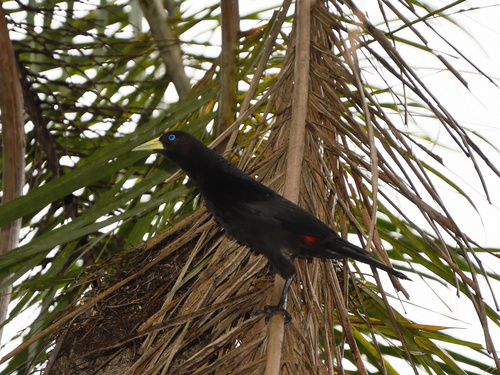 guaxe
Em resumo
The most reliable field mark to separate Band-tailed Cacique from Red-rumped Cacique is the tail pattern: Band-tailed shows a strikingly banded tail with yellow outer feathers tipped black, while Red-rumped has an all-black tail and a bright red rump. Both are mostly black birds with pale bills and blue irises, but the Band-tailed's chestnut crown/nape and yellow tail are unique. Red-rumped Cacique lacks any yellow in the tail and instead flashes a vivid red lower back and rump. These differences are visible in both perched and flying birds, and are present in all age classes. Structure and size are similar, but the Band-tailed is slightly larger and longer-tailed. Habitat can also help: Band-tailed is a scarce várzea specialist in western Amazonia, while Red-rumped is widespread in lowland forests across South America.
Dicas de identificação
- Tail pattern is the single best field mark: Band-tailed Cacique has a tail with black central feathers and yellow outer feathers tipped black, creating a banded look; Red-rumped Cacique's tail is entirely black with no yellow at any age.
- Rump color: Red-rumped Cacique always shows a bright red lower back and rump, especially obvious in flight or when the tail is spread; Band-tailed Cacique has a black rump, never red.
- Crown and nape color: Band-tailed Cacique has a chestnut crown, nape, and upper back, which contrasts with the black body; Red-rumped Cacique is glossy black throughout the head and back, lacking any chestnut.
- Bill color: Both species have ivory bills, but Band-tailed's may show a dusky tip or maxilla, while Red-rumped's is clean ivory. This is subtle and not always visible in the field.
- Iris color: Males of both species have pale blue irises, but females are duller (brownish blue in Red-rumped). This is not a strong separator but may help with close views.
- Sex/age differences: Both species are sexually monomorphic in plumage, with females duller black. Juveniles resemble adult females but retain the diagnostic tail and rump patterns.
- Size and structure: Band-tailed is slightly larger and longer-tailed, but overlap is considerable; use only as a supporting mark.
- Habitat and range: Band-tailed is restricted to western Amazonian várzea and is rare; Red-rumped is widespread in lowland forests across South America. If seen outside the western Amazon, it is almost certainly Red-rumped.
- Foraging behavior: Both forage in groups below the canopy and may join mixed flocks, so behavior is not a strong separator.
- Flight views: In flight, Band-tailed's yellow tail bands and lack of red rump are obvious; Red-rumped flashes a red rump and all-black tail.
- Perched views: Look for the chestnut crown/nape (Band-tailed) versus all-black head (Red-rumped), and check the tail and rump for color.
- Vocalizations: Band-tailed gives a twanging 'ka'CHAWWW' or 'CHOOO' song and rich, throaty calls; Red-rumped's voice is not detailed in the notes, so do not rely on this.
- Nest placement: Both species build suspended nests, but this is not a field mark unless colonies are observed and species are known.
- Plumage gloss: Red-rumped is described as glossy black, Band-tailed as velvety black with a bluish gloss on the wings; this is subtle and not reliable at distance.
- Bill thickness (subspecies): Some Red-rumped subspecies have thicker or thinner bills, but this is not a practical field mark for most observers.
Tamanho
Band-tailed Cacique is the larger of the two, with males averaging about 33 cm in length and 96.5 g in mass, and females about 24.5 cm and 75 g. Red-rumped Cacique males are smaller at 29 cm and 96.5 g, and females are 25 cm and 62–74 g. The difference in length is more marked than in mass, and Band-tailed appears longer-tailed and slightly bulkier, but overlap is considerable and size alone is not reliable for field separation.
Plumagem
- Juvenile/Immature/Adult (all ages): The most diagnostic difference is in the tail and rump. Band-tailed Cacique has black central tail feathers, but the rest of the tail is yellow with black tips, creating a bold banded effect; the rump is black. Red-rumped Cacique has an all-black tail and a bright red lower back and rump, with no yellow in the tail. Both species are otherwise mostly black, but Band-tailed shows a chestnut crown, nape, and upper back, while Red-rumped is glossy black throughout except for the red rump. Both have pale blue irises (males; females duller) and ivory bills, though Band-tailed's bill may have a dusky tip or maxilla. Juveniles of both resemble duller females, but the tail and rump patterns remain diagnostic.
Comportamento
Both species forage in groups, often below the canopy, and are social. Band-tailed Cacique may join mixed-species flocks in large numbers, while Red-rumped Cacique is also gregarious and colonial. Both build suspended nests, but Band-tailed may nest solitarily or in small colonies, while Red-rumped is more typically colonial. Behavior is not a strong separator in the field.
Habitat
Band-tailed Cacique is a specialist of várzea (seasonally flooded) forests along rivers and islands in the far western Amazon Basin (Brazil, Colombia, Ecuador, Peru), and is generally rare to uncommon. Red-rumped Cacique is far more widespread, found in lowland forests throughout most of South America (except Chile), including both flooded and terra firme forests. If seen outside the western Amazonian várzea, Band-tailed is very unlikely.
Voz
Band-tailed Cacique gives a short, twanging 'ka'CHAWWW' or 'CHOOO' song, mixed with higher rusty squeaks, and calls that are rich, throaty 'g'luck', 'rhaw', and 'chaw' notes. Red-rumped Cacique's voice is not described in the provided notes, so vocalizations are not a reliable separator based on current information.