

Elliotkolibrie vs Witoorsaffierkolibrie
Selasphorus ellioti versus Basilinna leucotis
Speel een quiz met Elliotkolibrie en Witoorsaffierkolibrie
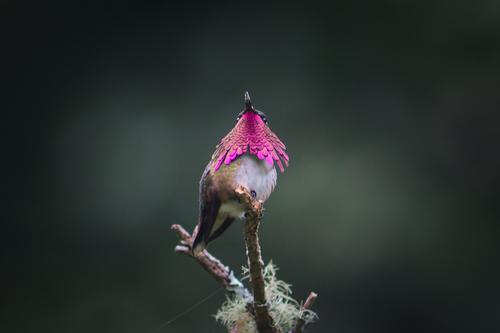 Elliotkolibrie
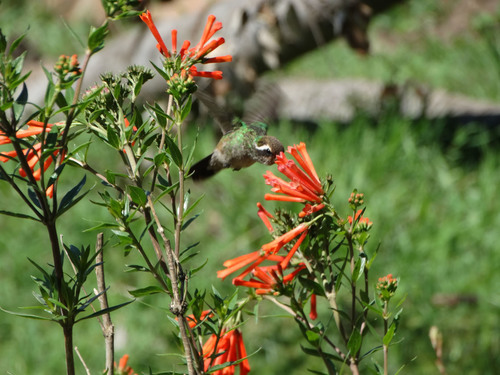 Witoorsaffierkolibrie
Kort gezegd
The most reliable field mark to separate Wine-throated from White-eared Hummingbird is the male's throat color: Wine-throated males show a glittering rose-pink to violet gorget, while White-eared males have a violet-blue chin and throat with a contrasting white ear stripe. Females and immatures are trickier, but the Wine-throated is notably smaller and has more rufous and cinnamon in the tail and flanks, while White-eared is larger, with a bold white post-ocular stripe and more green and bronze in the plumage. Bill color also helps: White-eared males have a red-based bill, while Wine-throated bills are blackish. Both species share some green upperparts and white behind the eye, but their tail patterns and overall size differ significantly.
Herkenningstips
- Size: White-eared is noticeably larger and bulkier than Wine-throated; use this when both are present or compared to other local hummingbirds (all ages).
- Bill Color: Adult male White-eared has a red-based bill with a black tip, while Wine-throated's bill is short, straight, and entirely blackish (both sexes, all ages). Female White-eared has some red or orange at the base, but mostly blackish.
- White Ear Stripe: White-eared of all ages and sexes shows a bold white stripe behind the eye, much broader and more obvious than the small white spot in Wine-throated.
- Male Throat Color: Wine-throated males have a glittering rose-pink to violet gorget with violet highlights; White-eared males have a violet-blue chin and throat, sometimes appearing more blue or purple, with a metallic emerald green lower throat.
- Female Throat: Wine-throated females have a white chin and throat with many dusky spots; White-eared females have pale brownish gray to grayish white underparts with metallic bronze green spots, but lack the dense spotting of Wine-throated.
- Flank and Undertail Color: Wine-throated (both sexes) shows cinnamon or buff flanks and undertail coverts; White-eared has bronze to bronze-green flanks and grayish or grayish brown undertail coverts, sometimes with a bronze gloss.
- Tail Pattern: Wine-throated's tail has green central feathers, rufous outer feathers with a broad black band and white (male) or cinnamon (female) tips. White-eared's tail is bronze-green centrally, with bronzy-black outer feathers and green tips, lacking rufous or cinnamon.
- Crown and Forehead: Male White-eared has a metallic violet or bluish-violet forehead and dull black crown; females have a dusky brown crown. Wine-throated has a green crown matching the upperparts.
- Face Pattern: White-eared has a mostly black face (male) with a wide white stripe; Wine-throated has a green face with only a small white spot behind the eye.
- Underparts: Wine-throated males have whitish underparts with cinnamon/green flanks; White-eared males have bronze to bronze-green underparts with a dull grayish white center.
- Tail Shape: Both species have similar tail shapes, but the color pattern is more diagnostic.
- Vocalizations: If heard, a high, buzzy, squeaky chip series breaking into a warble (Wine-throated) or a loud wing-thrum may indicate Wine-throated; White-eared's calls are less distinctive in this context.
- Habitat: In the northern part of the range (Mexico, Guatemala), White-eared is more widespread and likely at a wider range of elevations and habitats; Wine-throated is more localized in highlands.
- Behavior: White-eared is more likely to be seen aggressively defending flowers, sometimes even from larger hummingbirds; Wine-throated's behavior is less well-documented.
- Pitfalls: Female and immature hummingbirds are notoriously tricky; focus on size, bill color, ear stripe, and tail pattern. Avoid relying on upperwing pattern, as neither species has distinctive marks there.
Grootte
White-eared Hummingbird is distinctly larger, at 9–10 cm in length and averaging 3.6 g (male) and 3.2 g (female) in weight. Wine-throated Hummingbird is much smaller, at only 6.5–7 cm, with females weighing 2–4 g (male weights not documented but likely similar or lighter). This size difference is often apparent in the field, especially when seen side-by-side or compared to other hummingbirds in the area. The Wine-throated also appears more compact and delicate, while White-eared is bulkier and longer-tailed.
Verenkleed
-
Juvenile/Immature Upperwing/Flight Marks: No distinctive age-specific upperwing or flight pattern marks are described for either species in the sources; separation relies on body and tail plumage, not wing pattern.
-
Adult Males: Wine-throated males have a glittering rose-pink to violet gorget with flared hind feathers, green upperparts, and a tail with green central feathers and rufous outer feathers with a broad black band and white tips (outermost). White-eared males have a violet-blue chin and upper throat, metallic green to bronze upperparts, and a bold white stripe behind the eye; their tail is bronze-green centrally, bronzy-black on the outer feathers with green tips, lacking the rufous and white pattern of Wine-throated.
-
Adult Females: Wine-throated females have green upperparts, white chin and throat with dusky spots, cinnamon flanks and undertail coverts, and a tail with more black and less rufous than the male, with cinnamon-tipped outer feathers. White-eared females are similar to males but with a dusky brown crown, lack the brilliant throat, and have pale brownish gray underparts with bronze green spots; their tail has brownish gray tips, and the white ear stripe remains prominent.
-
Subspecies Variation: Both species have minor subspecific differences, but these do not overlap in a way that confuses the two; the main field marks above hold across their ranges.
Gedrag
Both species forage for nectar at low to mid-levels in vegetation and may also take small arthropods. White-eared Hummingbird is more territorial, defending feeding areas even against larger species, and is known for secretive approaches to flowers in other birds' territories. Wine-throated forages at all levels but is less well-documented in terms of territoriality. In flight, White-eared may appear bulkier and longer-tailed, while Wine-throated is more compact and agile.
Habitat
Wine-throated Hummingbird is found in highland regions of El Salvador, Guatemala, Honduras, and southern Mexico, usually in pine-oak forests and edges. White-eared Hummingbird has a broader range, from the southwestern US to Nicaragua, and is common in montane forests, pine-oak woodlands, and forest edges. Both can occur at similar elevations in Central America, but White-eared is more widespread and likely in a wider range of wooded habitats.
Geluid
Wine-throated Hummingbird gives a series of high, buzzy, squeaky chips that break into a warble, with sharp 'sip-sip' or 'cheup cheup' calls. Its wings make a distinctive 'thrum' when hovering. White-eared Hummingbird's vocalizations are not detailed in the notes, so voice is not a strong separator unless the Wine-throated's song or wing-thrum is heard.
Elliotkolibrie · Witoorsaffierkolibrie · Mijn lastige vogels