

Witpootneushoornvogel vs Trompetneushoornvogel
Bycanistes albotibialis versus Bycanistes bucinator
Speel een quiz met Witpootneushoornvogel en Trompetneushoornvogel
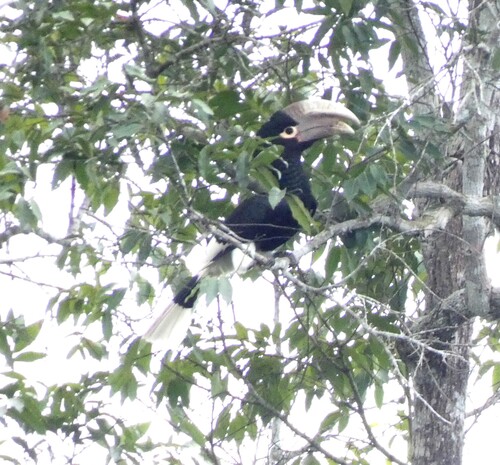 Witpootneushoornvogel
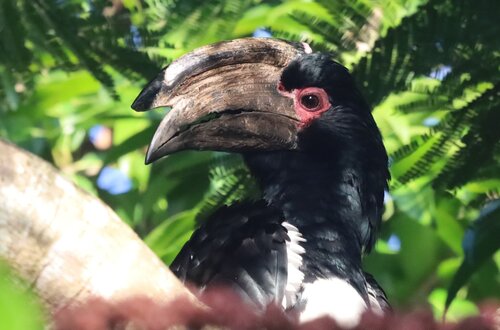 Trompetneushoornvogel
Kort gezegd
The most reliable field mark to separate Trumpeter Hornbill from White-thighed Hornbill is the combination of plumage pattern and facial skin color: Trumpeter Hornbill shows a striking white belly and underwing coverts, with pink or red bare skin around the eyes, while White-thighed Hornbill lacks these features. In flight, Trumpeter Hornbill reveals white-tipped wings and a contrasting white underwing, which is not described for White-thighed Hornbill. Structurally, Trumpeter Hornbill has a prominent grey casque atop the bill, especially noticeable in males. Both species are medium-to-large hornbills, but Trumpeter Hornbill is slightly heavier on average. Habitat and range do not overlap extensively, but confusion may arise in captivity or in range-edge situations.
Herkenningstips
- Underwing pattern in flight: Trumpeter Hornbill shows white underwing coverts and white-tipped wings, visible in all ages during flight. White-thighed Hornbill lacks description of this pattern; if you see a hornbill with a white underwing, it is Trumpeter.
- Belly color: Trumpeter Hornbill has a white belly, contrasting with its black back. White-thighed Hornbill does not have a white belly; its underparts are not described as contrastingly pale.
- Facial skin color: Look for pink or red bare skin around the eye in Trumpeter Hornbill. White-thighed Hornbill lacks this, having darker or less conspicuous facial skin.
- Bill casque: Trumpeter Hornbill has a large, prominent grey casque on the bill, especially in males. White-thighed Hornbill's casque is not described as especially large or grey, so a pronounced casque is a strong clue for Trumpeter.
- Group size and behavior: Trumpeter Hornbill is often seen in groups, sometimes quite large. If you see a flock of hornbills, especially in southern Africa, Trumpeter is more likely.
- Range and location: If you are in central or western Africa, White-thighed Hornbill is possible; in southeastern Africa, Trumpeter Hornbill is expected. Always check for vagrancy or captive birds in unusual locations.
- Back color: Trumpeter Hornbill has an all-black back. If you see a hornbill with a paler or differently patterned back, reconsider Trumpeter.
- Sexual dimorphism: Trumpeter Hornbill females have a smaller casque, but both sexes show the other key marks. Casque size is less useful for separating these two than for sexing Trumpeter.
- White thighs: Both species have white thighs, so this is not a reliable separator on its own. Focus on the extent of white on the underparts and underwing.
- Perched vs. flight views: In perched birds, focus on belly, facial skin, and casque. In flight, prioritize underwing and belly color.
- Confusion with other Bycanistes: Trumpeter Hornbill is similar to Silvery-cheeked Hornbill, but not to White-thighed Hornbill in key field marks. Do not confuse the white underwing and belly of Trumpeter with the more restricted white of White-thighed.
- Juvenile/immature plumage: No specific juvenile marks are described for White-thighed Hornbill, but Trumpeter's white underwing and belly should still be visible in young birds.
- Habitat context: Both species prefer evergreen forests, so habitat alone is not diagnostic unless combined with range.
- Captive birds: In zoos or aviculture, rely on plumage and casque, not range.
- When in doubt: If you see a hornbill with a white belly, white underwing, pink/red facial skin, and a large casque, it is a Trumpeter Hornbill.
Grootte
Trumpeter Hornbill is a medium-sized hornbill with a body mass around 644 g [wikidata], and a length of 58–65 cm [wikipedia]. No direct measurement is available for White-thighed Hornbill, but both are considered medium-to-large Bycanistes hornbills and likely overlap in size. In the field, size alone is not a reliable separator unless both are seen side by side, but Trumpeter Hornbill may appear slightly bulkier, especially in the chest and bill due to the casque.
Verenkleed
Plumage differences are most obvious in adults and likely in immatures as well, though age-specific flight patterns are not detailed for White-thighed Hornbill. Trumpeter Hornbill of all ages shows an all-black back, white belly, and white underwing coverts; in flight, the white underwing and white-tipped wings are diagnostic. The facial skin around the eye is pink to red, which stands out in the field. White-thighed Hornbill lacks mention of a white belly or underwing, and does not have the pink/red facial skin. Both species have white thighs, but Trumpeter Hornbill's white underparts and underwing are more extensive and obvious, especially when the bird is flying or when seen from below. The casque on Trumpeter Hornbill is large and grey, smaller in females, and is a key structural mark not described for White-thighed Hornbill.
Gedrag
Trumpeter Hornbill is notably gregarious, often seen in small groups (2–5, sometimes up to 50), and is active and social, especially in fruiting trees. White-thighed Hornbill's social behavior is not detailed, but as a Bycanistes, it may also be seen in pairs or small groups. In captivity, Trumpeter Hornbills are described as tame and intelligent, but this is not a field mark. Both species may be active and vocal, but Trumpeter Hornbill's group behavior can be a subtle clue in the field.
Habitat
White-thighed Hornbill is found in central and western Africa (Angola, Benin, Cameroon, Central African Republic, Republic of the Congo, Democratic Republic of the Congo, Equatorial Guinea, Gabon, Nigeria, Sudan, and Uganda) [wikipedia]. Trumpeter Hornbill is a resident of southeastern Africa (Burundi, Mozambique, Botswana, Congo, North Pare Mountains of Tanzania, Kenya, Caprivi strip of Namibia, eastern South Africa) [wikipedia]. Their ranges do not overlap extensively, so location is a strong clue, but not diagnostic in captivity or at range edges. Both prefer tropical evergreen forests.
Witpootneushoornvogel · Trompetneushoornvogel · Mijn lastige vogels