

Wigstaartpijlstormvogel vs Bullerpijlstormvogel
Ardenna pacifica versus Ardenna bulleri
Speel een quiz met Wigstaartpijlstormvogel en Bullerpijlstormvogel
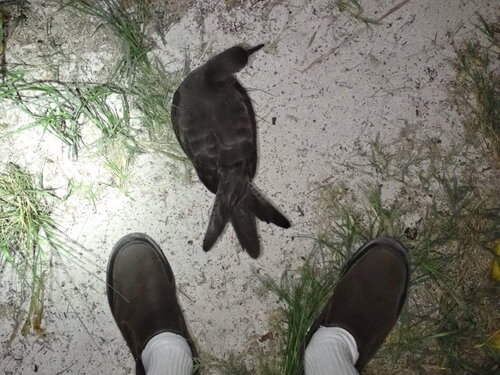 Wigstaartpijlstormvogel
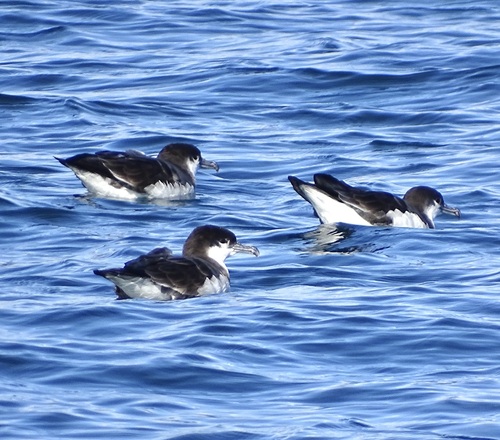 Bullerpijlstormvogel
Kort gezegd
Bullerpijlstormvogel is best separated from Wigstaartpijlstormvogel by its striking upperwing pattern in flight: a bold, broken black 'M' or 'W' across pale grey upperwings, unique among large shearwaters. Wigstaartpijlstormvogel, in contrast, shows either uniform dark or plain grey-brown upperparts without any strong wing pattern, regardless of age or morph. Both have wedge-shaped tails and dark bills, but Bullerpijlstormvogel is slimmer and lighter overall. Use flight views and upperwing pattern first; perched or distant birds are trickier, especially for Wigstaartpijlstormvogel's pale morph.
Herkenningstips
- Upperwing pattern in flight (all ages): Bullerpijlstormvogel shows a bold, broken black 'M' of 'W' across pale grey upperwings, with blackish primaries and a dark secondary stripe separated by a pale panel. Wigstaartpijlstormvogel (both morphs) lacks any such pattern; upperwings are plain grey-brown (pale morph) or uniformly dark (dark morph).
- Underwing and body contrast: Bullerpijlstormvogel has a bright white underside and underwing, with sharp contrast to the upperparts. Wigstaartpijlstormvogel's pale morph is also white below, but lacks the sharp upperwing contrast; the dark morph is uniformly dark below as well.
- Head and face: Bullerpijlstormvogel has a grey cap extending to eye level, setting off a bright white cheek that can look striking in good light. Wigstaartpijlstormvogel's head matches the upperparts—either grey-brown (pale) or dark (dark morph)—and lacks a sharply defined white face.
- Tail shape and color: Both have wedge-shaped tails, but Bullerpijlstormvogel's tail is blackish and matches the flight feathers, while Wigstaartpijlstormvogel's tail is the same color as the back (grey-brown or dark grey-brown).
- Bill color and shape: Both have dark bills, but Bullerpijlstormvogel's is slightly finer and more slender; this is subtle and not always reliable at sea.
- Overall size and build: Wigstaartpijlstormvogel is bulkier and heavier; Bullerpijlstormvogel is slimmer and more elegant, but size is hard to judge unless seen together.
- Flight style: Bullerpijlstormvogel often appears more buoyant and graceful, with long, arcing glides and less flapping. Wigstaartpijlstormvogel can look heavier and more direct.
- Plumage morphs: Wigstaartpijlstormvogel comes in pale and dark morphs; Bullerpijlstormvogel is always the same pattern. Beware pale Wigstaartpijlstormvogel, which can look superficially similar below to Bullerpijlstormvogel, but never shows the upperwing 'M'.
- Juvenile/immature birds: Juvenile Bullerpijlstormvogel look like adults, so the upperwing pattern is always present. Juvenile Wigstaartpijlstormvogel match their morph, with no special wing pattern.
- Perched/rafter views: Separation is much harder when birds are sitting on water; rely on head pattern (Bullerpijlstormvogel: white face, grey cap) and overall color (Wigstaartpijlstormvogel: plain, never patterned). Tail shape is not always obvious when sitting.
- Habitat and range: Both can be found in the tropical Pacific, but Bullerpijlstormvogel is more likely in temperate waters and off the Americas in late summer/autumn. Wigstaartpijlstormvogel is more strictly tropical.
- Voice: Only useful at colonies; Wigstaartpijlstormvogel gives long, moaning calls. Not helpful at sea.
- Pitfalls: The main error is mistaking a pale-morph Wigstaartpijlstormvogel for Bullerpijlstormvogel due to the white belly; always check for the upperwing 'M' in flight. Dark-morph Wigstaartpijlstormvogel is unlikely to be confused with Bullerpijlstormvogel.
- Sex and season: No sexual dimorphism or seasonal plumage difference in either species; all field marks apply year-round.
- Lighting conditions: The 'M' pattern on Bullerpijlstormvogel is most obvious in good light, but the pale panel is usually visible even in dull conditions. Always try to get a view of the upperwing in flight for confident separation.
Grootte
Wigstaartpijlstormvogel is the heavier bird (465 g vs. 326 g), and is the largest Tropische pijlstormvogel. Bullerpijlstormvogel is still large, but noticeably lighter and slightly smaller in bulk. Both are long-winged and similar in overall proportions, but Bullerpijlstormvogel can appear more elegant due to its slimmer build.
Verenkleed
The most diagnostic difference is in flight: Bullerpijlstormvogel (all ages from fledging onward) shows a distinctive upperwing pattern—a dark, broken 'M' of 'W' formed by blackish primaries and a dark stripe along the secondaries, separated by a pale silvery-grey panel. This is visible even at a distance and is unique among large shearwaters. The rest of the upperparts are bluish-grey, with a bright white underside and a grey cap that extends to eye level, setting off the white face. Wigstaartpijlstormvogel never shows this pattern. Instead, it comes in two morphs: the pale morph has plain grey-brown upperparts and upperwings, with a white belly, while the dark morph is uniformly dark grey-brown all over. Both morphs lack any wing panel, 'M', or contrasting pattern—upperwings are plain. Juvenile Bullerpijlstormvogel already look like adults; juvenile Wigstaartpijlstormvogel resemble their respective morphs. Both species have wedge-shaped tails, but Bullerpijlstormvogel's tail is darker and matches the flight feathers.
Gedrag
Both species are pelagic and often seen gliding low over the sea, but Bullerpijlstormvogel is noted for its more buoyant, graceful flight, often with languid, arcing glides and less frequent flapping. Wigstaartpijlstormvogel can appear heavier and more direct in flight, especially when compared side-by-side. Both nest in burrows, but this is not a field mark at sea.
Habitat
Both are oceanic and can overlap in the tropical and subtropical Pacific. Wigstaartpijlstormvogel is more strictly tropical, while Bullerpijlstormvogel ranges widely across the Pacific, including temperate and even subarctic waters, and is more likely off the west coast of the Americas in late summer and autumn. Habitat is rarely diagnostic at sea, but context may help in marginal areas.
Geluid
Wigstaartpijlstormvogel is known for its long, moaning calls at colonies, with a distinctive inhaling and exhaling pattern ('OOO...err'), especially at night. Bullerpijlstormvogel is less often heard at sea and is not noted for distinctive calls in field situations. Voice is not usually helpful for separation at sea.
Wigstaartpijlstormvogel · Bullerpijlstormvogel · Mijn lastige vogels