

Karoolangsnavelleeuwerik vs Kaapse langsnavelleeuwerik
Certhilauda subcoronata versus Certhilauda curvirostris
Speel een quiz met Karoolangsnavelleeuwerik en Kaapse langsnavelleeuwerik
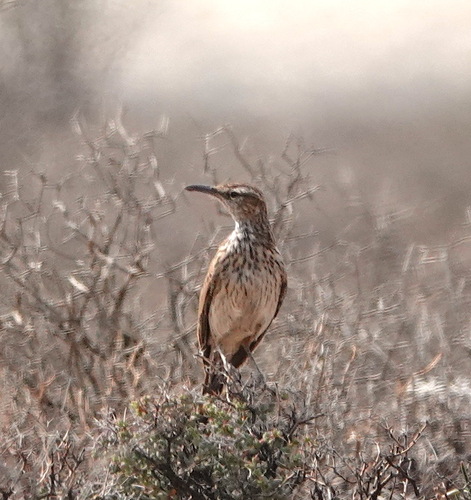 Karoolangsnavelleeuwerik
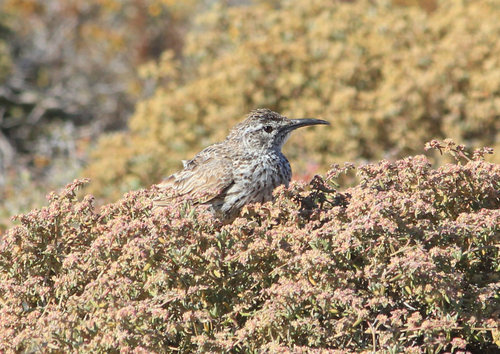 Kaapse langsnavelleeuwerik
Kort gezegd
Karoo Long-billed Lark and Cape Long-billed Lark are notoriously similar, especially in adult plumage, but can often be separated by subtle differences in structure, habitat, and context. No strong age-specific wing or flight pattern differences are documented between these two, so field separation relies on bill shape, overall jizz, and especially habitat and range. Both are large, sandy-brown larks with long, decurved bills, but Cape Long-billed Lark tends to show a more pronouncedly curved and heavier bill, and is more often found in coastal fynbos and grassland, while Karoo Long-billed Lark prefers drier, inland Karoo shrubland. Vocal and behavioral clues are not reliably distinctive in the field.
Herkenningstips
- Bill shape: Cape Long-billed Lark usually shows a heavier, more strongly decurved bill than Karoo Long-billed Lark. This is most useful at close range or in good profile views. Beware overlap and individual variation, especially in females and immatures.
- Overall jizz: Cape Long-billed Lark can appear bulkier and more robust, with a deeper-chested look, while Karoo Long-billed Lark is often slightly slimmer and longer-bodied. This is subtle and best used with other marks.
- Plumage tone: Both species are sandy-brown above and pale below, with streaking. Cape Long-billed Lark (especially the Agulhas subspecies) may be slightly warmer or more rufous, but this is not reliable due to overlap and wear.
- Upperwing and flight pattern: No distinctive age-specific wing or flight pattern differences are documented. Both species lack strong contrasting panels or distinctive juvenile upperwing marks.
- Habitat: Karoo Long-billed Lark is typical of dry, inland Karoo shrubland; Cape Long-billed Lark is more often in coastal fynbos, grassland, and farmland. Use habitat as a strong supporting clue, but not as the sole criterion in overlap zones.
- Range: If you are in the southwest Cape coastal region, Cape Long-billed Lark is more likely; in central or northern Karoo, Karoo Long-billed Lark predominates. Check local range maps for your site.
- Behavior: Both species forage on the ground and fly low; no strong behavioral differences are noted.
- Vocalization: Calls and songs are not reliably separable in the field.
- Subspecies confusion: Some subspecies of Karoo Long-billed Lark and Cape Long-billed Lark have been treated as separate species or as subspecies of each other in the past. If you are in a zone of potential overlap or hybridization, identification may be genuinely uncertain.
- Sex and age: No documented sexual dimorphism or age-specific field marks for separation; both sexes and all ages are similar in both species.
- Pitfalls: Do not rely on single features such as overall color or breast streaking, as these are highly variable and overlap. Bill shape and habitat together are most useful.
- Context: If you see a long-billed lark in cropland or coastal fynbos, lean toward Cape Long-billed Lark; in arid, stony Karoo, lean toward Karoo Long-billed Lark.
- Uncertainty: In some cases, especially with distant or poor views, or in areas of range overlap, field identification may not be possible. Honest uncertainty is preferable to overconfidence.
Grootte
Both species are large for larks and similar in size, with no clear difference in length or mass documented in the sources [avonet][wikidata]. Bill size and curvature are more useful than overall size: Cape Long-billed Lark typically has a heavier, more strongly decurved bill, while Karoo Long-billed Lark's bill is long but slightly less robust and less deeply curved. In hand or at very close range, this can be a subtle but helpful distinction.
Verenkleed
No age-specific upperwing or flight pattern differences are described in the sources for either species. Both adults and immatures are sandy to rufous-brown above with pale underparts, and both show streaking on the breast and flanks. Subtle differences in tone may exist (Cape Long-billed Lark sometimes described as warmer or more rufous, especially in the Agulhas subspecies), but these are unreliable in the field and overlap extensively. Juvenile and immature plumages are not described as distinct between the two, and both lack strong wing panels or contrasting upperwing marks. In all ages, the bill shape (see above) and habitat are more reliable than plumage.
Gedrag
Both species forage on the ground in open, arid or semi-arid habitats, often running or walking rather than hopping. Flight is typically low and undulating. There are no strong behavioral differences noted in the sources that would reliably separate the two in the field.
Habitat
Habitat is often the most practical field clue. Karoo Long-billed Lark is strongly associated with dry, inland Karoo shrubland in southern Africa, especially in central and western South Africa and Namibia [wikipedia]. Cape Long-billed Lark, while overlapping in some semi-arid shrub, is more often found in coastal fynbos, grassland, and cropland, especially in the southwest Cape region. If you are in true Karoo or dry shrubland far from the coast, Karoo Long-billed Lark is more likely; in coastal or near-coastal fynbos, grassland, or farmland, Cape Long-billed Lark is favored. However, ranges can overlap in transitional zones, so use habitat in combination with other marks.
Geluid
No reliable differences in vocalization are described between these two species in the sources. Both have similar lark-like calls and songs, and vocalizations are not considered diagnostic for field separation.
Karoolangsnavelleeuwerik · Kaapse langsnavelleeuwerik · Mijn lastige vogels