

Motmot

Bosrupsvogel vs Roetmees

Ceblepyris caesius versus Melaniparus niger

Speel een quiz met Bosrupsvogel en Roetmees
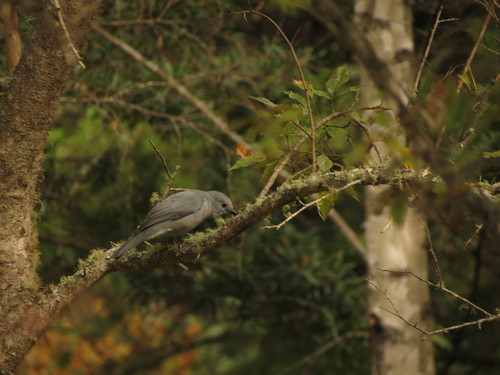
Bosrupsvogel (Ceblepyris caesius) Bosrupsvogel
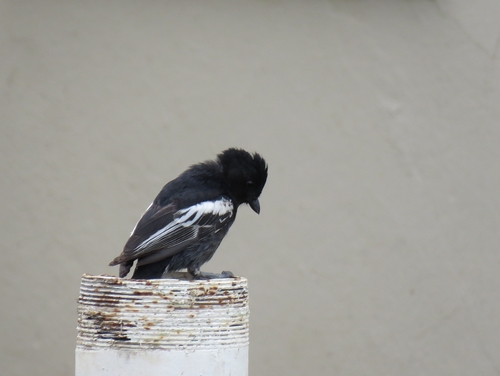
Roetmees (Melaniparus niger) Roetmees

Media

Laden…

Kort gezegd

The most reliable field mark to separate Grey Cuckooshrike from Southern Black-Tit is overall size and structure: Grey Cuckooshrike is much larger and longer-bodied, with a blue-grey coloration and a prominent black eye with a thin white eye-ring, while Southern Black-Tit is much smaller, compact, and almost entirely black or greyish depending on sex. Juvenile Grey Cuckooshrikes show distinct brown and white barring above and white underparts with brown barring, never matched by the tit. In flight or perched, the cuckooshrike's longer tail and slow, heavy wingbeats contrast with the tit's short, rounded tail and more active, agile movements. If you see a medium-sized, blue-grey bird with a large black eye in the canopy, it's the cuckooshrike; if it's a small, monotone black or greyish bird in woodland, it's the tit.

Herkenningstips

  1. Size and structure: Grey Cuckooshrike is much larger and longer-tailed (25–27 cm, 53–68 g) than Southern Black-Tit (16 cm, 21 g). Use this as your first check, especially in mixed flocks or when near other species for scale.
  2. Juvenile plumage: Juvenile Grey Cuckooshrikes are brown above with grey-white barring and have white underparts with brown barring, plus black tails with white edges—these features are never shown by the tit at any age.
  3. Adult coloration: Adult cuckooshrikes are blue-grey with a large black eye and thin white eye-ring; males have a dark grey loreal patch, females a paler one. Southern Black-Tit males are blue-black, females greyish, but both lack the cuckooshrike's blue-grey tones and white eye-ring.
  4. Tail and wing pattern: Cuckooshrike has a longer, more graduated tail and, in juveniles, white edges on tail and flight feathers. The tit's tail is short, lacks any white, and is not graduated.
  5. Bill and face: Cuckooshrike has a relatively robust, black bill and a strikingly large black eye with a thin white ring. The tit's bill is shorter and less robust, and it lacks the white eye-ring.
  6. Sexual dimorphism: Both species show some sexual dimorphism, but in the tit, males are distinctly blue-black and females greyish; in cuckooshrike, both sexes are blue-grey, with only subtle differences in the loreal patch and overall shade.
  7. Behavior and movement: Cuckooshrike moves slowly and methodically in the upper canopy, often alone or in pairs, with slow, heavy wingbeats in flight. The tit is much more active, agile, and often seen in mixed flocks, foraging energetically at lower levels.
  8. Habitat: Cuckooshrike is a forest specialist, usually in high-elevation forest patches or edges; tit is a woodland and open-woodland species, rarely in dense forest.
  9. Vocalizations: Cuckooshrike is quiet, with faint, high-pitched calls; tit is likely more vocal, but specific calls are not detailed here.
  10. Perched posture: Cuckooshrike often appears upright and elongated when perched, while the tit is more compact and horizontal.
  11. Flight style: Cuckooshrike's flight is slow and level with heavy wingbeats; tit's flight is quicker and more bounding, typical of small parids.
  12. Plumage simplicity: Tit is almost entirely monotone (black or greyish), lacking any barring, white edges, or subtle shading; cuckooshrike is more softly patterned and paler overall.
  13. White in tail/wings: Only juvenile cuckooshrike shows white edges in tail and flight feathers; tit never shows white in tail or wings.
  14. Eye color: Cuckooshrike's large, jet-black eye with a white ring is distinctive; tit's eye is less prominent and lacks a ring.
  15. Contextual clues: If seen foraging high in the forest canopy, especially alone or in pairs, cuckooshrike is more likely; if in open woodland or in a mixed flock of small birds, tit is more probable.

Grootte

Grey Cuckooshrike is substantially larger, with a body length of 25–27 cm and weighing 53–68 g [wikipedia], compared to Southern Black-Tit at only about 16 cm and 21 g [wikidata]. The cuckooshrike appears long-bodied and long-tailed, while the tit is compact and short-tailed. This size difference is obvious even at a distance, especially in mixed flocks or when seen near other birds for scale.

Verenkleed

Juvenile Grey Cuckooshrikes are dark brown above with grey-white barring, white underparts with brown barring, and black tails edged with white at the tips and on the flight feathers—these features are never shown by Southern Black-Tit of any age. Adult Grey Cuckooshrikes (both sexes) are blue-grey with a large black eye and thin white eye-ring; males have a dark grey loreal patch, females a paler grey one. Southern Black-Tit males are distinctly blue-black all over, while females are more greyish, but both lack the cuckooshrike's blue-grey tones and white eye-ring. The tit has no white in the tail or wings, and its plumage is nearly monotone, lacking any barring or contrasting feather edges. In all ages, the tit's coloration is simpler and darker, while the cuckooshrike is more subtly patterned and paler.

Gedrag

Grey Cuckooshrike is typically inconspicuous, moving slowly and deliberately in the upper forest canopy, often alone or in pairs, sometimes in small groups or mixed flocks. Its flight is slow, level, and marked by heavy wingbeats. Southern Black-Tit is much more active and agile, typical of tits, foraging energetically in woodland, often in mixed flocks, and showing quick, darting movements. The tit is more likely to be seen hopping and flitting through lower branches and foliage, while the cuckooshrike stays higher and moves more methodically.

Habitat

Grey Cuckooshrike is a forest species, found in forest patches at higher elevations in southern and central Africa, usually in the upper canopy or at forest edges. Southern Black-Tit prefers woodland habitats, not dense forest, and is more widespread in open woods and savanna. If you are in dense, high-elevation forest, cuckooshrike is more likely; in open woodland, especially at lower elevations, expect the tit.

Geluid

Grey Cuckooshrike is relatively quiet, with a faint, high-pitched 'tseeeeep' while foraging, a 'seeeeea' call at the nest, and occasional weaver-like chatters or sneeze-like 'chi-ooo' sounds. Southern Black-Tit vocalizations are not described in the provided notes, but tits in general are more vocal and varied in their calls. If you hear only faint, high-pitched, or soft calls, cuckooshrike is possible; a more varied or typical tit-like chatter would suggest the tit.

Stuur een betere beschrijving

Gebruik dezelfde onderdelen als de vergelijking. Je tekst staat meteen live.

The most reliable field mark to separate Grey Cuckooshrike from Southern Black-Tit is overall size and structure: Grey Cuckooshrike is much larger and longer-bodied, with a blue-grey coloration and a prominent black eye with a thin white eye-ring, while Southern Black-Tit is much smaller, compact, and almost entirely black or greyish depending on sex. Juvenile Grey Cuckooshrikes show distinct brown and white barring above and white underparts with brown barring, never matched by the tit. In flight or perched, the cuckooshrike's longer tail and slow, heavy wingbeats contrast with the tit's short, rounded tail and more active, agile movements. If you see a medium-sized, blue-grey bird with a large black eye in the canopy, it's the cuckooshrike; if it's a small, monotone black or greyish bird in woodland, it's the tit.

  1. Size and structure: Grey Cuckooshrike is much larger and longer-tailed (25–27 cm, 53–68 g) than Southern Black-Tit (16 cm, 21 g). Use this as your first check, especially in mixed flocks or when near other species for scale.
  2. Juvenile plumage: Juvenile Grey Cuckooshrikes are brown above with grey-white barring and have white underparts with brown barring, plus black tails with white edges—these features are never shown by the tit at any age.
  3. Adult coloration: Adult cuckooshrikes are blue-grey with a large black eye and thin white eye-ring; males have a dark grey loreal patch, females a paler one. Southern Black-Tit males are blue-black, females greyish, but both lack the cuckooshrike's blue-grey tones and white eye-ring.
  4. Tail and wing pattern: Cuckooshrike has a longer, more graduated tail and, in juveniles, white edges on tail and flight feathers. The tit's tail is short, lacks any white, and is not graduated.
  5. Bill and face: Cuckooshrike has a relatively robust, black bill and a strikingly large black eye with a thin white ring. The tit's bill is shorter and less robust, and it lacks the white eye-ring.
  6. Sexual dimorphism: Both species show some sexual dimorphism, but in the tit, males are distinctly blue-black and females greyish; in cuckooshrike, both sexes are blue-grey, with only subtle differences in the loreal patch and overall shade.
  7. Behavior and movement: Cuckooshrike moves slowly and methodically in the upper canopy, often alone or in pairs, with slow, heavy wingbeats in flight. The tit is much more active, agile, and often seen in mixed flocks, foraging energetically at lower levels.
  8. Habitat: Cuckooshrike is a forest specialist, usually in high-elevation forest patches or edges; tit is a woodland and open-woodland species, rarely in dense forest.
  9. Vocalizations: Cuckooshrike is quiet, with faint, high-pitched calls; tit is likely more vocal, but specific calls are not detailed here.
  10. Perched posture: Cuckooshrike often appears upright and elongated when perched, while the tit is more compact and horizontal.
  11. Flight style: Cuckooshrike's flight is slow and level with heavy wingbeats; tit's flight is quicker and more bounding, typical of small parids.
  12. Plumage simplicity: Tit is almost entirely monotone (black or greyish), lacking any barring, white edges, or subtle shading; cuckooshrike is more softly patterned and paler overall.
  13. White in tail/wings: Only juvenile cuckooshrike shows white edges in tail and flight feathers; tit never shows white in tail or wings.
  14. Eye color: Cuckooshrike's large, jet-black eye with a white ring is distinctive; tit's eye is less prominent and lacks a ring.
  15. Contextual clues: If seen foraging high in the forest canopy, especially alone or in pairs, cuckooshrike is more likely; if in open woodland or in a mixed flock of small birds, tit is more probable.

Grey Cuckooshrike is substantially larger, with a body length of 25–27 cm and weighing 53–68 g [wikipedia], compared to Southern Black-Tit at only about 16 cm and 21 g [wikidata]. The cuckooshrike appears long-bodied and long-tailed, while the tit is compact and short-tailed. This size difference is obvious even at a distance, especially in mixed flocks or when seen near other birds for scale.

Juvenile Grey Cuckooshrikes are dark brown above with grey-white barring, white underparts with brown barring, and black tails edged with white at the tips and on the flight feathers—these features are never shown by Southern Black-Tit of any age. Adult Grey Cuckooshrikes (both sexes) are blue-grey with a large black eye and thin white eye-ring; males have a dark grey loreal patch, females a paler grey one. Southern Black-Tit males are distinctly blue-black all over, while females are more greyish, but both lack the cuckooshrike's blue-grey tones and white eye-ring. The tit has no white in the tail or wings, and its plumage is nearly monotone, lacking any barring or contrasting feather edges. In all ages, the tit's coloration is simpler and darker, while the cuckooshrike is more subtly patterned and paler.

Grey Cuckooshrike is typically inconspicuous, moving slowly and deliberately in the upper forest canopy, often alone or in pairs, sometimes in small groups or mixed flocks. Its flight is slow, level, and marked by heavy wingbeats. Southern Black-Tit is much more active and agile, typical of tits, foraging energetically in woodland, often in mixed flocks, and showing quick, darting movements. The tit is more likely to be seen hopping and flitting through lower branches and foliage, while the cuckooshrike stays higher and moves more methodically.

Grey Cuckooshrike is a forest species, found in forest patches at higher elevations in southern and central Africa, usually in the upper canopy or at forest edges. Southern Black-Tit prefers woodland habitats, not dense forest, and is more widespread in open woods and savanna. If you are in dense, high-elevation forest, cuckooshrike is more likely; in open woodland, especially at lower elevations, expect the tit.

Grey Cuckooshrike is relatively quiet, with a faint, high-pitched 'tseeeeep' while foraging, a 'seeeeea' call at the nest, and occasional weaver-like chatters or sneeze-like 'chi-ooo' sounds. Southern Black-Tit vocalizations are not described in the provided notes, but tits in general are more vocal and varied in their calls. If you hear only faint, high-pitched, or soft calls, cuckooshrike is possible; a more varied or typical tit-like chatter would suggest the tit.

Wijzigingen weggooien?

Je hebt niet-opgeslagen wijzigingen. Als je nu weggaat, gaan die verloren.

Bosrupsvogel · Roetmees · Mijn lastige vogels