

Grote glansvogel vs Natterermierklauwier
Jacamerops aureus versus Thamnophilus stictocephalus
Speel een quiz met Grote glansvogel en Natterermierklauwier
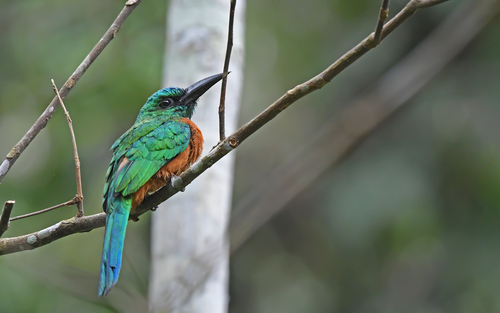 Grote glansvogel
 Natterermierklauwier
Kort gezegd
Great Jacamar and Natterer's Slaty-Antshrike differ dramatically in size, structure, and overall coloration, making confusion unlikely with good views, but possible in dense forest or poor light. The Great Jacamar is much larger, bulkier, and shines with metallic greens and rufous below, while the antshrike is smaller, with a stouter hooked bill and strong sexual dimorphism—males are slaty gray with white wing spots, females are rufous and clay-colored. If you see a big, long-billed, iridescent bird perched quietly in the mid-canopy, it's the jacamar; a smaller, rounder, more active bird with a hooked bill and spotted wings in the understorey is the antshrike. Both may be seen in similar lowland forest, so careful attention to size, bill shape, and plumage is essential.
Herkenningstips
- Size is the most immediate clue: Great Jacamar is nearly twice as long and three times as heavy as Natterer's Slaty-Antshrike. If the bird appears large and elongated, it's almost certainly the jacamar.
- Bill shape and length: Jacamar has a long, straight, slender bill suited for aerial insect-catching; antshrike has a shorter, stout, hooked bill typical of antbirds. Bill shape is diagnostic even at distance.
- Plumage gloss and color: Jacamar males are metallic green with gold, blue, and copper tones above, white lower throat, and deep rufous below. Females lack the white throat spot but are otherwise similar. Antshrike males are matte slaty gray-black with white spots on wings; females are rufous and clay with white-spotted dark brown wings. The jacamar's iridescence is unique.
- Sexual dimorphism: Antshrike shows strong sexual dimorphism (males gray-black, females rufous/clay); jacamar sexes are similar except for the female's lack of white throat spot.
- Wing and tail pattern: Antshrike has white spots and edges on wings and white tips to tail feathers in both sexes. Jacamar's wings are plain black, tail blue-black, with no white spots or tips.
- Underparts: Jacamar is deep rufous below (both sexes), with a white lower throat in males. Antshrike males are gray below with a whitish belly; females are pale clay and gray below.
- Perching posture and jizz: Jacamar perches upright, often exposed, with a long tail and bill. Antshrike is more compact, often horizontal, and stays within cover.
- Foraging behavior: Jacamar sallies for flying insects from a perch; antshrike hops through vegetation, gleaning prey, and rarely sallies far.
- Habitat strata: Jacamar is in mid-canopy or forest edge; antshrike is in understorey to mid-storey, rarely above 10 m.
- Tail shape: Jacamar's tail is long and straight; antshrike's is shorter, with white tips visible in good views.
- Leg color: Jacamar has dark horn-colored legs; antshrike's leg color is not distinctive for separation.
- Contextual clues: If seen following army ants, it's more likely the antshrike (though not a strict rule). If sallying out in open air, it's the jacamar.
- Juvenile/immature birds: No distinctive age-specific wing patterns are described for either species, so rely on structure and overall coloration for young birds.
- Confusion risk: In poor light, a female antshrike's rufous tones could be mistaken for the jacamar's rufous belly, but the size, bill, and lack of iridescence will separate them.
- Range overlap: Both species occur in Bolivia and Brazil, so do not use range alone for ID in these areas.
Grootte
Great Jacamar is by far the larger species, measuring 25–30 cm in length and weighing about 63 g [wikidata]. Natterer's Slaty-Antshrike is much smaller, at 14–15 cm and 19–22 g [wikipedia]. This size difference is striking in the field: the jacamar is almost twice as long and three times as heavy as the antshrike. The jacamar also appears more elongated and slender, while the antshrike is compact and round-bodied.
Verenkleed
-
Juvenile/immature wing pattern: No age-specific upperwing marks are described for either species, so focus on adult plumage for separation.
-
Great Jacamar (adult): Males are bright metallic green above with gold and blue tones, a white lower throat, and deep rufous underparts. Primaries are black, tail is blue-black, and the bill is long and straight. Females are similar but lack the white throat spot.
-
Natterer's Slaty-Antshrike (adult): Strong sexual dimorphism. Males are mostly slaty gray to black above with a black crown and forehead, white spots and edges on black wings, and a gray face. Underparts are gray with a whitish belly. Females have a rufous crown, reddish-brown upperparts, dark brown wings with white spots, and clay-colored edges on the flight feathers. Both sexes have black or dark brown tails with white tips. The antshrike's plumage is matte and patterned, lacking the jacamar's iridescence.
Gedrag
Great Jacamar typically sits quietly, sallying out from a perch to catch insects in flight, often in the mid-canopy or at forest edge. Its long, straight bill is adapted for aerial hawking. Natterer's Slaty-Antshrike is much more active, hopping through understorey and mid-storey vegetation, gleaning insects from leaves and branches, and sometimes making short upward sallies. The antshrike's behavior is more restless and terrestrial, rarely sallying far from cover, and it often forages in pairs. The jacamar is more likely to be seen perched out in the open, while the antshrike stays within dense foliage.
Habitat
Both species occur in lowland forests of Bolivia and Brazil, but they differ in vertical foraging strata. Great Jacamar prefers the mid-canopy and shaded forest edges, often near banks or clearings, and is usually seen perched above the understorey. Natterer's Slaty-Antshrike is found in the understorey to mid-storey (1–10 m above ground), foraging within dense vegetation. While their ranges overlap, the jacamar is more likely higher up and at forest edge, the antshrike lower and deeper within the forest.
Grote glansvogel · Natterermierklauwier · Mijn lastige vogels