

Motmot

Gouden taling vs Kaapse slobeend

Spatula hottentota versus Spatula smithii

Speel een quiz met Gouden taling en Kaapse slobeend

Gouden taling (Spatula hottentota) Gouden taling
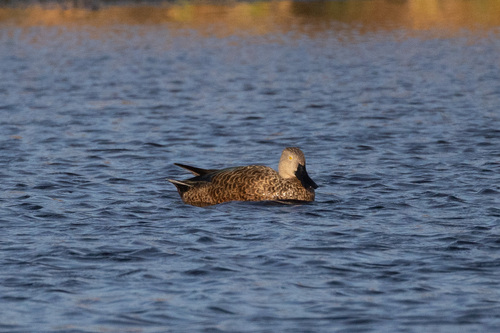
Kaapse slobeend (Spatula smithii) Kaapse slobeend

Media

Laden…

Kort gezegd

The most reliable way to separate Blue-billed Teal from Cape Shoveler is by size and bill shape: Cape Shoveler is much larger and has a broad, shovel-shaped bill, while Blue-billed Teal is small with a proportionally short, narrow, bluish bill. In flight or on water, Blue-billed Teal shows a compact build and a green speculum with white and black borders, whereas Cape Shoveler is bulkier, with a pale blue forewing and green speculum separated by a white border. Adult male Blue-billed Teal have a distinctly spotted breast and a dark crown with a pale face, while Cape Shoveler adults are more uniformly speckled brown-grey. Juveniles and females of both can be tricky, but the size and bill differences remain obvious. Both species may occur together in southern Africa, but Cape Shoveler is more localized and gregarious.

Herkenningstips

  1. Size is the first check: Cape Shoveler is much larger and bulkier than Blue-billed Teal. If you see two similar ducks together, the smaller one is almost certainly Blue-billed Teal.
  2. Bill shape is crucial: Cape Shoveler has a broad, long, spatulate bill that looks oversized for its head. Blue-billed Teal has a proportionally short, narrow, bluish bill with a blackish tip. This is obvious in both perched and swimming birds.
  3. Wing pattern in flight or at rest: Blue-billed Teal (all ages) shows a green speculum bordered behind by black and then a white bar. Cape Shoveler has a pale blue forewing (coverts) and a green speculum separated by a white border; females have a grey forewing. This is best seen in flight or when birds are preening.
  4. Adult male Blue-billed Teal: Look for a dark brown crown, pale face, and strongly spotted breast and neck. The face is distinctly paler than the crown, with a blackish patch near the ear.
  5. Cape Shoveler adult plumage: Uniformly speckled grey-brown overall, with males having a paler head than females. No strong contrast between crown and face.
  6. Leg and eye color: Blue-billed Teal has bluish-grey legs and brown eyes; Cape Shoveler has dull orange legs and, in males, yellow eyes. These are subtle but can help at close range.
  7. Juvenile/female confusion: Both species' females and juveniles are duller and less distinct, but the size and bill shape remain reliable. Juvenile Blue-billed Teal are smaller and less spotted than adults, but never approach the bulk or bill size of shoveler.
  8. Feeding behavior: If you see a duck swinging its bill side-to-side at the water surface, it's likely Cape Shoveler. Blue-billed Teal dabbles more conventionally.
  9. Group size: Large flocks on open water are more likely to be Cape Shoveler. Blue-billed Teal are more often in pairs or small groups.
  10. Habitat overlap: Both can occur in southern African wetlands, but Blue-billed Teal is more widespread and can be found in a wider range of wetland types.
  11. Voice: Calls are rarely helpful, but a mechanical 'burping' from a small duck is Blue-billed Teal; a quiet 'rarr' or 'cawick' or a quack from a large duck is Cape Shoveler.
  12. Sex differences: Male Cape Shoveler has a paler head and yellow eyes, but both sexes are similar. Male Blue-billed Teal is more strongly marked than female or juvenile.
  13. In mixed flocks: Always check for the small, compact duck with a short bill among shovelers—this will be Blue-billed Teal.
  14. When in doubt: Size and bill shape are the most reliable, even at a distance or in poor light.
  15. Common pitfalls: Do not rely solely on plumage pattern, especially in eclipse or juvenile birds—structure and size are much more reliable for these two species.

Grootte

Cape Shoveler is substantially larger: 51–53 cm in length versus 33–35 cm for Blue-billed Teal ([wikipedia]). The shoveler also has a much broader, longer bill. Blue-billed Teal is a small, delicate duck, weighing 53–288 g, while Cape Shoveler is much heavier (exact weight not given, but consistently described as large and stocky). Wingspan is also greater in Cape Shoveler (not specified, but implied by overall size). These size differences are obvious in the field, even at a distance or in mixed flocks.

Verenkleed

Juvenile and female Blue-billed Teal are duller and less spotted than adult males, but still show a small, neat pattern with a compact build. The upperwing in all ages of Blue-billed Teal is blackish with a green speculum, bordered behind by narrow black and then white bars. Cape Shoveler, in all plumages, shows a pale blue forewing (coverts) and a green speculum separated by a white border; females have a grey forewing instead of blue. Adult male Blue-billed Teal has a dark brown crown, pale face, and strongly spotted breast, while Cape Shoveler is more uniformly speckled grey-brown with a paler head in males. Both sexes of Cape Shoveler have dull orange legs and yellow eyes (male), while Blue-billed Teal has bluish-grey legs and brown eyes. Juvenile Blue-billed Teal are duller and less distinctly marked than adults, but still smaller and with a shorter bill than any Cape Shoveler.

Gedrag

Cape Shoveler is often seen in large, gregarious flocks outside the breeding season, feeding by swinging its broad bill side-to-side to strain food from water. Blue-billed Teal is more likely to be seen in pairs or small groups, and is generally less conspicuous. Both species dabble, but the shoveler's feeding technique is more distinctive due to its specialized bill. Blue-billed Teal is relatively undemonstrative in breeding behavior, with subtle courtship displays.

Habitat

Both species use open wetlands, marshes, and wet grasslands, but Cape Shoveler prefers open water with some emergent vegetation and is more likely to be seen in large flocks on open wetlands. Blue-billed Teal is widespread in a variety of wetland habitats across sub-Saharan Africa and Madagascar, often in smaller numbers and sometimes in more vegetated or secluded wetlands. Overlap is possible in southern Africa, but Cape Shoveler is more localized and less widespread.

Geluid

Cape Shoveler is generally quiet, but males give 'rarr' and 'cawick' calls, while females have a quack. Blue-billed Teal males can produce a soft mechanical 'burping' call during display, but both species are not especially vocal and calls are rarely diagnostic at a distance.

Stuur een betere beschrijving

Gebruik dezelfde onderdelen als de vergelijking. Je tekst staat meteen live.

The most reliable way to separate Blue-billed Teal from Cape Shoveler is by size and bill shape: Cape Shoveler is much larger and has a broad, shovel-shaped bill, while Blue-billed Teal is small with a proportionally short, narrow, bluish bill. In flight or on water, Blue-billed Teal shows a compact build and a green speculum with white and black borders, whereas Cape Shoveler is bulkier, with a pale blue forewing and green speculum separated by a white border. Adult male Blue-billed Teal have a distinctly spotted breast and a dark crown with a pale face, while Cape Shoveler adults are more uniformly speckled brown-grey. Juveniles and females of both can be tricky, but the size and bill differences remain obvious. Both species may occur together in southern Africa, but Cape Shoveler is more localized and gregarious.

  1. Size is the first check: Cape Shoveler is much larger and bulkier than Blue-billed Teal. If you see two similar ducks together, the smaller one is almost certainly Blue-billed Teal.
  2. Bill shape is crucial: Cape Shoveler has a broad, long, spatulate bill that looks oversized for its head. Blue-billed Teal has a proportionally short, narrow, bluish bill with a blackish tip. This is obvious in both perched and swimming birds.
  3. Wing pattern in flight or at rest: Blue-billed Teal (all ages) shows a green speculum bordered behind by black and then a white bar. Cape Shoveler has a pale blue forewing (coverts) and a green speculum separated by a white border; females have a grey forewing. This is best seen in flight or when birds are preening.
  4. Adult male Blue-billed Teal: Look for a dark brown crown, pale face, and strongly spotted breast and neck. The face is distinctly paler than the crown, with a blackish patch near the ear.
  5. Cape Shoveler adult plumage: Uniformly speckled grey-brown overall, with males having a paler head than females. No strong contrast between crown and face.
  6. Leg and eye color: Blue-billed Teal has bluish-grey legs and brown eyes; Cape Shoveler has dull orange legs and, in males, yellow eyes. These are subtle but can help at close range.
  7. Juvenile/female confusion: Both species' females and juveniles are duller and less distinct, but the size and bill shape remain reliable. Juvenile Blue-billed Teal are smaller and less spotted than adults, but never approach the bulk or bill size of shoveler.
  8. Feeding behavior: If you see a duck swinging its bill side-to-side at the water surface, it's likely Cape Shoveler. Blue-billed Teal dabbles more conventionally.
  9. Group size: Large flocks on open water are more likely to be Cape Shoveler. Blue-billed Teal are more often in pairs or small groups.
  10. Habitat overlap: Both can occur in southern African wetlands, but Blue-billed Teal is more widespread and can be found in a wider range of wetland types.
  11. Voice: Calls are rarely helpful, but a mechanical 'burping' from a small duck is Blue-billed Teal; a quiet 'rarr' or 'cawick' or a quack from a large duck is Cape Shoveler.
  12. Sex differences: Male Cape Shoveler has a paler head and yellow eyes, but both sexes are similar. Male Blue-billed Teal is more strongly marked than female or juvenile.
  13. In mixed flocks: Always check for the small, compact duck with a short bill among shovelers—this will be Blue-billed Teal.
  14. When in doubt: Size and bill shape are the most reliable, even at a distance or in poor light.
  15. Common pitfalls: Do not rely solely on plumage pattern, especially in eclipse or juvenile birds—structure and size are much more reliable for these two species.

Cape Shoveler is substantially larger: 51–53 cm in length versus 33–35 cm for Blue-billed Teal ([wikipedia]). The shoveler also has a much broader, longer bill. Blue-billed Teal is a small, delicate duck, weighing 53–288 g, while Cape Shoveler is much heavier (exact weight not given, but consistently described as large and stocky). Wingspan is also greater in Cape Shoveler (not specified, but implied by overall size). These size differences are obvious in the field, even at a distance or in mixed flocks.

Juvenile and female Blue-billed Teal are duller and less spotted than adult males, but still show a small, neat pattern with a compact build. The upperwing in all ages of Blue-billed Teal is blackish with a green speculum, bordered behind by narrow black and then white bars. Cape Shoveler, in all plumages, shows a pale blue forewing (coverts) and a green speculum separated by a white border; females have a grey forewing instead of blue. Adult male Blue-billed Teal has a dark brown crown, pale face, and strongly spotted breast, while Cape Shoveler is more uniformly speckled grey-brown with a paler head in males. Both sexes of Cape Shoveler have dull orange legs and yellow eyes (male), while Blue-billed Teal has bluish-grey legs and brown eyes. Juvenile Blue-billed Teal are duller and less distinctly marked than adults, but still smaller and with a shorter bill than any Cape Shoveler.

Cape Shoveler is often seen in large, gregarious flocks outside the breeding season, feeding by swinging its broad bill side-to-side to strain food from water. Blue-billed Teal is more likely to be seen in pairs or small groups, and is generally less conspicuous. Both species dabble, but the shoveler's feeding technique is more distinctive due to its specialized bill. Blue-billed Teal is relatively undemonstrative in breeding behavior, with subtle courtship displays.

Both species use open wetlands, marshes, and wet grasslands, but Cape Shoveler prefers open water with some emergent vegetation and is more likely to be seen in large flocks on open wetlands. Blue-billed Teal is widespread in a variety of wetland habitats across sub-Saharan Africa and Madagascar, often in smaller numbers and sometimes in more vegetated or secluded wetlands. Overlap is possible in southern Africa, but Cape Shoveler is more localized and less widespread.

Cape Shoveler is generally quiet, but males give 'rarr' and 'cawick' calls, while females have a quack. Blue-billed Teal males can produce a soft mechanical 'burping' call during display, but both species are not especially vocal and calls are rarely diagnostic at a distance.

Wijzigingen weggooien?

Je hebt niet-opgeslagen wijzigingen. Als je nu weggaat, gaan die verloren.

Gouden taling · Kaapse slobeend · Mijn lastige vogels