

ハジロクロハラアジサシ 対 メリケンアジサシ
Chlidonias leucopterus 対 Sterna forsteri
ハジロクロハラアジサシとメリケンアジサシのクイズ
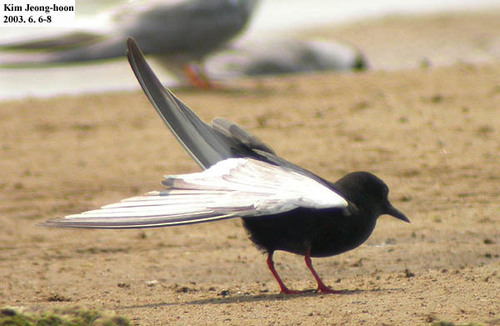 ハジロクロハラアジサシ
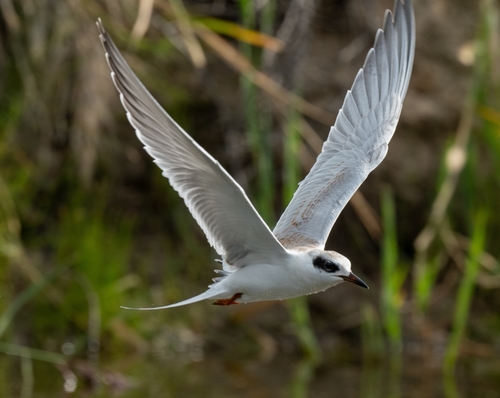 メリケンアジサシ
要点
The most reliable field mark to separate White-winged Black Tern from Forster's Tern is the upperwing pattern and overall coloration in non-breeding and immature birds: White-winged Black Tern (especially juveniles and non-breeding adults) shows a dark mantle isolated by a clear white rump and collar, with contrasting white wings and a square-tipped tail, while Forster's Tern has a more uniform pale gray upperwing, lacks the isolated dark mantle, and shows a deeply forked tail. Forster's Tern is also larger and longer-winged, with a slender, pointed bill and a more classic 'tern' jizz, while White-winged Black Tern is smaller, with a short, stubby bill and a more swallow-like, buoyant flight. In breeding plumage, White-winged Black Tern is strikingly dark below and on the head, whereas Forster's Tern is white below with a full black cap. Bill and leg color also differ in breeding season: Forster's has orange legs and a black-tipped orange bill, while White-winged Black Tern has red legs and a black bill. These differences are most apparent when birds are seen well in flight or at rest.
識別のコツ
- Juvenile/first-winter upperwing pattern: White-winged Black Tern juveniles and non-breeding adults show a sharply defined dark mantle ('saddle') isolated by a clear white rump and broad white collar, with mostly white wings and a square-tipped tail. Forster's Tern never shows this pattern; its upperwing is more uniformly pale gray with gingery-brown scaling in juveniles, and the tail is always deeply forked.
- Tail shape: Forster's Tern has a long, deeply forked tail with a gray center in all plumages. White-winged Black Tern's tail is shorter, paler, and appears square-tipped in juveniles.
- Bill shape and color: White-winged Black Tern has a short, stubby black bill (shorter than the head), while Forster's Tern has a longer, slender bill. In breeding plumage, Forster's Tern's bill is orange with a black tip; White-winged Black Tern's is black.
- Leg color: In breeding season, Forster's Tern has bright orange legs, while White-winged Black Tern has red legs. In non-breeding plumage, Forster's Tern's legs are duller, brownish-red.
- Head pattern (non-breeding): Forster's Tern shows a white crown with a distinctive black comma-shaped patch through the eye and ear-coverts. White-winged Black Tern has a blackish crown flecked with white, a dark patch in front of the eye, and a broad white collar.
- Head pattern (breeding): Forster's Tern has a full black cap extending down the neck, while White-winged Black Tern has a black head, neck, and belly, with a pale gray back and white face tinge.
- Underparts (breeding): White-winged Black Tern is dark below (black neck and belly), while Forster's Tern is bright white below.
- Upperwing color: White-winged Black Tern has mainly white wings with grayish inner portions and brown-tipped coverts; Forster's Tern's wings are pale gray with darker primaries, but never show the strong white/dark contrast of White-winged Black Tern.
- Flight style: White-winged Black Tern is more buoyant and swallow-like, with shallow, leisurely wingbeats. Forster's Tern is more angular and tern-like, with longer, more pointed wings.
- Size and structure: Forster's Tern is larger, longer-winged, and longer-tailed. White-winged Black Tern is smaller and more compact.
- Habitat and range: In North America, Forster's Tern is expected; in Eurasia, White-winged Black Tern is the default. Forster's Tern prefers saline/coastal habitats in winter, White-winged Black Tern is almost always in freshwater marshes.
- Feeding behavior: Forster's Tern plunge-dives for fish, often from a hover. White-winged Black Tern rarely dives, instead picking insects from the surface or in flight.
- Hybrid confusion: Rare hybrids between White-winged Black Tern and Black Tern can show mixed characters, but Forster's Tern does not show the dark breast-side patches of Black Tern or the isolated mantle of White-winged Black Tern.
- Voice: Not reliably diagnostic with the provided information.
- Pitfalls: Immature Forster's Tern may look gingery and scaly above, but never shows the sharp white rump/collar contrast and dark saddle of White-winged Black Tern. Always check tail shape and upperwing pattern in flight for the most reliable separation.
大きさ
Forster's Tern is distinctly larger, measuring 33–36 cm in length with a 78–80 cm wingspan and weighing 130–190 g [wikipedia]. White-winged Black Tern is a small tern, noticeably more compact and lighter, with a shorter, stubbier bill [wikipedia]. Forster's Tern appears longer-winged and longer-tailed, especially in flight, while White-winged Black Tern is more compact and swallow-like.
羽色
- Juvenile/First-winter/Non-breeding birds:
- White-winged Black Tern juveniles and non-breeding adults show a distinctive pattern: a dark brown mantle ('saddle') sharply isolated by a clear white rump and broad white collar. The upperwing is mostly white with grayish inner wing and brown-tipped coverts, and the tail is pale gray to almost white and appears square-tipped in juveniles. The underwing coverts retain some black. The head pattern includes a blackish crown flecked with white and a dark patch in front of the eye, with a broad white collar [wikipedia].
- Forster's Tern juveniles and non-breeding adults have a more uniform pale gray upperwing, lacking the isolated dark mantle and white rump/collar contrast. The back and wing coverts show a scaly gingery-brown pattern, but the overall effect is much less contrasting than in White-winged Black Tern. The tail is deeply forked, with a gray center, and the underparts are white. The head shows a white crown with a black comma-shaped patch through the eye and ear-coverts [wikipedia].
- Breeding adults:
- White-winged Black Tern is strikingly dark: black neck and belly, dark gray back, white rump and tail, black head with a white face tinge, and short red legs with a short, black bill. Wings are mainly white but with grayish inner portions and brown-tipped coverts.
- Forster's Tern has a full black cap extending down the neck, bright white underparts, pale gray upperparts, and a black-tipped orange bill with bright orange legs. The tail is long and deeply forked, with a gray center.
- Key contrasts: Only White-winged Black Tern shows the isolated dark mantle with white collar and rump in young and non-breeding birds; Forster's Tern never shows this pattern. Forster's Tern always has a deeply forked tail, while White-winged Black Tern's tail is square-tipped in juveniles and less deeply forked overall.
行動
White-winged Black Tern feeds by slow, shallow flight over water, picking insects from the surface or catching them in the air, and rarely dives [wikipedia]. Its flight is buoyant and swallow-like, with shallow, leisurely wingbeats. Forster's Tern is a more typical 'white' tern, feeding by plunge-diving for fish, often from a hover, and is more aggressive in defense of its nest. Forster's Tern usually feeds in saline or brackish environments in winter, while White-winged Black Tern is more associated with freshwater marshes. In flight, Forster's Tern appears more angular and tern-like, while White-winged Black Tern is more compact and swallow-like.
生息環境
White-winged Black Tern is almost always found in or near freshwater marshes, lakes, and wetlands across Europe, Africa, Asia, and Australia [wikipedia]. Forster's Tern breeds in inland marshes in North America but winters primarily in coastal, saline, or brackish habitats. In Europe, Forster's Tern is a rare vagrant, so location can be a strong clue. If seen in a North American saltmarsh or on the coast, Forster's Tern is much more likely; if in Eurasian freshwater marshes, White-winged Black Tern is the default.
声
No diagnostic vocal differences are described in the provided notes. Forster's Tern is noted to have calls similar to Common Tern, with some harsher, gull-like notes, but this is not described for White-winged Black Tern.
ハジロクロハラアジサシ · メリケンアジサシ · 苦手な鳥