

ワタハラハチドリ 対 ビジョハチドリ
Chalybura buffonii 対 Goldmania bella
ワタハラハチドリとビジョハチドリのクイズ
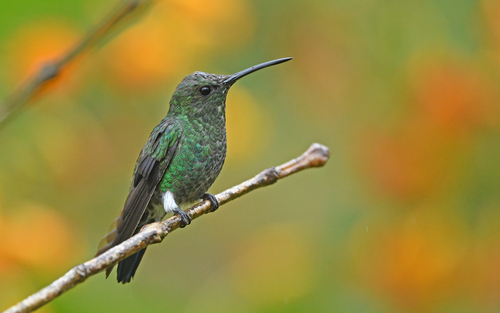 ワタハラハチドリ
 ビジョハチドリ
要点
The most reliable field mark to separate White-vented Plumeleteer from Pirre Hummingbird is the combination of tail and vent coloration: White-vented Plumeleteer always shows long, white undertail coverts and a dark, blue-black or bronze tail, while Pirre Hummingbird has white undertail coverts but a strikingly bicolored tail with cinnamon-buff outer feathers tipped black. Males of Pirre Hummingbird also have a unique chestnut forehead and lores, never seen in Plumeleteer. Females differ in underpart color: Plumeleteer females are gray below with green flecks, while Pirre females are pale cinnamon buff underneath. Bill color also helps—Pirre Hummingbird always shows a pink-based mandible, while Plumeleteer is all black except in one subspecies. Size and structure differ, but can be subtle in the field.
識別のコツ
- Tail pattern is critical: White-vented Plumeleteer always has a uniform dark (blue-black or bronze) tail, while Pirre Hummingbird shows a bicolored tail with cinnamon-buff outer feathers and black tips. This is visible in both perched and flying birds of all ages and sexes.
- Undertail coverts: Both species have white undertail coverts, but Plumeleteer's are longer and more prominent, often forming a noticeable tuft. Pirre Hummingbird's are shorter and less bushy.
- Male forehead and lores: Pirre Hummingbird males have a distinctive chestnut forehead and lores, never present in Plumeleteer. If you see a rufous or chestnut wash on the face, it's Pirre.
- Female underparts: Female Plumeleteers are gray below with green flecks, while Pirre Hummingbird females are pale cinnamon buff underneath with no green flecking. This is a strong mark in good light.
- Bill color: Pirre Hummingbird always has a pink-based mandible with a black tip, while Plumeleteer is all black except for the rare intermedia subspecies (which has a pinkish base and is not found in most of the range). If you see a pinkish lower bill, suspect Pirre.
- Size and bulk: Plumeleteer is larger and heavier, but this is only useful if both species are present for comparison or if you have experience with both.
- Crown and uppertail coverts: Plumeleteer males may show a bronzy crown and coppery uppertail coverts, while Pirre Hummingbird males have a bronzy rump but not a bronzy crown.
- Central tail feathers: In Pirre Hummingbird, the central tail feathers are bronze-green at the base with black tips; in Plumeleteer, the tail is uniformly dark with a bronze gloss on the central feathers.
- Female face: Pirre Hummingbird females have chestnut lores (but not forehead), which can be a subtle but useful mark.
- Underpart color in males: Plumeleteer males have a bluish upper breast and bright metallic green lower breast, with a whitish lower belly. Pirre Hummingbird males have a shiny bluish green throat, breast, and belly, but a cinnamon chin.
- Geographic context: If you are outside Panama or far NW Colombia, Pirre Hummingbird is extremely unlikely. Plumeleteer is much more widespread.
- Subspecies variation: Some Plumeleteer subspecies (e.g., caeruleogaster, intermedia) show more blue or gray on the underparts, but never the cinnamon tones of Pirre Hummingbird.
- Tail in flight: Even in quick flight views, Pirre Hummingbird's cinnamon tail panels are often visible and contrast with the otherwise green bird.
- Perched jizz: Plumeleteer may appear bulkier and longer-tailed, but this is subtle and not always reliable.
- No voice distinction: No vocal differences are described in the sources, so do not rely on song or call for separation.
大きさ
White-vented Plumeleteer is notably larger and heavier: 10.5–12 cm long, with males 6–7.3 g and females up to 7.9 g. Pirre Hummingbird is smaller and lighter, at 8.4–9.5 cm and 3–4 g for both sexes. In direct comparison, Plumeleteer looks bulkier and longer, but size overlap can make this unreliable unless both are seen together. Bill length and body proportions are not strongly contrasting, but Pirre Hummingbird may appear more delicate overall.
羽色
- Juvenile/immature plumages: No specific upperwing or flight pattern differences are described for either species, so focus on tail and vent area in all ages.
- Adult males: White-vented Plumeleteer males are dark metallic green above with a bronzy crown and coppery uppertail coverts, blue-black tail, and long, white undertail coverts. Pirre Hummingbird males have a chestnut forehead and lores, metallic green upperparts with a bronzy rump, a bicolored tail (bronze-green central feathers, cinnamon-buff outers with black tips), and a shiny bluish green belly with a cinnamon chin.
- Adult females: Plumeleteer females are paler metallic green above, gray below with green speckling, and have a dark tail with gray tips. Pirre Hummingbird females lack the chestnut forehead, have chestnut lores, entirely green upperparts, and pale cinnamon buff underparts. Their tail is also bicolored as in the male.
- Undertail coverts: Both species have white undertail coverts, but Plumeleteer's are longer and more conspicuous.
- Tail: Plumeleteer always has a dark tail (blue-black or bronze), while Pirre Hummingbird's tail is bicolored with obvious cinnamon and black.
行動
Both species forage for nectar and likely small arthropods, typically from low to mid-levels in the forest. No major behavioral differences are described in the sources. Both can be seen hovering at flowers, but Pirre Hummingbird is noted for foraging near the ground to mid-levels. In flight or perched, behavioral jizz is not a reliable separator.
生息環境
White-vented Plumeleteer is found in a broader range across Colombia, Ecuador, Panama, Peru, and Venezuela, often in lowland and foothill forests. Pirre Hummingbird is much more restricted, occurring only in Panama and far northwestern Colombia, typically in humid forest, especially in the Serranía del Pirre region. If seen outside this limited range, Pirre Hummingbird is unlikely.