

ムラサキケンバネハチドリ 対 アオボウシモリハチドリ
Campylopterus hemileucurus 対 Thalurania colombica
ムラサキケンバネハチドリとアオボウシモリハチドリのクイズ
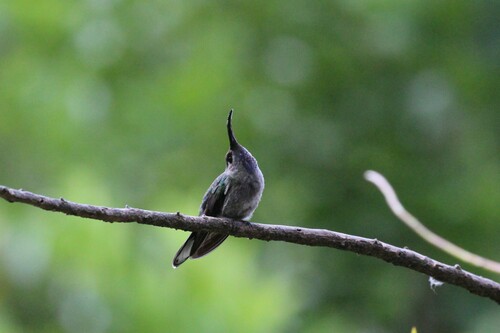 ムラサキケンバネハチドリ
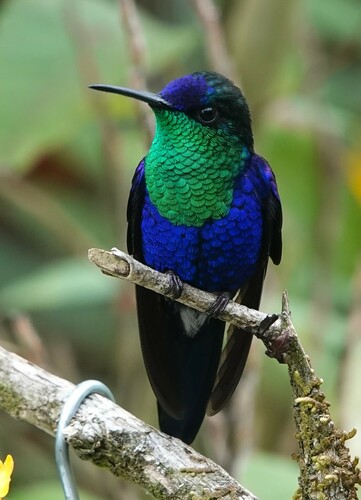 アオボウシモリハチドリ
要点
The most reliable way to separate Violet Sabrewing from Crowned Woodnymph is by size and structure: the sabrewing is dramatically larger and bulkier, with a heavier build and longer bill, while the woodnymph is much smaller and more delicate. If seen in flight or perched, note the sabrewing’s broad, white-tipped tail versus the woodnymph’s deeply forked, blue-black tail (with white tips only on female/immature woodnymphs). Adult male plumage can overlap in violet and green hues, but the sabrewing’s overall metallic violet-blue and green is much more extensive and darker, while the woodnymph male shows a glittering green throat and chest with a violet crown and belly. Female and immature birds are best separated by size, tail pattern, and underpart color. Structural differences and tail shape are often more reliable than subtle color shades, especially in poor light.
識別のコツ
- Size is the quickest separator: If the bird looks large and chunky for a hummingbird, it is almost certainly a Violet Sabrewing. The woodnymph is much smaller and more slender.
- Bill structure: Sabrewing has a thick, long, straight black bill; woodnymph’s bill is shorter, thinner, and more delicate.
- Tail shape in flight or perched: Sabrewing’s tail is broad, only slightly forked, and all but the central feathers have wide white tips. Woodnymph’s tail is deeply forked and blue-black; only females and immatures show white tips, and only on the outer three pairs.
- Adult male color: Sabrewing male is metallic violet-blue over most of the body, with green lower back and uppertail coverts. Woodnymph male is more patterned: violet crown, upper back, and belly, but glittering green throat and chest, and a bronzy green nape.
- Adult female color: Sabrewing female has metallic green to bronze-green upperparts, a violet-blue throat, gray underparts with green spots along the sides, and a white-tipped tail. Woodnymph female is bright green above, pale gray below, and has a blue-black tail with white tips only on outer feathers.
- Immature/juvenile birds: Woodnymph immatures are dull green above and entirely pale gray below, with white-tipped outer tail feathers. Sabrewing immatures are not described in detail, but should always show some metallic color and a broad white tail tip.
- Underpart color (all ages): Sabrewing underparts are more violet-blue (male) or gray with green spots (female); woodnymph underparts are glittering green on males, pale gray on females/immatures.
- Crown color: Woodnymph males have a distinctive violet crown; sabrewing’s crown is dusky with bluish-green gloss.
- Tail color: Sabrewing’s central tail feathers are bluish green to bluish black; woodnymph’s tail is blue-black throughout.
- Behavior at feeders: Sabrewing is dominant and aggressive, often chasing other hummingbirds. Woodnymph is less assertive.
- Habitat and elevation: If seen above 1,500 m in montane forest, sabrewing is more likely; woodnymph is more common in lowland and foothill forests, but ranges overlap.
- Vocalizations: If you hear loud, sharp, high-pitched chipping or warbling, suspect sabrewing. Woodnymph’s voice is less distinctive.
- Subspecies variation: Some woodnymph subspecies have green crowns or all-green backs; always check tail shape and size if color is ambiguous.
- At a distance: Use size and tail shape first; color can be misleading in poor light or at odd angles.
- When in doubt: If the bird seems unusually large for a hummingbird and shows a broad, white-tipped tail, it is almost certainly a Violet Sabrewing.
大きさ
Violet Sabrewing is the largest hummingbird in Mexico and Central America, measuring 13–15 cm and weighing 9–12 g. In contrast, Crowned Woodnymph is much smaller: males are 9.5–11.5 cm (4–5.5 g), females even smaller at 8.5–9.2 cm (3.5–4.2 g). The sabrewing appears massive and robust next to the dainty, slender woodnymph. Even at a distance, the difference in bulk, length, and bill size is striking and diagnostic.
羽色
-
Immature/juvenile birds: Crowned Woodnymph immatures (both sexes) have dull green upperparts and entirely pale gray underparts, with females showing white-tipped outer tail feathers. Violet Sabrewing immatures are not described in detail, but both sexes always show some metallic coloration and a broad white tip across the tail.
-
Adult males: Sabrewing males are metallic violet-blue over most of the body, with a green lower back and white-tipped tail. Woodnymph males have a violet crown, upper back, and belly, but a glittering green throat/chest, bronzy green nape, and a blue-black, deeply forked tail without white tips.
-
Adult females: Sabrewing females have metallic green to bronze-green upperparts, a violet-blue throat, gray underparts with green spots along the sides, and a white-tipped tail. Woodnymph females are bright green above, pale gray below, and have a blue-black tail with white tips only on the outer three pairs of feathers.
-
Tail in flight: Sabrewing’s tail is broad and only slightly forked, with all but the central feathers blackish and widely tipped white. Woodnymph’s tail is deeply forked and blue-black; only females/immatures show white tips, and only on outer feathers.
行動
Violet Sabrewing is dominant and aggressive at feeders and flower patches, often chasing away other hummingbirds, including woodnymphs. It forages mostly in the understory and is more likely to be seen defending a territory. Crowned Woodnymph is less dominant and more likely to be seen trap-lining (visiting flowers in a circuit) or foraging quietly. The sabrewing’s larger size and assertive behavior at feeding sites can be a clue, especially if both species are present.
生息環境
Both species occur in humid forests and edges from southern Mexico through Central America, but Violet Sabrewing is typically found at higher elevations (500–2,500 m, often above 1,500 m), especially in montane forests, mature secondary growth, banana plantations, and gardens. Crowned Woodnymph has a broader elevational range, from lowlands to foothills, and is found from Belize and Guatemala south to northern Peru. In areas of overlap, elevation and habitat type may help, but are not always diagnostic.
声
Violet Sabrewing’s song is a series of sharp, high-pitched chips and warbles, sometimes described as ventriloquial or explosive. Its calls are sharp, hard chipping notes, often given in flight. Crowned Woodnymph’s vocalizations are not described in detail here, so voice is not a reliable separator unless the sabrewing’s distinctive, loud chipping is heard.