

カオジロミズナギドリ 対 アオミズナギドリ
Pterodroma mollis 対 Halobaena caerulea
カオジロミズナギドリとアオミズナギドリのクイズ
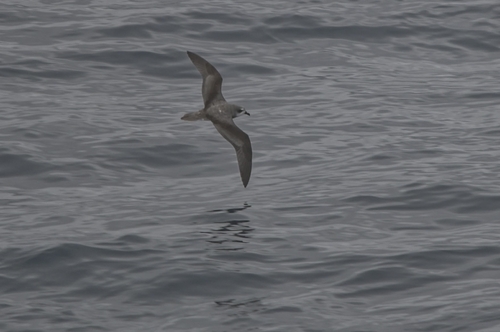 カオジロミズナギドリ
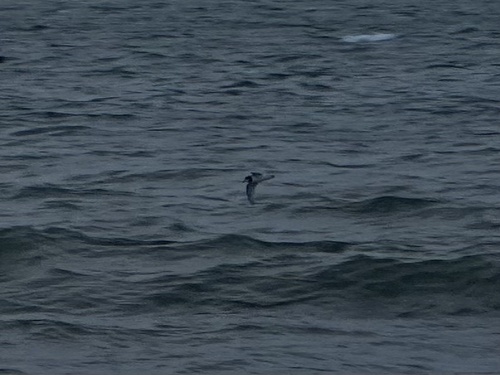 アオミズナギドリ
要点
The most reliable way to separate Soft-plumaged Petrel from Blue Petrel in the field is by their upperwing pattern in flight: Blue Petrel of all ages shows a striking dark 'M' or 'W' across the upperwings, while Soft-plumaged Petrel lacks this and instead has more uniform dark grey upperwings. Blue Petrel also has a square tail with a white tip, contrasting with the Soft-plumaged Petrel's pointed tail. Structurally, Soft-plumaged Petrel is larger and heavier-bodied, with a proportionally longer, hooked bill. Both species have white underparts, but Soft-plumaged Petrel has a darker head with white cheeks and throat, while Blue Petrel has a black cap and cleaner white face. These differences are visible at sea with good views, especially in flight.
識別のコツ
- Upperwing pattern in flight (all ages): Blue Petrel always shows a bold dark 'M' or 'W' across the upperwings, visible from above and often from below in good light. Soft-plumaged Petrel never shows this pattern; its upperwings are more uniformly dark grey.
- Tail shape: Blue Petrel has a square tail with a white tip, visible in flight and when banking. Soft-plumaged Petrel has a pointed tail without a white tip.
- Head pattern: Blue Petrel has a black cap with crisp white cheeks and throat, giving a clean, high-contrast look. Soft-plumaged Petrel's head is dark grey with white cheeks and throat, but the white is less sharply defined and often speckled, with a dark eye patch and some white on the forehead.
- Underwing color: Both species have dark underwings, but Soft-plumaged Petrel's are described as dark grey, while Blue Petrel's underwing pattern is not detailed in the notes. Use other marks for separation.
- Bill shape: Soft-plumaged Petrel has a longer, more hooked black bill (25–32 mm), which may be visible at close range. Blue Petrel's bill is shorter and more slender.
- Leg color: Soft-plumaged Petrel has pink legs with black on the outer webs and toes, which may be visible when landing or in photos. Blue Petrel's leg color is not described in the notes.
- Body size and shape: Soft-plumaged Petrel is larger and heavier-bodied, with a more robust appearance and longer wings. Blue Petrel is smaller, more delicate, and compact.
- Flight style: Blue Petrel often appears more buoyant and agile, with frequent banking that shows off the 'M' pattern. Soft-plumaged Petrel is steadier, with narrower wings and a pointed tail.
- Plumage variation: Soft-plumaged Petrel has a rare dark morph, which is much darker overall and could be confused with other dark petrels, but not with Blue Petrel.
- Voice: Only Soft-plumaged Petrel is described as vocal at colonies, with medium-pitched moans and shrill squeaks. This is not a field mark at sea.
- Habitat and context: Both are pelagic and can overlap at sea, so do not rely on location alone for identification.
- Pitfalls: In poor light or distant views, the 'M' pattern on Blue Petrel may be missed, and the size difference may be hard to judge. Focus on tail shape and head pattern as backup marks.
- Season and age: The key wing and tail patterns are present in all ages and seasons for both species, so these marks are reliable year-round.
- Sex: No sexual dimorphism is noted in either species, so all marks apply to both sexes.
- When in doubt: Prioritize the combination of upperwing pattern, tail shape, and head contrast for the most reliable separation.
大きさ
Soft-plumaged Petrel is distinctly larger and heavier than Blue Petrel, with an average mass of 300 g versus 210 g for Blue Petrel [wikidata]. This size difference is often noticeable in direct comparison or when seen alongside other seabirds. Blue Petrel is also shorter in length (26–32 cm) and has a smaller wingspan (62–71 cm), giving it a more delicate, compact appearance compared to the more robust and longer-winged Soft-plumaged Petrel.
羽色
-
Juvenile/immature and adult Blue Petrel: Shows a diagnostic dark 'M' or 'W' marking across the upperwing, formed by the dark edges and coverts, visible in all ages and seasons. The tail is square with a white tip, and the head features a black cap with clean white cheeks and a white throat. The underparts are white, with a dark patch at the side of the neck.
-
Soft-plumaged Petrel (all ages): Lacks any 'M' or 'W' on the upperwing; instead, the upperwing is a more uniform dark grey. The tail is pointed, not square, and lacks a white tip. The head is dark grey with white cheeks and throat, but the white is less clean and more speckled, with a prominent dark eye patch and white speckling on the forehead. Underwings are dark grey, and the underparts are mostly white. There is a dark morph, but this is rare and much darker overall.
-
Bill and legs: Both have black bills, but Soft-plumaged Petrel's is longer and more hooked. Soft-plumaged Petrel has pink legs with black on the outer webs and toes; Blue Petrel's leg color is not described in the notes.
行動
Both species are pelagic and typically seen gliding low over the ocean. Soft-plumaged Petrel appears more robust and may show steadier, more powerful flight with narrower wings and a pointed tail. Blue Petrel, being smaller and lighter, often appears more buoyant and agile, with a fluttery flight and frequent banking, which accentuates the dark 'M' pattern on the wings. Both species are rarely seen perched except at breeding colonies.
生息環境
Both species are oceanic and typically encountered far from land. Blue Petrel is closely associated with the Southern Ocean and breeds near the Antarctic Convergence zone, while Soft-plumaged Petrel has a broader southern oceanic distribution. At sea, habitat overlap is possible, so field marks are essential for separation.
声
Soft-plumaged Petrel is described as noisy, with medium-pitched moans and shrill squeaks, especially at breeding sites. No specific vocalization details are provided for Blue Petrel in the notes, so voice is unlikely to be a reliable field mark at sea.
カオジロミズナギドリ · アオミズナギドリ · 苦手な鳥