

ヒメミフウズラ 対 スミレスナバシリ
Turnix sylvaticus 対 Rhinoptilus chalcopterus
ヒメミフウズラとスミレスナバシリのクイズ
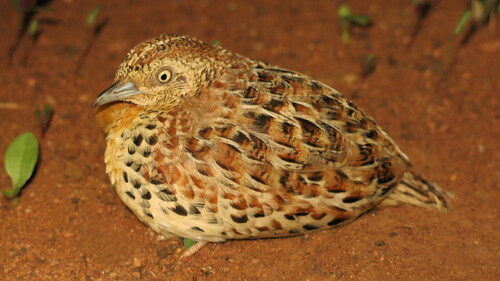 ヒメミフウズラ
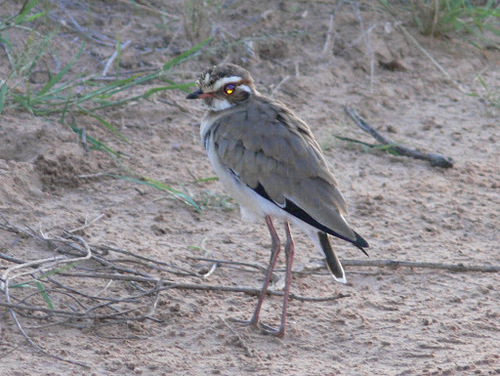 スミレスナバシリ
要点
The most reliable field mark to separate Small Buttonquail from Bronze-winged Courser is seen in flight: the buttonquail shows a narrow whitish wingbar on otherwise grey wings, while the courser flashes iridescent copper-violet wingtips and white underwing coverts, with no wingbar. Juvenile plumages are also distinct—young buttonquail are more spotted below, while juvenile coursers have cream-tipped upperparts and a faint breast band. Structurally, the courser is much larger, with long red legs and a downcurved bill, compared to the buttonquail's tiny, round, quail-like build. Buttonquail are extremely skulking and rarely fly, while coursers are more likely to be seen running or flying in open ground.
識別のコツ
- In flight, look for the wing pattern: Small Buttonquail shows a narrow whitish wingbar on otherwise grey wings (all ages), while Bronze-winged Courser flashes white underwing coverts and dark primaries tipped with iridescent copper-violet (adults), with no wingbar.
- Juvenile plumage: Juvenile buttonquail are more spotted below and have a plain face; juvenile coursers have cream-tipped upperparts and a faint breast band, with chicks being speckled above and white below.
- Head pattern: Buttonquail has a plain face; courser has a bold cream-white supercilium, forecrown, and posterior eyeline, with dark lores and ear-coverts (adults).
- Breast band: Courser adults have a thin black band separating the brown-grey upper chest from the buff belly; buttonquail lacks this feature.
- Leg color and length: Courser has long, bright red legs (adults); buttonquail has short, inconspicuous legs.
- Bill shape: Courser's bill is long, slightly downcurved, and black with a reddish-purple base; buttonquail's bill is short and straight.
- Eye ring: Courser adults show a bright reddish-purple eye ring; buttonquail lacks any such feature.
- Tail pattern: Courser has a white upper tail with dark brown bordered by white; buttonquail's tail is not distinctive.
- Body size: Courser is much larger and heavier (153 g) than the tiny buttonquail.
- Behavior: Buttonquail is extremely skulking, rarely flies, and prefers to run and hide; courser is more likely to be seen running in the open or taking flight.
- Habitat: Buttonquail is found in dense grass or scrub; courser prefers open, semi-arid savanna and recently burned ground.
- Perched jizz: Buttonquail appears squat and round; courser stands tall and upright.
- Underpart coloration: Buttonquail is buff below with black flank markings; courser is buffy below with a distinct black chest band.
- Flank markings: Buttonquail shows black flank marks; courser does not.
- When in doubt: If you see a small, drab, running bird in thick cover that avoids flying, it's likely a buttonquail. If the bird is large, with long legs and a bold head pattern, running or flying in open ground, it's a courser.
大きさ
Bronze-winged Courser is dramatically larger, with an adult body mass of about 153 g [wikidata], compared to the much smaller Small Buttonquail (not directly measured here, but typically around 15 cm in length and much lighter). The courser has long legs and a proportionately longer, downcurved bill, while the buttonquail is compact, short-legged, and quail-like. In the field, the courser appears tall and upright, while the buttonquail is squat and runs close to the ground.
羽色
- Juveniles/immatures: Juvenile Small Buttonquail are more spotted below, with streaked sandy-brown upperparts and a plain face. Juvenile Bronze-winged Coursers are less vibrant than adults, with cream-yellow tips to the upper feathers and a very thin breast band; chicks are speckled above and white below.
- Adults in flight: Buttonquail show a narrow whitish wingbar on grey wings, with otherwise plain sandy-brown upperparts and buff underparts with black flank marks. Bronze-winged Courser adults show white underwing coverts, dark black primaries with iridescent copper-violet tips (the 'bronze wing'), and a white upper tail with dark brown bordered by white. The courser's head is boldly marked with a cream supercilium, forecrown, and posterior eyeline, and a thin black band separates the brown-grey upper chest from the buff belly.
- Adults perched: Buttonquail are drab, with a plain face and streaked sandy-brown upperparts. Courser adults are more striking, with a distinct head pattern, reddish-purple eye ring, and long red legs.
行動
Small Buttonquail are secretive, terrestrial, and rarely fly—preferring to run and hide in dense cover. They are extremely difficult to flush and often go unseen. Bronze-winged Coursers, while also ground-dwelling, are more likely to be seen running in open ground or taking flight when disturbed. They are solitary or in pairs, often active at dusk or night, and nest in open, recently burned areas. The courser's behavior is more conspicuous, especially when flying and showing their distinctive wing pattern.
生息環境
Small Buttonquail prefer dense grassland or scrub, where they can remain hidden and avoid detection. They are rarely seen in open areas. Bronze-winged Courser inhabits semi-arid savannas and woodlands, favoring open ground, especially in areas recently affected by fire. The courser is more likely to be encountered in open, dry habitats, while buttonquail are associated with denser, more concealed vegetation.