

トラフサギ 対 ナンベイサンカノゴイ
Tigrisoma lineatum 対 Botaurus pinnatus
トラフサギとナンベイサンカノゴイのクイズ
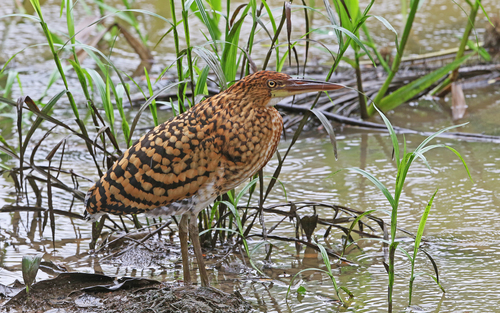 トラフサギ
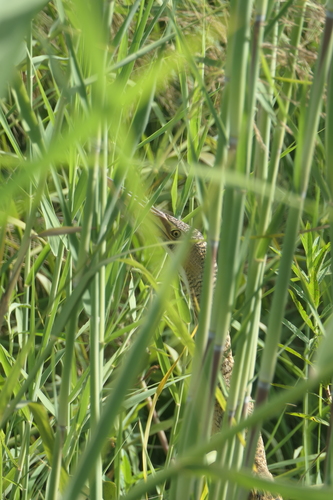 ナンベイサンカノゴイ
要点
The most reliable field mark for separating immature Rufescent Tiger-Heron from Pinnated Bittern is the bold, coarse black-and-buff barring on the tiger-heron's wings and body, especially obvious in flight or on perched juveniles. Pinnated Bitterns of all ages are more cryptically streaked and lack the pronounced banding, instead showing a more blended, streaky pattern and a two-toned wing in flight due to slate-grey remiges. Adults are easier: Rufescent Tiger-Heron has a rich rufous head and neck with a white foreneck stripe, while Pinnated Bittern remains overall buffy and streaked. Both are large, chunky herons, but subtle differences in structure and behavior can help when plumage is obscured.
識別のコツ
- Juvenile wing and body pattern: Juvenile Rufescent Tiger-Heron shows bold, coarse black-and-buff barring on the wings and body, especially visible in flight or when perched. Pinnated Bittern juveniles are more finely streaked and barred, with a reddish-buff ground color but never the tiger-heron's dramatic banding.
- Flight pattern in immatures: In flight, Pinnated Bittern of all ages shows a two-toned wing due to slate-grey remiges contrasting with the rest of the wing. Rufescent Tiger-Heron lacks this two-toned effect.
- Adult head and neck color: Adult Rufescent Tiger-Heron has a rich rufous head, neck, and chest with a white foreneck stripe. Pinnated Bittern adults are buffy-brown with heavy streaking and lack any rufous tones or bold white stripes.
- Foreneck and throat: Both have white throats, but Rufescent Tiger-Heron's foreneck has a prominent central white stripe, while Pinnated Bittern's is broadly streaked with pale brown.
- Flank and belly pattern: Rufescent Tiger-Heron adults have black-and-white barred flanks and a buffy-brown belly, while Pinnated Bittern is broadly streaked with pale brown on the breast and belly.
- Tail color (adults): Pinnated Bittern males have black tails, females brown; Rufescent Tiger-Heron has a black tail narrowly barred with white, but this is rarely visible in the field.
- Bill and facial skin: Both have yellowish bills and bright yellow facial skin, but Pinnated Bittern shows a brown line across the lores, which Rufescent Tiger-Heron lacks.
- Leg color: Both species have greenish-yellow to dull green legs; not a strong separator.
- Behavior: Pinnated Bittern is extremely secretive, often freezing with neck vertical and body crouched, and flushes only at close range. Rufescent Tiger-Heron may be seen more openly at water edges.
- Habitat context: Pinnated Bittern prefers dense, tall vegetation (reeds, sedges), while Rufescent Tiger-Heron is more often seen in open wetlands, but both can overlap.
- Size and structure: Both are large and chunky, with similar proportions. Pinnated Bittern males can be heavier, but this is not apparent in the field.
- Sex differences: Only Pinnated Bittern shows sexual dimorphism in tail color (males black, females brown), but this is subtle and rarely diagnostic at a distance.
- Age progression: Rufescent Tiger-Heron takes up to five years to reach adult plumage, so strong barring may persist in subadults. Pinnated Bittern's juvenile plumage is less dramatically different from adults, mainly a slightly redder ground color.
- Plumage pitfalls: Do not rely on overall buffy coloration or size alone; focus on the presence or absence of bold barring and the two-toned wing in flight.
- When in doubt: If you see a large, streaky, cryptic heron in dense reeds that flushes only at close range and shows a two-toned wing, Pinnated Bittern is likely. If you see strong black-and-buff barring, especially on the wings, or a rufous-headed adult, it's Rufescent Tiger-Heron.
大きさ
Both species are large herons with overlapping size ranges: Rufescent Tiger-Heron measures 66–76 cm (26–30 in) and weighs 630–980 g, while Pinnated Bittern is 64–76 cm (25–30 in) and 554–1,157 g. Pinnated Bittern males are typically heavier than females, but in the field, size alone is not a reliable separator. Structure is similar: both have stout bills and long necks, but the tiger-heron may appear slightly more compact and thick-necked when perched.
羽色
-
Juvenile/immature birds: Rufescent Tiger-Heron juveniles are rusty-buff with coarse, bold black barring across the body and especially the wings, creating a striking banded look. The throat, central chest, and belly are white. This strong banding is the key field mark and persists for several years as the bird matures. Pinnated Bittern juveniles are also buffy but have a more reddish ground color and are heavily streaked and barred with black, not coarsely banded. Their pattern is more blended and cryptic, lacking the tiger-heron's dramatic wing bands. In flight, Pinnated Bittern shows a two-toned wing with slate-grey remiges contrasting with the rest of the wing, while Rufescent Tiger-Heron does not have this feature.
-
Adults: Adult Rufescent Tiger-Heron is unmistakable with a dark rufous head, neck, and chest, a white stripe down the foreneck, brownish upperparts with fine black vermiculations, and black-and-white barred flanks. The tail is black, narrowly barred with white. Pinnated Bittern adults remain buffy-brown with heavy streaking and barring, a white throat, foreneck streaked with pale brown, and a buff neck with thin black barring. The two-toned wing remains a feature in flight. Males have black tails, females brown.
-
Bare parts: Both have yellowish bills and bright yellow irides and facial skin, but Pinnated Bittern shows a brown line across the lores, which Rufescent Tiger-Heron lacks.
行動
Pinnated Bittern is extremely secretive, often freezing with its body crouched and neck vertical when alarmed, and flushes only at close range. It is largely nocturnal and typically solitary, sometimes gathering loosely at feeding sites. Rufescent Tiger-Heron is also shy but may be seen more readily at water edges or in open wetlands, often standing motionless or moving slowly. Both species can be hard to spot, but Pinnated Bittern is especially elusive due to its cryptic behavior and preference for dense cover.
生息環境
Both species inhabit freshwater wetlands across Central and South America, but Pinnated Bittern is more closely tied to dense reed beds, tall-grass marshes, and overgrown ditches, favoring areas with tall sedges, reeds, or cattails. It also uses rice and sugarcane fields. Rufescent Tiger-Heron is found in a broader range of wetland types, including open marshes and forested swamps. Habitat overlap is significant, so context alone is rarely diagnostic.
トラフサギ · ナンベイサンカノゴイ · 苦手な鳥