

キジミチバシリ 対 ヒメキジミチバシリ
Dromococcyx phasianellus 対 Dromococcyx pavoninus
キジミチバシリとヒメキジミチバシリのクイズ
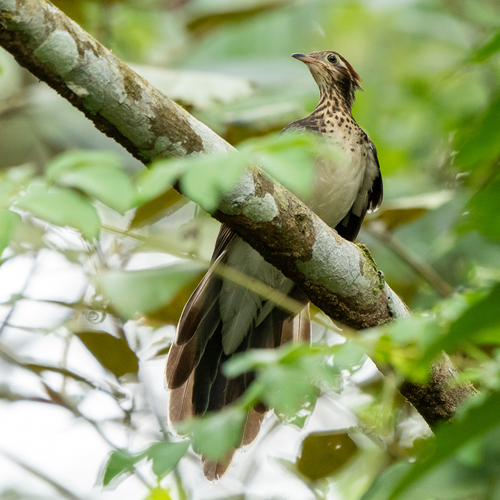 キジミチバシリ
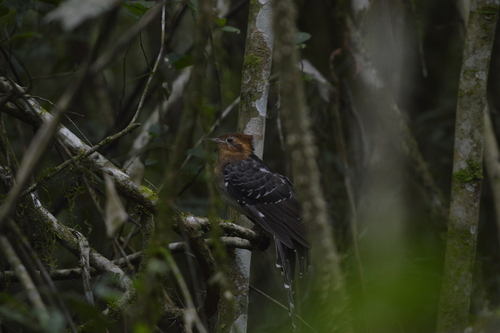 ヒメキジミチバシリ
要点
The best field mark to separate Pheasant Cuckoo from Pavonine Cuckoo is the patterning on the throat and breast: Pheasant Cuckoo shows much paler underparts with heavy black streaks, while Pavonine Cuckoo has richer buff tones and lacks any dark spotting or streaking on the throat and breast. Both species have a rusty-brown crest and long, graduated tail, but the Pavonine Cuckoo is slightly larger and has a more uniform, darker underpart coloration. In flight, Pavonine Cuckoo's slow, butterfly-like wingbeats and spread tail are distinctive, but both are shy and often hard to see well. If you glimpse the face, look for the richer buff supercilium and throat of Pavonine versus the paler, more contrasting face of Pheasant Cuckoo.
識別のコツ
- Throat and Breast Pattern: Pheasant Cuckoo has pale buff underparts with heavy black streaks on the breast; Pavonine Cuckoo's throat and breast are rich buff and completely unmarked. This is the most reliable field mark for all ages and sexes.
- Supercilium and Face: Pavonine Cuckoo shows a richer buff supercilium, throat, and breast, giving the face a warmer, more uniform look. Pheasant Cuckoo's face is paler and more contrasting.
- Crest Color: Both have short, rusty-brown crests, so this is not a strong separator.
- Tail Shape and Length: Both species have long, graduated tails, but no distinctive tail pattern is described for either. Use with caution.
- Flight Style: Pavonine Cuckoo's flight is slow and butterfly-like, with the tail spread and a pause at the top of each wingbeat. Pheasant Cuckoo's flight style is not described as distinctive, so if you see this butterfly-like flight, lean toward Pavonine.
- Terrestrial Behavior: If you see the bird foraging on the ground with stylized bobbing and bill clapping, it's likely Pheasant Cuckoo. Pavonine is more arboreal and less likely to be seen on the ground.
- Display Behavior: Pheasant Cuckoo males may display by raising the crest, puffing out breast feathers, and partially spreading wings to show white spots. This is not described for Pavonine.
- Voice: If you hear a two-note whistle followed by a trill, it's Pheasant Cuckoo. Pavonine's call is different but not described here, so use with caution unless you know both species' songs.
- Size: Pavonine Cuckoo is slightly larger and heavier, but this is subtle and hard to judge unless both are seen together.
- Habitat: Both species use similar lowland tropical forests; habitat alone is not diagnostic.
- Brood Parasitism: Both are brood parasites, so this is not helpful for field ID.
- Age and Sex: No documented differences in field marks by age or sex for either species; use underpart pattern and face color for all individuals.
- Pitfalls: Both are shy and often glimpsed briefly or heard only. Poor views can make the underpart pattern hard to see, so try for a clear look at the throat and breast.
- When Marks Fail: If you can't see the underpart pattern or face color, separation is very difficult. Use behavior (ground foraging vs. butterfly-like flight) as a secondary clue.
- Summary: Always prioritize the presence or absence of dark streaks on the throat and breast; this is the most consistent and visible difference in the field.
大きさ
Direct size comparison is difficult in the field, but Pavonine Cuckoo is somewhat larger and heavier (adult mass ~46g [wikidata]), while no mass is available for Pheasant Cuckoo, but it is described as a large cuckoo. Both have long, graduated tails and short crests, so overall jizz is similar, but Pavonine may appear bulkier if seen side by side.
羽色
No age-specific upperwing or flight pattern differences are documented for either species, so focus on underpart and facial coloration in all plumages. Adult Pheasant Cuckoo shows pale buff underparts with bold black streaks on the breast, creating a strong contrast with the dark sooty-brown upperparts. Its crest is short and tipped rusty brown. Pavonine Cuckoo, by contrast, has a rusty-brown head and crest, but the rest of the upperparts are dark brown. The underparts are paler than the back but richer buff overall, especially on the supercilium, throat, and breast, and crucially, these areas are unmarked—no dark spots or streaks. This difference in throat and breast pattern is the most reliable visual separator. Both species have long, graduated tails, but tail pattern details are not described as distinctive. Juvenile or immature-specific plumage differences are not documented.
行動
Both species are shy, skulking, and more often heard than seen. Pheasant Cuckoo is known for a terrestrial foraging style, with stylized movements, wing and tail bobbing, and bill clapping as it hunts insects on the ground. Males display by raising the crest and breast feathers and partially spreading the wings to show white spots. Pavonine Cuckoo is mainly solitary and is noted for its unique flight style: slow, measured wingbeats with a butterfly-like quality and a brief pause at the top of each beat, often with the tail spread. Both are brood parasites, but this is not helpful for field separation.
生息環境
Both species inhabit lowland tropical forests in Central and South America, often in dense or secondary growth, so habitat is not a strong separator. Both are secretive and tend to stay hidden in thick cover, though Pheasant Cuckoo may be more often seen on or near the ground due to its terrestrial foraging habits.
声
Both species are more often detected by voice than seen. Pheasant Cuckoo's call is a sequence of two short whistles (the second higher) followed by a trill: "whee! whee! wheerr-rr". Pavonine Cuckoo's call is described as different but details are not provided in the notes, so voice is not a reliable separator unless you are familiar with both species' vocalizations.