

シロハラシマアカゲラ 対 ホオジロシマアカゲラ
Dryobates nuttallii 対 Leuconotopicus borealis
シロハラシマアカゲラとホオジロシマアカゲラのクイズ
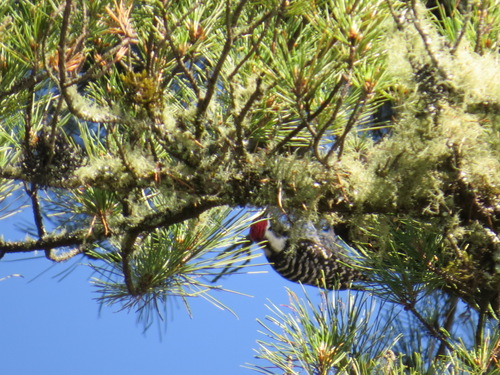 シロハラシマアカゲラ
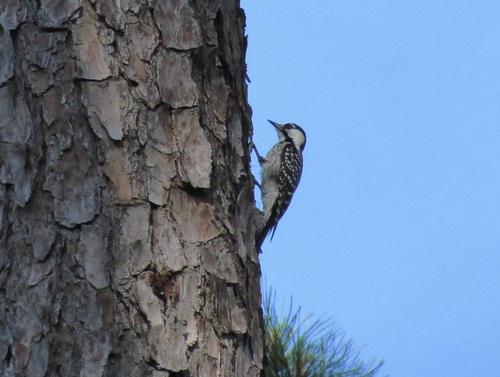 ホオジロシマアカゲラ
要点
The most reliable field mark between Nuttall's Woodpecker and Red-cockaded Woodpecker is the face pattern: Red-cockaded shows large, clear white cheek patches surrounded by a black cap and nape, while Nuttall's has a black forehead with white streaks and lacks such bold cheek patches. Both species have barred black-and-white backs, but Nuttall's has a distinctive unbarred black patch at the top of the back, which Red-cockaded lacks. Juvenile and adult males of Nuttall's show a red crown patch (females and older juveniles may lack or reduce this), while the Red-cockaded male's red 'cockade' is tiny, rarely visible, and never forms a crown patch. In flight or perched, focus on the face and upper back pattern for the quickest separation.
識別のコツ
- Face pattern: Red-cockaded Woodpecker has large, clear white cheek patches surrounded by a black cap and nape—this is the single most diagnostic field mark. Nuttall's has a black forehead with white streaks and lacks such bold cheek patches.
- Upper back pattern: Nuttall's shows an unbarred black patch at the top of the back; Red-cockaded's back is evenly barred black and white with no solid black patch.
- Crown color (age/sex): Adult male Nuttall's and all juveniles show a red crown patch; adult female Nuttall's lack this. Red-cockaded males have only a tiny, hard-to-see red streak ('cockade') on the side of the black cap, not a crown patch; females lack red entirely.
- Juvenile head streaking: Nuttall's juveniles show white streaks on the head; Red-cockaded juveniles do not.
- Size and structure: Red-cockaded is slightly larger and heavier, with a somewhat longer bill, but this is subtle and not always reliable in the field.
- Wing and tail barring: Both species have black-and-white barred wings and tail, so this is not a reliable separator.
- Flight jizz: In flight, Red-cockaded's white cheek patch may flash, while Nuttall's shows a more streaked face and the black upper back patch.
- Habitat: Nuttall's is almost strictly in California oak woodlands; Red-cockaded is found only in mature pine forests of the Southeast. Habitat alone can often clinch the ID.
- Behavior: Red-cockaded is often in family groups and forages high in pines; Nuttall's is more solitary or in pairs and forages lower in oaks.
- Drumming and calls: Nuttall's gives soft wheezing calls and drumming in the breeding season; Red-cockaded's vocalizations are not detailed here.
- Sexing by red mark: Only male Nuttall's (and all juveniles) show a red crown; Red-cockaded's red cockade is tiny and on the side of the cap, rarely visible.
- Plumage pitfalls: Both can be confused with other barred-backed woodpeckers, but the face and upper back pattern are the key for this pair.
- Geographic range: If outside California or the Southeast, neither species is likely; check for vagrancy but expect other species.
- Perched vs. flight views: Face and upper back are best seen when perched; in flight, look for the white cheek patch (Red-cockaded) or black upper back patch (Nuttall's).
- Juvenile confusion: If you see a streaky-headed juvenile with a red crown patch in California oaks, it's Nuttall's; a clean-faced juvenile in a pine forest is likely Red-cockaded.
大きさ
Red-cockaded Woodpecker is slightly larger and heavier (body mass ~47 g, length 18–23 cm, wingspan 34–41 cm) compared to Nuttall's Woodpecker (body mass ~38 g, length 16–18 cm, wingspan 38–43 cm). The size difference is subtle and may not be obvious in the field unless both species are seen side by side, but Red-cockaded tends to look a bit bulkier and longer-billed.
羽色
- Juvenile/immature birds: Nuttall's juveniles of both sexes show some white streaking on the head and a red crown patch, which is lacking in Red-cockaded juveniles (whose males only have a tiny, rarely visible red streak on the side of the cap). Both species have black-and-white barred backs, but Nuttall's shows a distinctive unbarred black patch at the top of the back, while Red-cockaded's barring is more continuous.
- Adults: Nuttall's adult males retain the red crown patch (lost in females), while Red-cockaded males have a very small, hard-to-see red cockade on the side of the black cap. Red-cockaded's face is strikingly marked with a large white cheek patch surrounded by black, unlike the more streaked and less contrasting face of Nuttall's. Both have barred wings and tails, but the face and upper back patterns are more diagnostic.
- In flight: Both show black-and-white barred upperparts, but the white cheek patch of Red-cockaded is often visible even in flight, while Nuttall's shows a more streaked face and the unbarred black upper back patch.
行動
Both species forage by hammering and peeling bark for insects, but Red-cockaded is more likely to be seen in family groups due to its cooperative breeding, while Nuttall's is usually solitary or in pairs outside the breeding season. Nuttall's is more likely to be seen drumming on branches in the early breeding season (late January–March). Red-cockaded often forages higher in mature pine trees, while Nuttall's prefers lower trunks and branches in oak woodlands.
生息環境
Nuttall's Woodpecker is found almost exclusively in oak woodlands of California, rarely straying from this habitat. Red-cockaded Woodpecker is endemic to the southeastern United States and strictly tied to mature pine forests, especially longleaf pine. If you are in oak woodland in California, you are almost certainly seeing Nuttall's; in mature pine forests of the Southeast, Red-cockaded is the likely candidate.
声
Nuttall's gives soft wheezing calls and drumming, especially in the breeding season; its calls are less intense than the territorial rattles of some other woodpeckers. Red-cockaded's calls and drumming are not described in the provided notes, so voice is not a primary separator here.
シロハラシマアカゲラ · ホオジロシマアカゲラ · 苦手な鳥