

Northern House Wren 対 フユミソサザイ
Troglodytes aedon 対 Troglodytes hiemalis
Northern House Wrenとフユミソサザイのクイズ
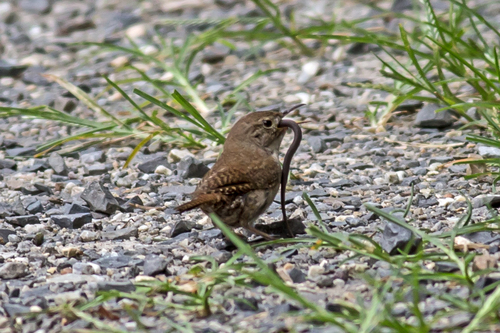 Northern House Wren
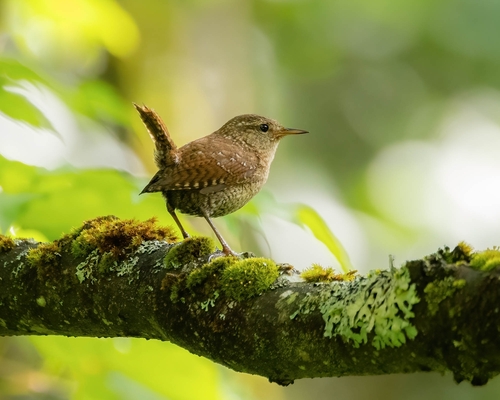 フユミソサザイ
要点
The most reliable field mark to separate Northern House Wren from Winter Wren is overall coloration and barring: Winter Wren is more richly and extensively barred, appearing darker and more rufous, especially on the flanks and underparts, while House Wren is plainer, with less distinct barring and a paler, often grayer or buffier underside. Both species are tiny, short-tailed wrens with cocked tails and pale eyebrows, but Winter Wren is even more compact and round-bodied, often described as a 'small brown ball.' In the field, Winter Wren favors dense coniferous forests and is rarely seen in open or suburban habitats where House Wren is common. Be alert for subtle differences in structure and jizz, especially in perched birds, and use habitat and context as supporting clues.
識別のコツ
- Overall color and barring: Winter Wren is more richly rufous-brown and heavily barred on the flanks, wings, and tail, even in young birds. House Wren is plainer, with less distinct barring and a paler, sometimes buffy or grayish underside.
- Eyebrow (supercilium): Both have pale eyebrows, but Winter Wren's is usually more prominent and contrasts more with the surrounding plumage.
- Body shape and posture: Winter Wren appears especially compact and round, like a 'small brown ball,' with a very short neck. House Wren is slim and elongated by comparison, though still small and roundish.
- Tail: Both species cock their short tails, but Winter Wren's tail appears even shorter and is often held higher above the back. House Wren's tail is short but proportionally longer and less stubby.
- Bill: Both have thin, slightly downcurved bills. House Wren's lower mandible is often yellowish or pale gray with a black tip, while Winter Wren's is dark brown throughout. This is subtle and may not be visible in the field.
- Leg color: House Wren's legs are pinkish or gray; Winter Wren's are pale brown. This is not a strong field mark but can support other clues.
- Juvenile/immature birds: Young Winter Wrens are less distinctly barred than adults but still show more barring than House Wrens. House Wren juveniles are even plainer, with little to no barring on the flanks.
- Habitat: In dense coniferous or mixed forests, especially with lots of downed wood, expect Winter Wren. In open woods, gardens, parks, or suburban areas, House Wren is much more likely.
- Behavior: Winter Wren is more secretive and spends more time creeping low in dense cover, rarely perching in the open. House Wren is bolder, often perching on exposed branches or fence posts.
- Song: House Wren's song is rich and bubbly, usually delivered from an open perch in spring/summer. Winter Wren's song is longer and more exuberant, often heard deep in forest. Use with caution unless you are familiar with both.
- Flight: Both have short, whirring flights, but Winter Wren's is especially rapid and direct, often low to the ground.
- Size: House Wren is slightly larger and longer, but this is rarely obvious unless both are side by side.
- Underpart color: House Wren can show brown, buff, pale gray, or nearly white underparts, while Winter Wren is always grayer and more heavily barred below.
- Flank barring: Winter Wren has crisp, dark barring on the flanks; House Wren has little or no barring here, except in some subspecies where it is faint.
- Context: If you see a wren in a city or open country, it's almost certainly a House Wren; in deep, dark forest, especially in the north or east, expect Winter Wren.
大きさ
Both species are very small wrens, but the Northern House Wren is slightly larger on average (body mass ~11.5 g, length 11–13 cm, wingspan ~15 cm) compared to the Winter Wren (length 8–12 cm, wingspan 12–16 cm, weight 8–12 g). In practice, this size difference is subtle and rarely diagnostic in the field, but Winter Wren often appears even more compact and round-bodied due to its shorter neck and more spherical posture.
羽色
- Juvenile/immature plumage: Young Winter Wrens are less distinctly barred than adults but still show more overall barring than House Wrens of any age. Both species have pale eyebrows, but Winter Wren's is usually more prominent.
- Adult plumage: Winter Wren is rufous-brown above and grayer below, with heavy, crisp dark barring on the wings, tail, and flanks. House Wren is variable above (from dull grayish-brown to rich brown), but always less rufous and less distinctly barred, especially on the underparts. House Wren's underparts can range from brown to buff, pale gray, or nearly white, and barring is limited to the wings, tail, and sometimes flanks, but is never as extensive or sharp as in Winter Wren. Both have a faint eye-ring and eyebrow, but Winter Wren's is usually bolder. Bill color is similar (dark above, paler below), but House Wren's lower mandible is often yellowish or pale gray with a black tip, while Winter Wren's is dark brown.
行動
Both wrens are active, restless, and often seen flicking their cocked tails. Winter Wren moves with incessant, creeping or climbing motions, often low to the ground or in dense cover, and its flight is short, direct, and very rapid with whirring wings. House Wren is also active but is more likely to be seen in open areas, gardens, or suburban settings, often perching out in the open or singing from exposed branches. Winter Wren tends to be more secretive and skulking, especially in dense forest undergrowth.
生息環境
Habitat is a strong supporting clue: Winter Wren is closely tied to dense, moist coniferous forests, especially with lots of fallen logs and tangled undergrowth, and is rarely found in open or suburban areas. Northern House Wren, by contrast, is common in suburban gardens, parks, open woodlands, and edge habitats, and is much less likely in deep forest. If you find a tiny wren in a city park or backyard, House Wren is far more likely; in a dark, dense spruce-fir forest, expect Winter Wren.
声
Both species have complex, musical songs, but the notes do not provide detailed comparison. House Wren's song is described as rich and bubbly, commonly heard during nesting season but rarely afterwards. Winter Wren's song is long and exuberant, often heard in its breeding habitat. Song is variable and can be difficult to use for separation without experience, but context and season may help: House Wren sings more in open/suburban settings, Winter Wren in deep forest.